When humans, animals, and machines move throughout the world, they always push against something, whether it’s the ground, air, or water. Until recently, physicists believed this to be a constant, following the law of conservation momentum. Now, researchers from the Georgia Institute of Technology have proven the opposite – when bodies exist in curved spaces, it turns out that they can in fact move without pushing against something.
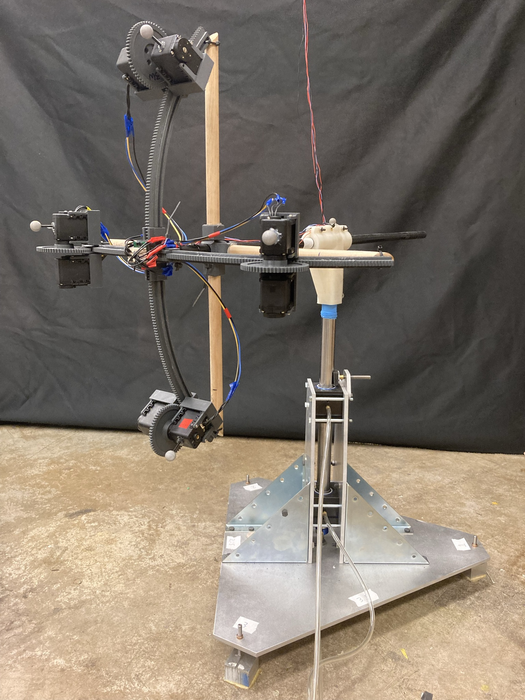
Credit: Georgia Tech
When humans, animals, and machines move throughout the world, they always push against something, whether it’s the ground, air, or water. Until recently, physicists believed this to be a constant, following the law of conservation momentum. Now, researchers from the Georgia Institute of Technology have proven the opposite – when bodies exist in curved spaces, it turns out that they can in fact move without pushing against something.
The findings were published in Proceedings of the National Academy of Sciences on July 28, 2022. In the paper, a team of researchers led by Zeb Rocklin, assistant professor in the School of Physics at Georgia Tech, created a robot confined to a spherical surface with unprecedented levels of isolation from its environment, so that these curvature-induced effects would predominate.
“We let our shape-changing object move on the simplest curved space, a sphere, to systematically study the motion in curved space,” said Rocklin. “We learned that the predicted effect, which was so counter-intuitive it was dismissed by some physicists, indeed occurred: as the robot changed its shape, it inched forward around the sphere in a way that could not be attributed to environmental interactions.”
Creating a Curved Path
The researchers set out to study how an object moved within a curved space. To confine the object on the sphere with minimal interaction or exchange of momentum with the environment in the curved space, they let a set of motors drive on curved tracks as moving masses. They then connected this system holistically to a rotating shaft so that the motors always move on a sphere. The shaft was supported by air bearings and bushings to minimize the friction, and the alignment of the shaft was adjusted with the Earth’s gravity to minimize the residual force of gravity.
From there, as the robot continued to move, gravity and friction exerted slight forces on it. These forces hybridized with the curvature effects to produce a strange dynamic with properties neither could induce on their own. The research provides an important demonstration of how curved spaces can be attained and how it fundamentally challenges physical laws and intuition designed for flat space. Rocklin hopes the experimental techniques developed will allow other researchers to explore these curved spaces.
Applications in Space and Beyond
While the effects are small, as robotics becomes increasingly precise, understanding this curvature-induced effect may be of practical importance, just as the slight frequency shift induced by gravity became crucial to allow GPS systems to accurately convey their positions to orbital satellites. Ultimately, the principles of how a space’s curvature can be harnessed for locomotion may allow spacecraft to navigate the highly curved space around a black hole.
“This research also relates to the ‘Impossible Engine’ study,” said Rocklin. “Its creator claimed that it could move forward without any propellant. That engine was indeed impossible, but because spacetime is very slightly curved, a device could actually move forward without any external forces or emitting a propellant – a novel discovery.”
Citation: Shengkai Li, Zeb Rocklin, et al. “Locomotion without force, and impulse via dissipation: Robotic swimming in curved space via geometric phase.” Proceedings of the National Academy of Science. DOI: 2200924119.
About Georgia Institute of Technology
The Georgia Institute of Technology, or Georgia Tech, is a top 10 public research university developing leaders who advance technology and improve the human condition. The Institute offers business, computing, design, engineering, liberal arts, and sciences degrees. Its nearly 40,000 students representing 50 states and 149 countries, study at the main campus in Atlanta, at campuses in France and China, and through distance and online learning. As a leading technological university, Georgia Tech is an engine of economic development for Georgia, the Southeast, and the nation, conducting more than $1 billion in research annually for government, industry, and society.
Journal
Proceedings of the National Academy of Sciences
DOI
10.1073/pnas.2200924119
Method of Research
Observational study
Subject of Research
Not applicable
Article Title
Robotic swimming in curved space via geometric phase
Article Publication Date
28-Jul-2022