A strain of E. coli bacteria called enterohemorrhagic E. coli (EHEC) is known to cause several gastrointestinal disorders, which include bloody diarrhea and abdominal cramps, by damaging the intestinal lining. When accompanied with fatal systemic complications, it can even cause acute renal failure in children. The EHEC exerts these deadly effects by producing the Shiga toxin (Stx), of which the Stx2a subtype is particularly virulent and deadly. Compounds that can inhibit these toxins are, therefore, desirable as potential therapeutics against EHEC infections.
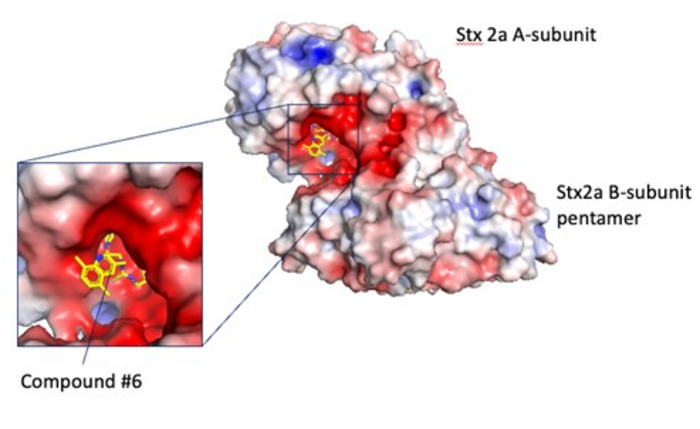
Credit: Image credit: Prof. Kiyotaka Nishikawa from Doshisha University, Japan
Image link: https://www.nature.com/articles/s41598-022-15316-1
A strain of E. coli bacteria called enterohemorrhagic E. coli (EHEC) is known to cause several gastrointestinal disorders, which include bloody diarrhea and abdominal cramps, by damaging the intestinal lining. When accompanied with fatal systemic complications, it can even cause acute renal failure in children. The EHEC exerts these deadly effects by producing the Shiga toxin (Stx), of which the Stx2a subtype is particularly virulent and deadly. Compounds that can inhibit these toxins are, therefore, desirable as potential therapeutics against EHEC infections.
To this end, a group of scientists from Japan led by Professor Kiyotaka Nishikawa from Doshisha University has recently discovered a molecule that inhibits Stx2a toxicity by binding to its “A-subunit” – the part of the toxin responsible for its lethality.
“The catalytic A-subunit of Stx2a toxin inhibits protein synthesis and its inhibition could be crucial for slowing EHEC pathogenesis,” says Prof. Nishikawa, explaining their motivation behind the study, which was published in Scientific Reports. The same group had earlier developed an inhibitory molecule that can bind to the B-subunit of Shiga toxin and reduce its toxicity.
Professor Nishikawa and his colleagues, including Assistant Professor Miho Watanabe-Takahashi of Doshisha University, Dr. Miki Senda and Dr. Toshiya Senda of the Institute of Materials Structure Science at High Energy Accelerator Research Organization (KEK), and Dr. Kentaro Shimizu of the University of Tokyo, among others, identified the potent compound from a database with over 7,400,000 molecules.
To do this, the researchers had to first identify the basic 3D arrangement of molecules (the peptide motif) that can occupy the catalytic cavity in the A-subunit. In a stroke of luck, they stumbled upon a synthetic molecule with a high affinity for A-subunit. This molecule, a peptide called “MMβA-mono,” helped identify the compound that could bind to the A-subunit of Shiga toxin by serving as a template.
The researchers next outlined the molecular and electronic structure that a possible inhibitory compound must have using structural analysis and X-ray crystallography. These features of a potential inhibitor, known as a “pharmacophore,” was then confirmed using molecular dynamics simulations.
Finally, they screened a chemical database for compounds that resembled the pharmacophore and identified nine candidates using docking simulations. Of these, a compound identified as “compound #6” showed effective binding to the A-subunit of Stx2a.
Further, in vitro cytotoxicity assays using Vero cells showed that compound #6 significantly reduced the destruction of cells caused by Stx2a. Additionally, mice models treated with a lethal dose of Stx2a and compound #6 survived longer than those injected with only Stx2a.
Prof. Nishikawa is optimistic about the future applications of this study. On being asked how the compound might work in the infected cells, he explains, “The hydrophobicity of compound #6 may facilitate penetration through the cell envelope, allowing it to inhibit the toxin present in the cells. We believe that it holds promise as a novel therapeutic agent for treating EHEC infections.”
The team has even suggested that their studied pharmacophore could help design more inhibitors for similar toxins, such as the bioterrorism agent ricin, whose catalytic region has a structure similar to that of Stx.
We can certainly expect some new developments in the treatment of intestinal diseases caused by bacteria!
About Assistant Professor Miho Watanabe-Takahashi from Doshisha University, Japan
Dr. Miho Watanabe-Takahashi is an Assistant Professor at the Faculty of Life and Medical Sciences in the Department of Medical Life Systems at Doshisha University. She received her Ph.D. from Hoshi University, Japan, in 2006. She works primarily in Life Sciences and Pharmacology with a focus on health and biochemistry. She has 24 peer-reviewed publications in reputed journals and holds several industrial property rights. Her major research interests include Shiga toxin, Endoplasmic Reticulum, Golgi Complex and Pleckstrin Homology Domain.
About Professor Kiyotaka Nishikawa from Doshisha University, Japan
Dr. Kiyotaka Nishikawa is a Professor at the Faculty of Life and Medical Sciences in the Department of Medical Life Systems at Doshisha University. He received his Ph.D. from The University of Tokyo, Japan in 1989. He works primarily in Life Sciences and Pharmacology with a focus on health and biochemistry. He has more than 33 years of experience as a researcher and has 56 publications in peer-reviewed international journals. He also holds several industrial property rights.
Media contact:
Organization for Research Initiatives & Development
Doshisha University
Kyotanabe, Kyoto 610-0394, JAPAN
E-mail:[email protected]
Journal
Scientific Reports
DOI
10.1038/s41598-022-15316-1
Method of Research
Experimental study
Subject of Research
Animals
Article Title
A unique peptide-based pharmacophore identifies an inhibitory compound against the A-subunit of Shiga toxin
Article Publication Date
6-Jul-2022
COI Statement
The authors declare no competing interests.