Credit: University of Basel, Department of Physics
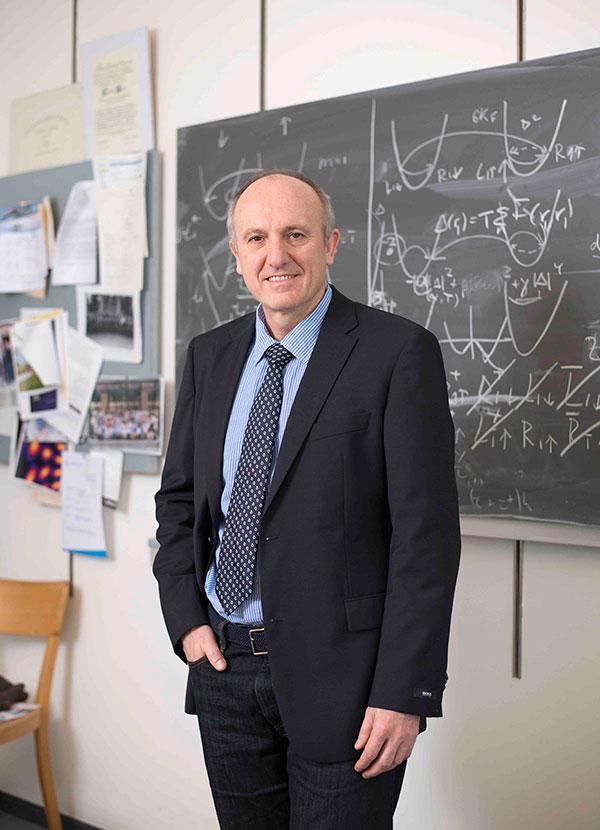
Professor Daniel Loss from the University of Basel's Department of Physics and the Swiss Nanoscience Institute has been awarded the King Faisal International Prize for Science 2017. The King Faisal Foundation awarded Loss the renowned science prize for his discovery of a concept for development of a quantum computer based on the intrinsic angular momentum of electrons. Loss has further refined his theory over recent years and established a completely new field of research.
"Daniel Loss has made a considerable contribution to our theoretical understanding of spin dynamics and spin coherence in quantum dots, creating new areas of opportunity with practical applications for spin-based quantum computing," the King Faisal Foundation said. Loss developed the idea to use the intrinsic angular movement (or spin) of electrons in quantum dots as the smallest memory unit, or quantum bit (qubit).
"His work has helped initiate a number of important experimental programs, and opened the door to high-performing quantum computers with extraordinary speed and storage capacity," the Foundation explained in its announcement. Loss will share the USD 200,000 prize with the physicist Professor Laurens Molenkamp from the Department of Physics at the University of Würzburg (Germany).
A theoretical basis for experimental work across the globe
Loss published the theory for the Loss-DiVincenzo quantum computer in 1998 together with David DiVincenzo. In this proposal, artificial atoms without nuclei are created in a semiconductor. The electrons are confined by means of an electrically charged gate. Within these quantum dots, the spin of the electron is partially protected from interaction with its environment, allowing the creation of interference-resistant qubits. These quantum dots and their spin qubits can also be coupled with one another by electrical means.
Numerous experimental research teams worldwide rely on Loss's theoretical contributions. These, as well as many further developments over the years, are an integral part of the effort to create a quantum computer based on spin qubits in semiconductors. Such quantum computers will not only enable superfast calculations and simulations but also addressing fundamental questions of quantum physics.
Highly cited publications and renowned prizes
Daniel Loss has more than 400 specialist publications to his name and is one of the world's most frequently cited physicists. He is Professor of Theoretical Physics at the University of Basel's Department of Physics, Co-Director of the University's Swiss Nanoscience Institute and Director of the Center for Quantum Computing and Quantum Coherence (QC2) in Basel.
Loss was awarded the European Academy of Science's Blaise Pascal Medal for physics in 2014. In 2010, he received Switzerland's most prestigious science award, the Marcel Benoist Prize, and in 2005 he earned Germany's Humboldt Research Award. Since 2014 he is a member of the German National Academy of Sciences Leopoldina.
###
The King Faisal International Prize
The King Faisal International Prize for Science has been awarded every year (for Physics every four years) by the King Faisal Foundation since 1984. It is named after the Saudi Arabian king, Faisal ibn Abd al-Aziz, who was the son of the state's founder. Alongside the prize for science, the Foundation also awards prizes in the fields of medicine, Islamic studies, Arabic language and literature, and services to Islam. This year's prizes will be awarded in April 2017 by the Saudi Arabian king in Riyadh. Many of the science prize recipients have gone on to receive the Nobel Prize.
Media Contact
Olivia Poisson
[email protected]
@UniBasel_en
http://www.unibas.ch/
############
Story Source: Materials provided by Scienmag