• HOME
  • NEWS
  • EXPLORE
    • CAREER
      • Companies
      • Jobs
    • EVENTS
    • iGEM
      • News
      • Team
    • PHOTOS
    • VIDEO
    • WIKI
  • BLOG
  • COMMUNITY
    • FACEBOOK
    • INSTAGRAM
    • TWITTER
Wednesday, June 24, 2026
BIOENGINEER.ORG
No Result
View All Result
  • Login
  • HOME
  • NEWS
  • EXPLORE
    • CAREER
      • Companies
      • Jobs
        • Lecturer
        • PhD Studentship
        • Postdoc
        • Research Assistant
    • EVENTS
    • iGEM
      • News
      • Team
    • PHOTOS
    • VIDEO
    • WIKI
  • BLOG
  • COMMUNITY
    • FACEBOOK
    • INSTAGRAM
    • TWITTER
  • HOME
  • NEWS
  • EXPLORE
    • CAREER
      • Companies
      • Jobs
        • Lecturer
        • PhD Studentship
        • Postdoc
        • Research Assistant
    • EVENTS
    • iGEM
      • News
      • Team
    • PHOTOS
    • VIDEO
    • WIKI
  • BLOG
  • COMMUNITY
    • FACEBOOK
    • INSTAGRAM
    • TWITTER
No Result
View All Result
Bioengineer.org
No Result
View All Result
Home NEWS Science News Chemistry

Chiral sources for metamaterial interface waveguides

Bioengineer by Bioengineer
July 19, 2022
in Chemistry
Reading Time: 2 mins read
0
Unidirectional excitation of metamaterial interface waveguides; the chirality of the source decides the direction of energy flow along the edge.
Share on FacebookShare on TwitterShare on LinkedinShare on RedditShare on Telegram

Metamaterial interface waveguides can confine and guide electromagnetic (EM) waves, which has attractive potential in integrated photonics physics and wireless devices, from radio frequencies to optical bands. The energy flow in waveguides can be fully controlled by sorting the near-field light waves according to their handedness (chirality) which determines the direction of energy transmission. Chirality sorting is an important process to develop in the field of chiral photonics. In the future, chiral-sorting metadevices may be fully digitized and programmable, so that reconfigurable unidirectional transmission routes and scattering performance of the artificial structures can be controlled simultaneously with fantastic functions.
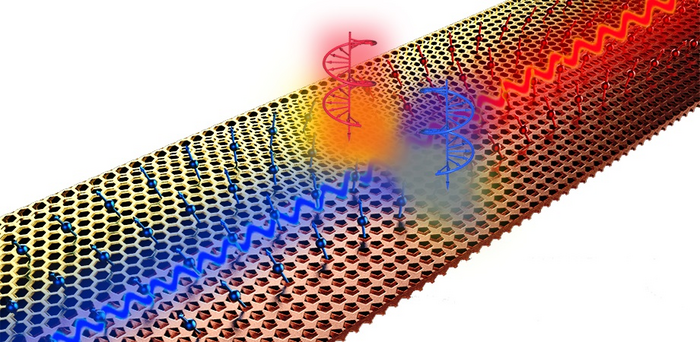
Unidirectional excitation of metamaterial interface waveguides; the chirality of the source decides the direction of energy flow along the edge.

Credit: Zhixia Xu.

Metamaterial interface waveguides can confine and guide electromagnetic (EM) waves, which has attractive potential in integrated photonics physics and wireless devices, from radio frequencies to optical bands. The energy flow in waveguides can be fully controlled by sorting the near-field light waves according to their handedness (chirality) which determines the direction of energy transmission. Chirality sorting is an important process to develop in the field of chiral photonics. In the future, chiral-sorting metadevices may be fully digitized and programmable, so that reconfigurable unidirectional transmission routes and scattering performance of the artificial structures can be controlled simultaneously with fantastic functions.

To get there, we must better understand the characteristics and possible applications of different edge modes. As reported in Advanced Photonics, researchers from Southeast University, Dalian Maritime University, and University of California at San Diego collaborated to visualize various unidirectional edge waves in microwave metamaterial interface waveguides, based on localized sources carrying spin angular momentum and orbital angular momentum.

In their work, they present a local light-beam source, composed of an electric probe array. Their design includes a broadband feeding network to ensure the performance of the angular momentum of the light beams. For their systematic experiments, they established a near-field scanning platform to measure the unidirectional transmission directly. Based on their observations of three edge states—spoof surface plasmon polaritons, line waves, and valley topological insulators—they assess the advantages and disadvantages of each.

Overall, this research advances the field of chiral photonics science and promotes applications of chiral-sorting technology, particularly for microwave metadevices. According to corresponding author Tie Jun Cui of the State Key Laboratory of Millimeter Waves at Southeast University in Nanjing, “Developing the freedom of microwave angular momentum in the waveguides is meaningful to increase the channel capacity and to design robust and flexible devices. Based on various metamaterial interface waveguides, novel metadevices such as filters, splitters, antennas, and multiplexers can be widely utilized in radar and communication systems.”

Read the Gold Open Access article by Xu et al., “Near-field chiral excitation of universal spin-momentum locking transport of edge waves in microwave metamaterials,” Adv. Photon. 4(4) 046004 (2022), doi 10.1117/1.AP.4.4.046004.


Journal

Advanced Photonics

DOI

10.1117/1.AP.4.4.046004

Article Title

Near-field chiral excitation of universal spin-momentum locking transport of edge waves in microwave metamaterials

Article Publication Date

19-Jul-2022

Share12Tweet8Share2ShareShareShare2

Related Posts

Electric Field and Oxygen Spillover Collaborate to Control Electrode Migration in SOECs

June 24, 2026
Innovative Speckle-Based Metrology System Advances Precision Measurement of Next-Generation X-Ray Mirrors — Chemistry

Innovative Speckle-Based Metrology System Advances Precision Measurement of Next-Generation X-Ray Mirrors

June 24, 2026

Water-Activated PVA Film Transforms from Bioplastic to High-Performance Wood Adhesive

June 24, 2026

SwRI and St. Mary’s University Partner to Forecast Durability of Metal Hydride Hydrogen Storage

June 24, 2026

POPULAR NEWS

  • Saying Goodbye to PGY-6: Pediatric Fellowship Realities

    103 shares
    Share 41 Tweet 26
  • Multi-Hospital Study Reveals Long Covid Burden Is Twice as High as Current Estimates

    92 shares
    Share 36 Tweet 23
  • Detection of EDCs in Breast Milk and Infant Urine Up to Six Months Highlights Early Exposure Risks

    77 shares
    Share 31 Tweet 19
  • New Drug Candidate Developed at McMaster Shows Potential for Treating Brain Cancer

    58 shares
    Share 23 Tweet 15

About

We bring you the latest biotechnology news from best research centers and universities around the world. Check our website.

Follow us

Recent News

Building Trust as the Foundation of Digital Behavioral Health

Virtual Reality Study Conducted Remotely Advances Insights into Cybersickness

Global Drop in Intimate Partner Violence Linked to Shifts in Attitudes and Behavior

Subscribe to Blog via Email

Enter your email address to subscribe to this blog and receive notifications of new posts by email.

Join 82 other subscribers
  • Contact Us

Bioengineer.org © Copyright 2023 All Rights Reserved.

Welcome Back!

Login to your account below

Forgotten Password?

Retrieve your password

Please enter your username or email address to reset your password.

Log In
No Result
View All Result
  • Homepages
    • Home Page 1
    • Home Page 2
  • News
  • National
  • Business
  • Health
  • Lifestyle
  • Science

Bioengineer.org © Copyright 2023 All Rights Reserved.