A new analysis describes how U.K. residents shifted the amount of time they spent on various activities over the course of the pandemic and whether they participated online or in-person. Lan Li of University College London, Centre for Digital Health in Emergencies (dPHE), U.K., and colleagues present these findings in the open-access journal PLOS ONE on July 13, 2022.
Credit: Li et al., 2022, PLOS ONE, CC-BY 4.0 (https://creativecommons.org/licenses/by/4.0/)
A new analysis describes how U.K. residents shifted the amount of time they spent on various activities over the course of the pandemic and whether they participated online or in-person. Lan Li of University College London, Centre for Digital Health in Emergencies (dPHE), U.K., and colleagues present these findings in the open-access journal PLOS ONE on July 13, 2022.
When the COVID-19 pandemic began, the U.K. joined many countries in introducing restrictions on people’s movement and social activities to mitigate viral spread. A growing body of research reveals how such restrictions have affected people’s lifestyles worldwide. However, it has been less clear how behavioral patterns of U.K. residents changed over time as different restrictions were implemented and lifted.
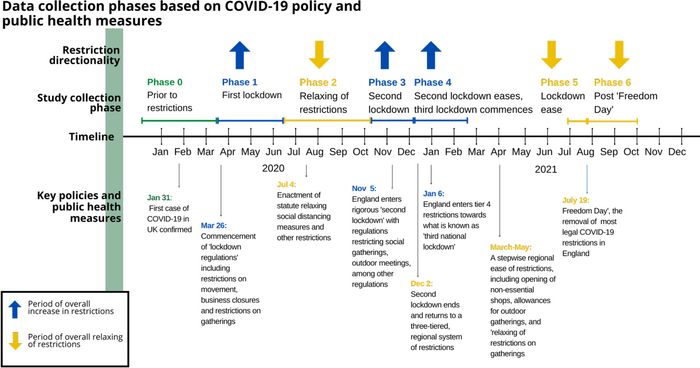
To help clarify, Li and colleagues conducted six online surveys of U.K. residents between April 2020 and July 2021 and were ultimately able to follow 203 people who responded to multiple surveys. The surveys included questions about 16 different types of activities respondents participated in during different phases of the pandemic, such as journaling, shopping, and getting active, and whether they participated online or in person.
Statistical analysis of the responses showed that the biggest changes in terms of amount of time spent—as well as the biggest changes in online versus in-person participation—occurred for cultural activities, spending time with others, and travelling. Changes were most pronounced in March to June 2020, corresponding with the first lockdown period, when participation in all 16 activities decreased. The biggest shift from in-person to online participation occurred from March to October 2020, which included the first lockdown followed by relaxation of restrictions.
On July 19, 2021, all restrictions were eliminated in the U.K. However, this analysis found, participation in cultural and group activities remained lower than before the pandemic. The majority of respondents also continued to participate in many activities online.
These findings could help U.K. policymakers understand the impact of their pandemic restrictions. In the future, the researchers plan to investigate how demographic factors, such as age and employment, may have affected the results, as well as long-term mental health implications of the lifestyle changes.
Prof. Patty Kostova, director of UCL dPHE and the lead of the study, adds: “This longitudinal research study illustrated citizens’ resilience throughout the stages of the pandemic.”
Lan Li adds: “This longitudinal study determines the frequency and way of people doing activities from Spring 2020 to Summer 2021 during different phases of the COVID-19 pandemic in the UK. The findings provide an invaluable insight into understanding how people in the UK changed their lifestyle, including what activities they do, and how they accessed those activities in light of the COVID-19 pandemic and related public health policy implemented to address the pandemic.”
#####
In your coverage please use this URL to provide access to the freely available article in PLOS ONE: https://journals.plos.org/plosone/article?id=10.1371/journal.pone.0270207
Citation: Li L, Sullivan A, Musah A, Stavrianaki K, Wood CE, Baker P, et al. (2022) To Zoom or not to Zoom: A longitudinal study of UK population’s activities during the COVID-19 pandemic. PLoS ONE 17(7): e0270207. https://doi.org/10.1371/journal.pone.0270207
Author Countries: U.K., U.S.A.
Funding: LL was partially supported by China Scholarship Council (File No. 202008060009).
Journal
PLoS ONE
DOI
10.1371/journal.pone.0270207
Method of Research
Survey
Subject of Research
People
Article Title
To Zoom or not to Zoom: A longitudinal study of UK population’s activities during the COVID-19 pandemic
Article Publication Date
13-Jul-2022
COI Statement
The authors have declared that no competing interests exist.