In an era of ubiquitous human entanglement with the natural world, scientists are turning to social–ecological systems approaches as a way to better understand our rapidly changing world. Writing in BioScience, Mary L. Cadenasso (University of California, Davis), Anne M. Rademacher (New York University), and Steward T. A. Pickett (Cary Institute of Ecosystem Studies) describe the ways in which systems thinking can inform our understanding of the world and foster better discourse between the social and ecological sciences. The authors argue that this approach, unlike earlier models, enables a more thoroughgoing understanding of the dynamically linked social and natural processes that underlie ecological perturbations.
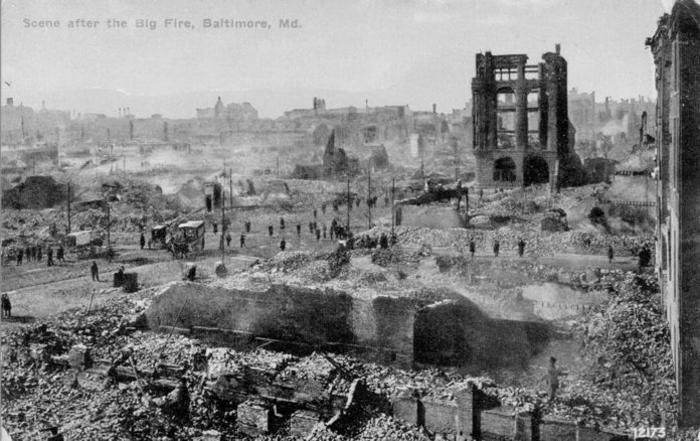
Credit: Baltimore Fire Museum
In an era of ubiquitous human entanglement with the natural world, scientists are turning to social–ecological systems approaches as a way to better understand our rapidly changing world. Writing in BioScience, Mary L. Cadenasso (University of California, Davis), Anne M. Rademacher (New York University), and Steward T. A. Pickett (Cary Institute of Ecosystem Studies) describe the ways in which systems thinking can inform our understanding of the world and foster better discourse between the social and ecological sciences. The authors argue that this approach, unlike earlier models, enables a more thoroughgoing understanding of the dynamically linked social and natural processes that underlie ecological perturbations.
Cadenasso and colleagues present fire in urbanized and urbanizing landscapes as an exemplar system and detail the ways that human and natural biophysical processes are working together to “coproduce” more frequent and dangerous fires. Such conflagrations, they argue, constitute a “human–natural disaster,” rather than a purely natural phenomenon. Because the nature and magnitude of these disasters result from human structures, fire-fighting strategies, regulations, as well as natural phenomena such as temperature, wind, and water availability, they are best understood, say the authors, as “neither only natural nor only social but a combination of the two.” They continue, “There is no such thing as a natural disaster in a place that people have built or have altered by their management or subsequent neglect.”
The importance of such theoretical approaches is particularly acute, argue Cadenasso and colleagues, in the face of a rapidly changing climate. As global change mounts, they say, older models will be quickly rendered obsolete, and new models for understanding fires and other disasters will be necessary for rapid adaptation. For instance, firefighting strategies that rely on small-scale fire breaks such as roads may not withstand the destruction of emerging “fire tornadoes,” in which climate-change-driven wind dynamics send large embers great distances from source flames. If our system models are not continually updated, our understanding of these processes may “lag behind changes in the world and, therefore, constrain how society views and reacts to fire as an extreme event, often with catastrophic consequences for people.” Avoiding such calamities, say the authors, will require a shared understanding of system thinking within the social and ecological sciences, one that will allow practitioners in both fields to “become better partners” and contribute to “civic discourse in a time of extraordinary change.”
###
BioScience, published monthly by Oxford Journals, is the journal of the American Institute of Biological Sciences (AIBS). BioScience is a forum for integrating the life sciences that publishes commentary and peer-reviewed articles. The journal has been published since 1964. AIBS is an organization for professional scientific societies and organizations, and individuals, involved with biology. AIBS provides decision-makers with high-quality, vetted information for the advancement of biology and society. Follow BioScience on Twitter @AIBSbiology.
Oxford Journals is a division of Oxford University Press. Oxford Journals publishes well over 300 academic and research journals covering a broad range of subject areas, two-thirds of which are published in collaboration with learned societies and other international organizations. The division has been publishing journals for more than a century, and as part of the world’s oldest and largest university press, has more than 500 years of publishing expertise behind it. Follow Oxford Journals on Twitter @OxfordJournals.
Journal
BioScience
DOI
10.1093/biosci/biac047
Method of Research
Case study
Subject of Research
Not applicable
Article Title
Systems in Flames: Dynamic Coproduction of Social–Ecological Processes
Article Publication Date
13-Jul-2022