

• HOME
  • NEWS
  • EXPLORE
    • CAREER
      • Companies
      • Jobs
    • EVENTS
    • iGEM
      • News
      • Team
    • PHOTOS
    • VIDEO
    • WIKI
  • BLOG
  • COMMUNITY
    • FACEBOOK
    • INSTAGRAM
    • TWITTER
Wednesday, May 6, 2026
BIOENGINEER.ORG
No Result
View All Result
  • Login
  • HOME
  • NEWS
  • EXPLORE
    • CAREER
      • Companies
      • Jobs
        • Lecturer
        • PhD Studentship
        • Postdoc
        • Research Assistant
    • EVENTS
    • iGEM
      • News
      • Team
    • PHOTOS
    • VIDEO
    • WIKI
  • BLOG
  • COMMUNITY
    • FACEBOOK
    • INSTAGRAM
    • TWITTER
  • HOME
  • NEWS
  • EXPLORE
    • CAREER
      • Companies
      • Jobs
        • Lecturer
        • PhD Studentship
        • Postdoc
        • Research Assistant
    • EVENTS
    • iGEM
      • News
      • Team
    • PHOTOS
    • VIDEO
    • WIKI
  • BLOG
  • COMMUNITY
    • FACEBOOK
    • INSTAGRAM
    • TWITTER
No Result
View All Result
Bioengineer.org
No Result
View All Result
Home NEWS Science News Biology

A machine learning model to predict immunotherapy response in cancer patients

Bioengineer by Bioengineer
July 12, 2022
in Biology
Reading Time: 2 mins read
0
Figure 1
Share on FacebookShare on TwitterShare on LinkedinShare on RedditShare on Telegram

Immunotherapy is a new cancer treatment that activates the body’s immune system to fight against cancer cells without using chemotherapy or radiotherapy. It has fewer side effects than conventional anticancer drugs because it attacks only cancer cells using the body’s immune system. In addition, because it uses the memory and adaptability of the immune system, patients who have benefited from its therapeutic effects experience sustained anticancer effects.
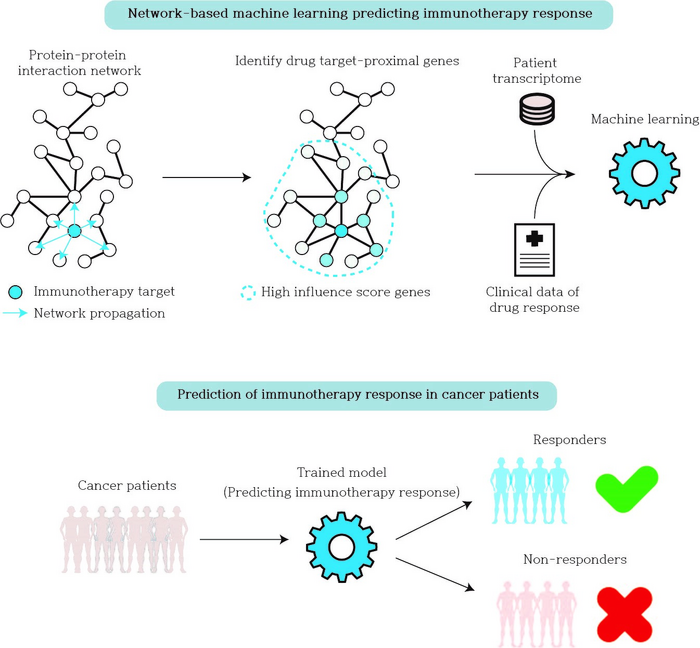
Figure 1

Credit: POSTECH

Immunotherapy is a new cancer treatment that activates the body’s immune system to fight against cancer cells without using chemotherapy or radiotherapy. It has fewer side effects than conventional anticancer drugs because it attacks only cancer cells using the body’s immune system. In addition, because it uses the memory and adaptability of the immune system, patients who have benefited from its therapeutic effects experience sustained anticancer effects.


The recently developed immune checkpoint inhibitor has considerably improved the survival rate of patients with cancer. However, the problem with cancer immunotherapy is that only approximately 30% of cancer patients receive benefits from its therapeutic effect, and the current diagnostic techniques do not accurately predict the patient’s response to the treatment.


Under this circumstance, the research team led by Professor Sanguk Kim (Department of Life Sciences) at POSTECH is gaining attention as they have improved the accuracy of predicting patient response to immune checkpoint inhibitors (ICIs) by using network-based machine learning. The research team discovered new network-based biomarkers by analyzing the clinical results of more than 700 patients with three different cancers (melanoma, gastric cancer, and bladder cancer) and the transcriptome data of the patients’ cancer tissues. By utilizing the network-based biomarkers, the team successfully developed artificial intelligence that could predict the response to anticancer treatment. The team further proved that the treatment response prediction based on the newly discovered biomarkers was superior to that based on conventional anticancer treatment biomarkers including immunotherapy targets and tumor microenvironment markers.


In their previous study, the research team had developed machine learning that could predict drug responses to chemotherapy in patients with gastric or bladder cancer. This study has shown that artificial intelligence using the interactions between genes in a biological network could successfully predict the patient response to not only chemotherapy, but also immunotherapy in multiple cancer types.


This study helps detect patients who will respond to immunotherapy in advance and establish treatment plans, resulting in customized precision medicine with more patients to benefit from cancer treatments. Supported by the POSTECH Medical Device Innovation Center, the Graduate School of Artificial Intelligence, and ImmunoBiome Inc, this study was recently published in Nature Communications, an international peer-reviewed journal.


Journal

Nature Communications

DOI

10.1038/s41467-022-31535-6

Article Title

Network-based machine learning approach to predict immunotherapy response in cancer patients

Article Publication Date

28-Jun-2022

Share12Tweet8Share2ShareShareShare2

Related Posts

More Than Just Rising Temperatures: How Marine Heatwaves Trigger Toxic Interactions Between Seagrasses and Microbes — Biology

More Than Just Rising Temperatures: How Marine Heatwaves Trigger Toxic Interactions Between Seagrasses and Microbes

May 6, 2026
Nobel Laureate Jules Hoffmann Heads Comprehensive Review Celebrating 40 Years of Toll-Like Receptor Research — Biology

Nobel Laureate Jules Hoffmann Heads Comprehensive Review Celebrating 40 Years of Toll-Like Receptor Research

May 6, 2026

How Do Extreme Climate Events Impact Animal Societies?

May 6, 2026

Scientists Discover Promising New Pathway for Antimalarial Drug Development

May 6, 2026

POPULAR NEWS

  • Research Indicates Potential Connection Between Prenatal Medication Exposure and Elevated Autism Risk

    836 shares
    Share 334 Tweet 209
  • New Study Reveals Plants Can Detect the Sound of Rain

    722 shares
    Share 288 Tweet 180
  • Scientists Investigate Possible Connection Between COVID-19 and Increased Lung Cancer Risk

    68 shares
    Share 27 Tweet 17
  • Salmonella Haem Blocks Macrophages, Boosts Infection

    61 shares
    Share 24 Tweet 15

About

We bring you the latest biotechnology news from best research centers and universities around the world. Check our website.

Follow us

Recent News

Engineering Hurdles and Opportunities in Gene Delivery

More Than Just Rising Temperatures: How Marine Heatwaves Trigger Toxic Interactions Between Seagrasses and Microbes

Cyclin E1 and CCNE1 Shift in Ovarian Cancer Post-PARP

Subscribe to Blog via Email

Enter your email address to subscribe to this blog and receive notifications of new posts by email.

Join 82 other subscribers
  • Contact Us

Bioengineer.org © Copyright 2023 All Rights Reserved.

Welcome Back!

Login to your account below

Forgotten Password?

Retrieve your password

Please enter your username or email address to reset your password.

Log In
No Result
View All Result
  • Homepages
    • Home Page 1
    • Home Page 2
  • News
  • National
  • Business
  • Health
  • Lifestyle
  • Science

Bioengineer.org © Copyright 2023 All Rights Reserved.
