Many historical buildings were built of limestone, such as Vienna’s St. Stephen’s Cathedral. Limestone is easy to work with, but does not withstand weathering well. It consists mainly of calcite minerals that are relatively weakly bound to each other, which is why parts of the stone keep crumbling away over the years, often requiring costly restoration and conservation treatments.
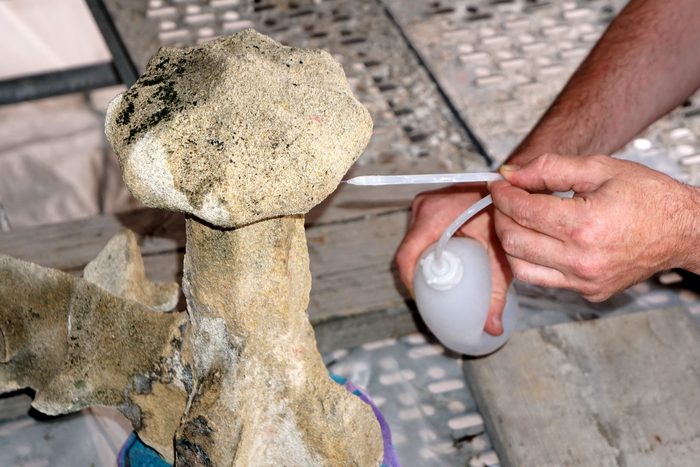
Credit: Archiv der Dombauhütte St. Stephan
Many historical buildings were built of limestone, such as Vienna’s St. Stephen’s Cathedral. Limestone is easy to work with, but does not withstand weathering well. It consists mainly of calcite minerals that are relatively weakly bound to each other, which is why parts of the stone keep crumbling away over the years, often requiring costly restoration and conservation treatments.
However, it is possible to increase the resistance of the stone by treating it with special silicate nanoparticles. The method is already being used, but what exactly happens in the process and which nanoparticles are best suited for this purpose has been unclear until now. A research team from TU Wien and the University of Oslo has now been able to clarify exactly how this artificial hardening process takes place through elaborate experiments at the DESY synchrotron in Hamburg and with microscopic examinations in Vienna. That way, the team could determine which nanoparticles are best suited for this purpose.
An aqueous suspension with nanoparticles
“We use a suspension, a liquid, in which the nanoparticles initially float around freely,” says Prof. Markus Valtiner from the Institute of Applied Physics at TU Wien. “When this suspension gets into the rock, then the aqueous part evaporates, the nanoparticles form stable bridges between the minerals and give the rock additional stability.”
This method is already used in restoration technology, but until now it was not known exactly what physical processes take place. When the water evaporates, a very special kind of crystallisation occurs: Normally, a crystal is a regular arrangement of individual atoms. However, not only atoms, but also entire nanoparticles can arrange themselves in a regular structure – this is then referred to as a “colloidal crystal”.
The silicate nanoparticles come together to form such colloidal crystals when they dry in the rock and thus jointly create new connections between the individual mineral surfaces. This increases the strength of the natural stone.
Measurements at the large-scale research facility DESY and in Vienna
To observe this crystallisation process in detail, the TU Wien research team used the DESY synchrotron facility in Hamburg. Extremely strong X-rays can be generated there, which can be used to analyse the crystallisation during the drying process.
“This was very important to understand exactly what the strength of the bonds that form depends on,” says Joanna Dziadkowiec (University of Oslo and TU Wien), the first author of the publication in which the research results have now been presented. “We used nanoparticles of different sizes and concentrations and studied the crystallisation process with X-ray analyses.” It was shown that the size of the particles is decisive for optimal strength gain.
To this end, the TU Vienna also measured the adhesive force created by the colloidal crystals. For this purpose, a special interference microscope was used, which is perfectly suited for measuring tiny forces between two surfaces.
Small particles, more force
“We were able to show: The smaller the nanoparticles, the more can they strengthen the cohesion between the grains of minerals,” says Joanna Dziadkowiec. “If you use smaller particles, more binding sites are created in the colloidal crystal between two grains of minerals, and with the number of particles involved, the force with which they hold the minerals together thus also increases.” How many particles are present in the emulsion is also important. “Depending on the particle concentration, the crystallisation process proceeds slightly differently, and this has an influence on how the colloidal crystals form in detail,” says Markus Valtiner. The new findings will now be used to make restoration work more durable and more targeted.
Journal
Langmuir
DOI
10.1021/acs.langmuir.2c00486
Method of Research
Experimental study
Subject of Research
Not applicable
Article Title
Cohesion Gain Induced by Nanosilica Consolidants for Monumental Stone Restoration
Article Publication Date
23-May-2022