A detailed collection of mortality estimates for diseases, disorders and external factors is publishing on June 16th in the open access journal PLOS Medicine. The study provides a resource to estimate reductions in life expectancy for a comprehensive range of disorders. The atlas will be a useful tool for clinicians, academics, and policymakers looking into links between disorders and mortality estimates, as well as for researchers studying specific diseases.
Credit: NPEPI Atlas (CC-BY 4.0, https://creativecommons.org/licenses/by/4.0/)
A detailed collection of mortality estimates for diseases, disorders and external factors is publishing on June 16th in the open access journal PLOS Medicine. The study provides a resource to estimate reductions in life expectancy for a comprehensive range of disorders. The atlas will be a useful tool for clinicians, academics, and policymakers looking into links between disorders and mortality estimates, as well as for researchers studying specific diseases.
Mortality metrics can help with decision-making and prioritizing healthcare resources, but studies looking at mortality and various disorders have typically not been comprehensive. They often focus on either comparing relative as opposed to absolute measures of mortality of people with a disorder to the general population, or crude estimates of life expectancy, not considering variation in the age of onset.
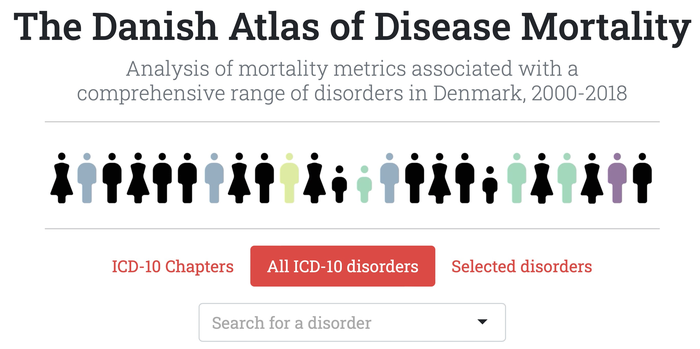
Oleguer Plana-Ripoll and colleagues at Aarhus University, Denmark created a comprehensive atlas of mortality-related estimates, based on de-identified data on 7,378,598 people living in Denmark from 2000 to 2018. They used national registers to examine individuals diagnosed with 1,803 specific categories of disorders and generated a panel of epidemiological and mortality metrics, including incidence rates, age-of-onset distributions, and comparison of mortality estimates for people with the disorder with the general population, as well as life years lost for each one. The team prepared an interactive data visualization to optimize the interrogation of their findings (http://nbepi.com/atlas).
A limitation of the study is the possibility that the association between the different disorders and mortality could be explained by other underlying factors associated with both the disorder and mortality.
Detailed and accessible data like this allows a fine-grained analysis of the associations between a comprehensive set of disorders and mortality-related estimates, and the findings can guide health research as well as serve as a benchmark to evaluate future health interventions.
Plana-Ripoll adds, “Most previous papers have used relative measures of mortality or crude estimates of life expectancy. Here, we use a new method that more accurately captures premature mortality for more than 1,800 different health conditions.”
#####
In your coverage, please use this URL to provide access to the freely available paper in PLOS Medicine:
http://journals.plos.org/plosmedicine/article?id=10.1371/journal.pmed.1004023
Citation: Plana-Ripoll O, Dreier JW, Momen NC, Prior A, Weye N, Mortensen PB, et al. (2022) Analysis of mortality metrics associated with a comprehensive range of disorders in Denmark, 2000 to 2018: A population-based cohort study. PLoS Med 19(6): e1004023. https://doi.org/10.1371/journal.pmed.1004023
Author Countries: Denmark, Norway, Australia
Funding: This study was supported by the Danish National Research Foundation, via a Niels Bohr Professorship to JM. OP-R is supported by a Lundbeck Foundation Fellowship (R345-2020-1588) and has received funding from the European Union’s Horizon 2020 research and innovation programme under the Marie Sklodowska-Curie grant agreement No 837180. AP is supported by a grant from the Novo Nordisk Foundation (grant NNF18OC0031194). The air pollution modelling was partly funded by NordForsk under the Nordic Programme on Health and Welfare project #75007 (NordicWelfAir). The Danish Big Data Centre for Environment and Health is funded by the Novo Nordisk Foundation Challenge Programme (grant NNF17OC0027864). The funders had no role in study design, data collection and analysis, decision to publish, or preparation of the manuscript.
Journal
PLoS Medicine
DOI
10.1371/journal.pmed.1004023
Method of Research
Observational study
Subject of Research
People
COI Statement
Competing interests: I have read the journal’s policy and the authors of this manuscript have the following competing interests: JWD has been involved in projects funded by the Novo Nordisk Foundation (NNF16OC0019126), The Central Denmark Region, and the Danish Epilepsy Association during the conduct of this study.