Viral hepatitis is a serious health condition that affects the liver. While hepatitis B and C viruses are commonly targeted by public health measures aiming to reduce the disease burden, there is another, less commonly known virus that can cause this condition. Hepatitis D virus (HDV), the smallest virus to be discovered in humans, coinfects people with the hepatitis B virus (HBV). This form of viral hepatitis can rapidly progress to life-threatening conditions including liver cirrhosis and liver cancer.
Credit: Chinese Medical Journal
Viral hepatitis is a serious health condition that affects the liver. While hepatitis B and C viruses are commonly targeted by public health measures aiming to reduce the disease burden, there is another, less commonly known virus that can cause this condition. Hepatitis D virus (HDV), the smallest virus to be discovered in humans, coinfects people with the hepatitis B virus (HBV). This form of viral hepatitis can rapidly progress to life-threatening conditions including liver cirrhosis and liver cancer.
Keeping the dangers of HDV infection in mind, a review published on April 5, 2022 in Volume 135, Issue 7 of the Chinese Medical Journal has shed light upon the recent advances and challenges in the field of HDV. Dr. Qiuwei Pan from Northwest Minzu University, the corresponding author of this article tells us, “The number of people living with chronic HBV infection is estimated to be approximately 240 to 350 million. With this article, our team hopes to increase awareness about the disease and inform research efforts in this field to reduce the HDV infection burden in different populations.”
His concerns are not completely unfounded. Though there has been progress in unraveling the life cycle of HDV, we still need to understand the origin of the virus and its interactions with its host. HDV was first identified in liver biopsies and in the serum of patients with chronic HBV. HDV belongs to the Deltaviridae family of viruses, which has a supposedly longer evolutionary history than what is currently known, owing to the presence of HDV-like viruses in a range of non-human hosts. The HDV that affects humans is a peculiar, defective single stranded RNA (ssRNA) virus. It entirely depends on its host’s cellular enzymes for its genetic replication and propagates in the liver cells using HBV machinery.
HDV has an interesting infection and replication strategy—it shares coat proteins with HBV in a way that allows the smaller virus to exploit HBV’s infectious particle release strategy and copy its transmission route to infect new host cells. Studies on mice show that HDV can persist within liver cells for at least 6 weeks, even in the absence of HBV. However, infectious HDV particles are only released following HBV infection.
Another interesting feature of HDV is its capacity to swiftly evolve into genetically diverse strains, enabled by its ssRNA genome. The genetic difference between HDV strains is greater than 35% and it is important to consider these differences while determining the prevalence of HDV—a statistic that differs greatly among various populations. For example, Nigeria, China, and India—which host the maximum number of HBV infections—account for only one-third of the world’s total HDV infections. Dr. Pan speculates: “The co-existence of particular HBV and HDV genotypes in specific geographical regions substantially affects their HDV prevalence rates. Nevertheless, large-scale, well-designed epidemiological studies are required to validate this concept.”
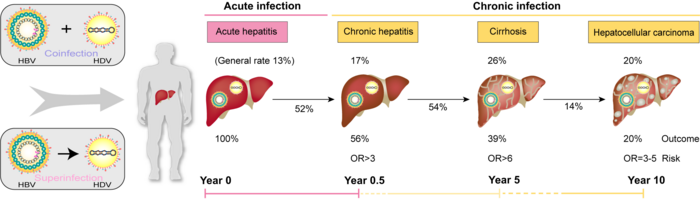
Speaking of the clinical manifestations of HDV infection, Dr. Pan tells us, “HDV and HBV may infect an individual simultaneously, or HDV may infect an individual with chronic HBV infection, thereby exacerbating it.” Both of these modes of infection have different manifestations. If the viruses infect an otherwise healthy individual together and the body’s immune system can fight both viruses, the person has a better chance of recovery. If the immune system cannot clear HBV, there are chances of the co-infection progressing to a chronic stage. Patients with HDV superinfection can progress to a very dangerous form of chronic hepatitis.
With our knowledge of HDV’s virology rapidly advancing, scientists are exploring therapeutic options on a large scale by targeting the different stages of the virus’ life cycle. For example, the antiviral medication bulevirtide, which was approved by the European Union in 2020, inhibits the cellular entry of HBV and HDV. The farnesyl transferase enzyme inhibitor lornafarnib is an oral drug that interferes with the assembly of virus particles. With a rise in in-vitro HDV models, many therapeutic options are starting to build and offer hope to HDV-infected patients. “Nevertheless, many challenges remain in combating HDV; overcoming these requires an enhancement of research, public health efforts, and patient care. Maybe then we will be able to achieve the global mission of eliminating viral hepatitis by 2030,” signs off Dr. Pan.
***
Reference
DOI: https://doi.org/10.1097/CM9.0000000000002011
Journal
Chinese Medical Journal
DOI
10.1097/CM9.0000000000002011
Method of Research
Literature review
Subject of Research
Not applicable
Article Title
Hepatitis D: advances and challenges
Article Publication Date
5-Apr-2022
COI Statement
None