• HOME
  • NEWS
  • EXPLORE
    • CAREER
      • Companies
      • Jobs
    • EVENTS
    • iGEM
      • News
      • Team
    • PHOTOS
    • VIDEO
    • WIKI
  • BLOG
  • COMMUNITY
    • FACEBOOK
    • INSTAGRAM
    • TWITTER
Saturday, February 7, 2026
BIOENGINEER.ORG
No Result
View All Result
  • Login
  • HOME
  • NEWS
  • EXPLORE
    • CAREER
      • Companies
      • Jobs
        • Lecturer
        • PhD Studentship
        • Postdoc
        • Research Assistant
    • EVENTS
    • iGEM
      • News
      • Team
    • PHOTOS
    • VIDEO
    • WIKI
  • BLOG
  • COMMUNITY
    • FACEBOOK
    • INSTAGRAM
    • TWITTER
  • HOME
  • NEWS
  • EXPLORE
    • CAREER
      • Companies
      • Jobs
        • Lecturer
        • PhD Studentship
        • Postdoc
        • Research Assistant
    • EVENTS
    • iGEM
      • News
      • Team
    • PHOTOS
    • VIDEO
    • WIKI
  • BLOG
  • COMMUNITY
    • FACEBOOK
    • INSTAGRAM
    • TWITTER
No Result
View All Result
Bioengineer.org
No Result
View All Result
Home NEWS Science News Health

Mechanical transmission enables EMT cancer cells to drive epithelial cancer cell migration to guide tumor spheroid disaggregation

Bioengineer by Bioengineer
June 15, 2022
in Health
Reading Time: 2 mins read
0
N/E-cadherin heterophilic complex mediated mechanical force transmission regulates mesenchymal-like cells induced epithelial cell migration
Share on FacebookShare on TwitterShare on LinkedinShare on RedditShare on Telegram

Recently, Dr. Feng Lin from College of Engineering, Peking University, published a research paper entitled “Mechanical transmission enables EMT cancer cells to drive epithelioid cancer cell migration to guide tumor spheroid disaggregation” online in the journal Chinese Science: Life Science, revealing the regulating mechanism(s) of caner cells with mesenchymal-like phenotype within tumor tissue promoting epithelial cancer cell migration and invasion from the perspective of mechano-biology.
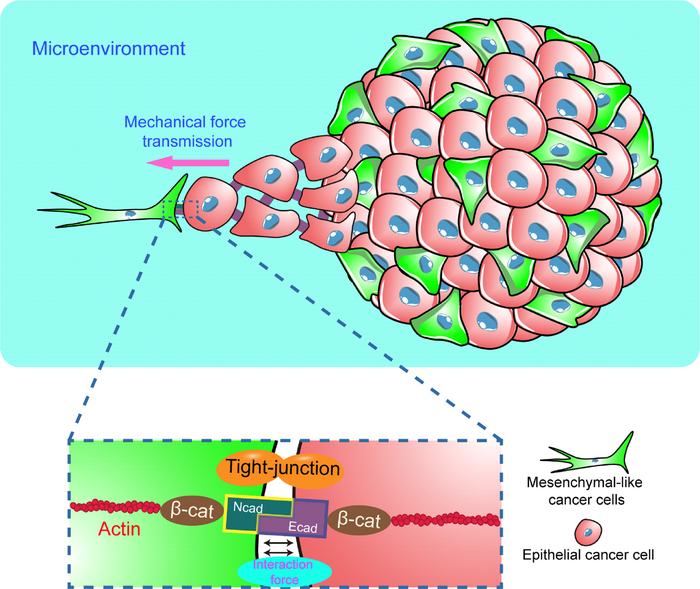
N/E-cadherin heterophilic complex mediated mechanical force transmission regulates mesenchymal-like cells induced epithelial cell migration

Credit: Science China Press

Recently, Dr. Feng Lin from College of Engineering, Peking University, published a research paper entitled “Mechanical transmission enables EMT cancer cells to drive epithelioid cancer cell migration to guide tumor spheroid disaggregation” online in the journal Chinese Science: Life Science, revealing the regulating mechanism(s) of caner cells with mesenchymal-like phenotype within tumor tissue promoting epithelial cancer cell migration and invasion from the perspective of mechano-biology.

Firstly, the heterogeneous tumor spheroids mixed with epithelial and mesenchymal cancer cells were constructed using hanging drop method. It was found that the cells with mesenchymal-like phenotype preferred to dominate in the peripheral region during tumor spheroid self-organization. The authors found that mesenchymal-like cells migrated out of tumor spheroids faster and guided epithelial cancer cell migration and invasion through 2D dispersion and 3D invasion assays. This process is regulated by the enhanced contractility of tumor cells after EMT phenotypic switch, and is pertinent to the stiffness of microenvironment. It can effectively prevent the invasion of tumor cells by inhibiting cell contraction. The authors als found that N-cadherin on the surface of mesenchymal-like cells and E-cadherin on the surface of epithelial cells can form a heterophilic complex, which exercises the transmission function of mechanical force from mesenchymal-like cells to epithelial cells. Inhibiting the formation of intercellular N/E-cadherin heterophilic complex significantly reduce the interaction between mesenchymal-like cells and epithelial cells and the cancer invasion. In conclusion, this paper not only reports the key role of mechanical transmission between mesenchymal-like and epithelial cancer cells in mediating tumor cell migration and invasion, but also provides new clues and ideas for developing and tumor treatment strategy through regulating the mechanical interaction between heterogeneous cells within tumor tissue from the perspective of mechano-biology.

Zhang Qing, a Ph.D. student from Peking University, is the first author of this article. This research is supported by the National Natural Science Foundation of China and the China Postdoctoral Science Foundation.

See the article: 
Mechanical transmission enables EMT cancer cells to drive epithelial cancer cell migration to guide tumor spheroid disaggregation
http://engine.scichina.com/doi/10.1007/s11427-021-2054-3


Journal

Science China Life Sciences

DOI

10.1007/s11427-021-2054-3

Share12Tweet8Share2ShareShareShare2

Related Posts

Evaluating Pediatric Emergency Care Quality in Ethiopia

February 7, 2026

TPMT Expression Predictions Linked to Azathioprine Side Effects

February 7, 2026

Improving Dementia Care with Enhanced Activity Kits

February 7, 2026

Decoding Prostate Cancer Origins via snFLARE-seq, mxFRIZNGRND

February 7, 2026

POPULAR NEWS

  • Robotic Ureteral Reconstruction: A Novel Approach

    Robotic Ureteral Reconstruction: A Novel Approach

    82 shares
    Share 33 Tweet 21
  • Digital Privacy: Health Data Control in Incarceration

    63 shares
    Share 25 Tweet 16
  • Study Reveals Lipid Accumulation in ME/CFS Cells

    57 shares
    Share 23 Tweet 14
  • Breakthrough in RNA Research Accelerates Medical Innovations Timeline

    53 shares
    Share 21 Tweet 13

About

We bring you the latest biotechnology news from best research centers and universities around the world. Check our website.

Follow us

Recent News

Evaluating Pediatric Emergency Care Quality in Ethiopia

TPMT Expression Predictions Linked to Azathioprine Side Effects

Improving Dementia Care with Enhanced Activity Kits

Subscribe to Blog via Email

Success! An email was just sent to confirm your subscription. Please find the email now and click 'Confirm' to start subscribing.

Join 73 other subscribers
  • Contact Us

Bioengineer.org © Copyright 2023 All Rights Reserved.

Welcome Back!

Login to your account below

Forgotten Password?

Retrieve your password

Please enter your username or email address to reset your password.

Log In
No Result
View All Result
  • Homepages
    • Home Page 1
    • Home Page 2
  • News
  • National
  • Business
  • Health
  • Lifestyle
  • Science

Bioengineer.org © Copyright 2023 All Rights Reserved.