Vancouver, British Columbia, Canada — A newly developed small-molecular radiopharmaceutical pair has successfully visualized and treated melanoma in a preclinical study, according to new research presented at the Society of Nuclear Medicine and Molecular Imaging 2022 Annual Meeting. Targeting a receptor that is aberrantly overproduced in many human solid tumors, this theranostic (therapy + diagnostic) approach shows promise for non-invasive diagnosis and treatment of patients with various forms of cancer.
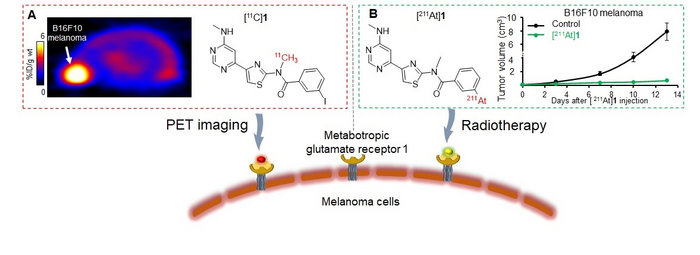
Credit: Lin Xie, Masayuki Hanyu, Masayuki Fujinaga, Lulu Zhang, Yiding Zhang, Kuan Hu, Mori Wakana, Katsuyuki Minegishi, Kotaro Nagatsu, Kazunori Kawamura, and Ming-Rong Zhang, Department of Advanced Nuclear Medicine Sciences, National Institute of Radiological Sciences, National Institutes for Quantum and Radiological Science and Technology, Chiba, Japan.
Vancouver, British Columbia, Canada — A newly developed small-molecular radiopharmaceutical pair has successfully visualized and treated melanoma in a preclinical study, according to new research presented at the Society of Nuclear Medicine and Molecular Imaging 2022 Annual Meeting. Targeting a receptor that is aberrantly overproduced in many human solid tumors, this theranostic (therapy + diagnostic) approach shows promise for non-invasive diagnosis and treatment of patients with various forms of cancer.
Metabotropic glutamate receptor 1 (GRM1) is aberrantly overproduced in a wide variety of human solid tumors, including melanoma. However, it is not found in normal surrounding organs. As such, GRM1 has been identified as a widely applicable target for theranostics for cancers.
In the study, researchers designed and developed a novel small-molecular radiopharmaceutical pair, [11C]1 and [211At]1, to target the GRM1. The theranostic potential of the pair was then explored in GRM1 melanoma-bearing mice. In vivo PET imaging with [11C]1 was performed to visualize the melanoma, and an ex vivo biodistribution study was conducted to determine the uptake and clearance of the radiopharmaceutical. After imaging, mice were treated with [211At]1 and monitored for tumor growth and adverse side effects.
PET imaging with [11C]1 clearly visualized the tumors with good tumor-to-background contrast and with rapid clearance from normal organs after injection. In the therapeutic studies, [211At]1 successfully prevented tumor growth with only a single treatment. No decrease in body weight, liver or kidney damage, or other side effects were observed.
“The results of this study highlight the strong potential of using [11C]1 and [211At]1 as theranostic agents for the management of GRM1-positive tumors,” said Lin Xie, MD, PhD, a senior researcher in the Department of Advanced Nuclear Medicine Sciences at the National Institutes for Quantum and Radiological Science and Technology. “This radiopharmaceutical pair may have broad application and help to bring us one step closer to winning the fight against solid cancers.”
Abstract 575. “Theranostics of melanoma targeting metabotropic glutamate receptor 1 with a novel small-molecular radiopharmaceutical pair,” Lin Xie, Masayuki Hanyu, Masayuki Fujinaga, Lulu Zhang, Yiding Zhang, Kuan Hu, Mori Wakana, Katsuyuki Minegishi, Kotaro Nagatsu, Kazunori Kawamura, and Ming-Rong Zhang, Department of Advanced Nuclear Medicine Sciences, National Institute of Radiological Sciences, National Institutes for Quantum and Radiological Science and Technology, Chiba, Japan.
Link to Abstract
###
All 2022 SNMMI Annual Meeting abstracts can be found online.
About the Society of Nuclear Medicine and Molecular Imaging
The Society of Nuclear Medicine and Molecular Imaging (SNMMI) is an international scientific and medical organization dedicated to advancing nuclear medicine and molecular imaging, vital elements of precision medicine that allow diagnosis and treatment to be tailored to individual patients in order to achieve the best possible outcomes.
SNMMI’s members set the standard for molecular imaging and nuclear medicine practice by creating guidelines, sharing information through journals and meetings and leading advocacy on key issues that affect molecular imaging and therapy research and practice. For more information, visit www.snmmi.org.
Journal
Journal of Nuclear Medicine
Article Title
Theranostics of melanoma targeting metabotropic glutamate receptor 1 with a novel small-molecular radiopharmaceutical pair
Article Publication Date
14-Jun-2022