Recently, coding metasurfaces, incorporating active components, have enabled real-time and programmable controls over EM functionalities, which used to be static or quite limited in conventional passive counterparts. However, these kinds of metasurface still require the manual operations. To directly inspect and distinguish the human’s will, the brain-computer interface (BCI) is presented to establish the communication between brain and devices, offering a new control perspective for programmable metasurfaces. By collecting brain signals from the “special hat”, a BCI can decode operator’s intentions and send commands to the controlled objects, without any requirement for the operator’s muscle activity.
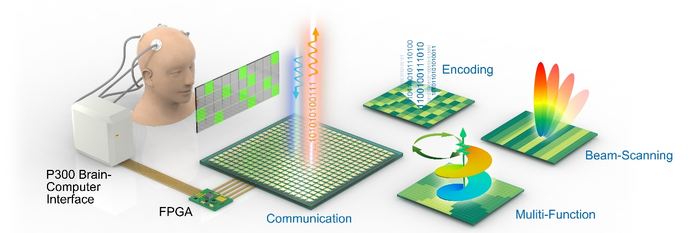
Credit: by Qian Ma, Wei Gao, Qiang Xiao, Lingsong Ding, Tianyi Gao, Yajun Zhou, Xinxin Gao, Tao Yan, Che Liu, Ze Gu, Xianghong Kong, Qammer H. Abbasi, Lianlin Li, Cheng-Wei Qiu, Yuanqing Li and Tie Jun Cui
Recently, coding metasurfaces, incorporating active components, have enabled real-time and programmable controls over EM functionalities, which used to be static or quite limited in conventional passive counterparts. However, these kinds of metasurface still require the manual operations. To directly inspect and distinguish the human’s will, the brain-computer interface (BCI) is presented to establish the communication between brain and devices, offering a new control perspective for programmable metasurfaces. By collecting brain signals from the “special hat”, a BCI can decode operator’s intentions and send commands to the controlled objects, without any requirement for the operator’s muscle activity.
In a new paper published in eLight, a team of scientists, led by Professor Tie Jun Cui from State Key Laboratory of Millimeter Waves, Southeast University, China, and co-workers have developed an electromagnetic brain-computer-metasurface (EBCM) to flexibly and non-invasively control the information syntheses and wireless transmissions. The presented EBCM can not only translate the operator’s brain messages to EEG signals, and further into various EM commands, but also perform the wireless “mind-communication” between two operators. As shown in Fig. 1, a displayer is placed in front of the operator to show the related commands. By simply staring the desired command, the EBCM can understand the operator’s intention and realize the EM functions including visual-beam scanning, wave modulations, and pattern encoding.
The researchers designed and experimentally demonstrated the wireless text communication based on EBCM, as shown in Fig. 2. A text GUI is provided for the BCI operator, where the visual buttons are directly coded as a specific coding sequence consisting of ‘0’ and ‘1’. In the experiment, the single-beam mode with high gain and the random scattering mode with low gain are used to distinguish the amplitude of metasurface reflections, which correspond to codes “1” (high amplitude) and “0” (low amplitude), respectively, for wireless information transmission. As a demonstration of the prototype, the researchers demonstrated the wireless transmission of text from one operator to another in the EBCM communication system. Operator A, as the text sender, sends letters by visually looking at the character buttons on the EBCM GUI. When the target letter is decoded from the EEG signal, an ASCII-based encoding sequence is implemented on the FPGA to switch time-varying modes, manipulating the metasurface to send information into space, which is received, demodulated, and presented by another operator’s EBCM.
“The average inputting time of each character is about 5s using the P300-based BCI by a skillful BCI operator. It is possible to improve the text input speed by applying some quick-spelling paradigms. It is also worth mentioning that the P300-based BCIs yield great accuracies and robustness among various noninvasive BCIs” they added.
“The presented work, combining the EM wave space and BCI, may further open up a new direction to explore the deep integration of metasurface, human brain intelligence, and artificial intelligence, so as to build up new generations of bio-intelligent metasurface systems.” the scientists forecast.
Journal
eLight
DOI
10.1186/s43593-022-00019-x