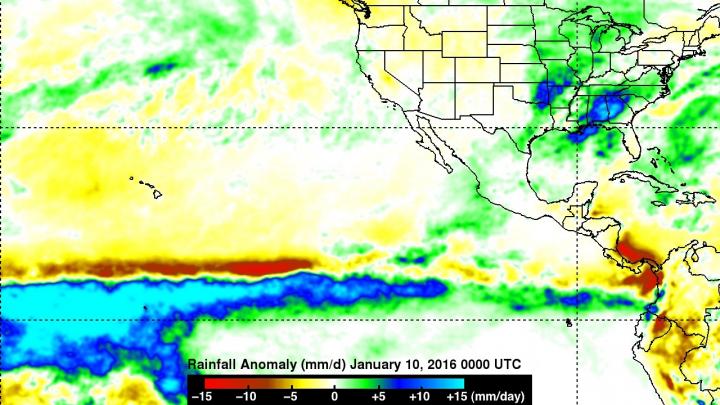
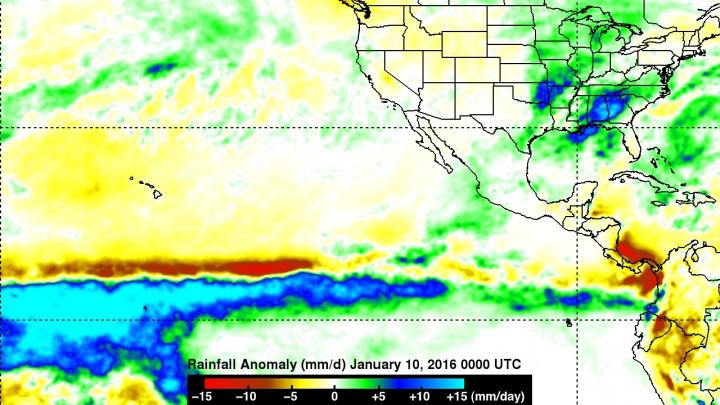
Credit: Credits: NASA/JAXA, Hal Pierce
California which has long been suffering through a strong, multi-year drought, is finally beginning to see some much needed relief as a result of a recent series of storms that are part of a weather pattern known as the "Pineapple Express."
The Pineapple Express is known as an atmospheric river. A large, slow-moving low pressure center off of the West Coast taps into tropical moisture originating from as far south as the Hawaiian Islands. This moisture is then channeled northeast by the subtropical jet steam towards the West Coast where the topography aids in squeezing out the moisture as air flows over the mountain ranges. Though these rains are certainly welcome and very much needed, they have also led to flooding and mudslides.
The first storm in the series arrived in the middle of last week, the week of January 2, and brought rain to northern and central California. The next storm occurred over the weekend of January 7 and 8 and brought heavy rains again to mostly northern and central California although southern California also received significant amounts. This event lead to widespread flooding, down trees and mudslides, especially in the Sierra Nevada where hurricane force winds occurred and Interstate 80 was closed due to a massive mudslide. Blizzard, winter storm, high wind, and flood warnings are already in effect as the third plume of moisture in this series is already making its way through the interior part of the state where several feet of snow are expected in the Sierra Nevada.
The TRMM-based, near-real time Multi-satellite Precipitation Analysis (TMPA) at the NASA Goddard Space Flight Center in Greenbelt, Maryland has been used to monitor rainfall over the global Tropics for many years. By subtracting the long-term average rainfall or climatology, rainfall anomalies can be constructed to show deviations from the normal pattern.
TRMM is the Tropical Rainfall Measuring Mission satellite that was in operation from 1997 to April 2015. It was designed to measure rainfall over the global Tropics using both passive and active sensors, including the first and at the time only precipitation radar in space. With its combination of passive microwave and active radar sensors, TRMM was used to calibrate rainfall estimates from other satellites to expand its coverage. TRMM's successor, the Global Precipitation Measurement mission or GPM core satellite was launched on February 27, 2014. TRMM and GPM are joint missions between NASA and the Japanese space agency JAXA.
The TMPA analysis was used to find rainfall anomalies for the one month period ending on January 10, 2017. During this period, higher-than-average precipitation extended from over and east of the Hawaiian Islands northeastward into California and covers most of the state, eastern Oregon and much of the northern Rockies. Embedded within this region are areas of much higher than average rainfall located northeast of Hawaii and over parts of central California with most of this due to the recent, ongoing atmospheric river event.
In contrast to the current situation, a 2016 analysis for the same time period showed average to slightly below average rainfall had fallen over the central and interior parts of California during this period. Also evident in the analysis is the well-pronounced, massive area of well above average rainfall associated with last year's El Nino where well above average sea surface temperatures stretched across the central, equatorial Pacific bringing much enhanced shower activity. That has now been replaced by La Nina conditions, which tend to suppress rainfall in this region as shown by this year's anomalies.
The current plume of moisture is expected to subside by this Friday with much drier conditions forecast for the weekend.
On Jan. 11, 2017 at 2:59 a.m. EST, the National Weather Service's Weather Prediction Center (NWS WPD) in College Park, Maryland noted "A series of Pacific storm systems will continue to impact the western U.S. with heavy rain and snow through the next couple days. One frontal system will move across the Great Basin toward the Rockies today, bringing widespread snow to much of the interior western U.S. Snow will persist across the central Rockies into Thursday as the front weakens overhead."
The second low pressure system is forecast to affect California by late in the day on January 13, when it is expected to generate rain and mountain snow. Snow is expected over much of the Great Basin on January 14 with scattered rain showers farther south over portions of the Southwest.
The potential for heavy rain and snow across the West will persist as these two systems traverse the region.
###
For updates from the NWS WPD, visit: http://www.weather.gov/
Media Contact
Rob Gutro
[email protected]
@NASAGoddard
http://www.nasa.gov/goddard
############
Story Source: Materials provided by Scienmag