KINGSTON, R.I.– June 8, 2022 — With an Early Career Award from the U.S. Department of Energy, a University of Rhode Island chemist will study a surprising chemical reaction that could be useful in releasing hydrogen for fuel cells.
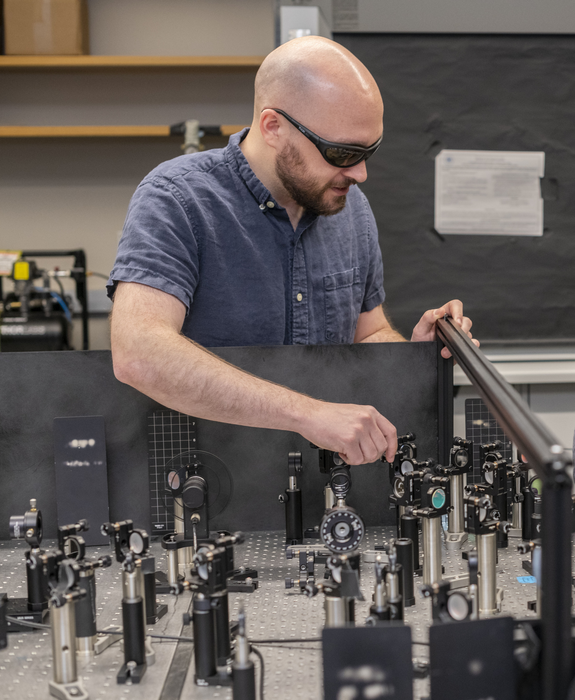
Credit: URI Photo/Mike Salerno
KINGSTON, R.I.– June 8, 2022 — With an Early Career Award from the U.S. Department of Energy, a University of Rhode Island chemist will study a surprising chemical reaction that could be useful in releasing hydrogen for fuel cells.
Dugan Hayes, an assistant professor of chemistry, is one of only 83 scientists nationwide chosen in this year’s round of Early Career Awards, which provide around $150,000 in research funding per year for five years.
Hayes’s research group specializes in photochemistry — reactions that occur in response to light. Perhaps the most well-known example of photochemistry is photosynthesis, the process through which plants convert light into the chemical energy they need to survive. But photochemical reactions are important in the biomedical industry, water purification, clean energy and elsewhere.
Hayes and his team work to understand the details of how these reactions take place.
“When a molecule absorbs light, there’s a huge number of processes that can happen,” he said. “There are physical processes in which bonds contract or elongate, and chemical processes where bonds are broken or new bonds are formed. Our goal is to figure out which processes happen in a given reaction, and the succession in which those steps occur.”
To do that, Hayes uses transient absorption spectroscopy, a technique involving a series of laser pulses fired at photoreactive molecules. An initial pulse spurs the photochemical reaction itself, while subsequent pulses probe the reaction steps as they play out. The key to the technique is that the laser pulses occur with amazing speed — one the order of a few quadrillionths of a second.
“These reactions happen really fast,” Hayes said. “If you want to see what’s happening, you need a camera shutter that’s at least that fast, and that’s what these laser pulses can do.”
By understanding each step of the reaction, Hayes says, it might be possible to optimize those reactions to produce more desirable reaction products more efficiently. Hayes is particularly interested in optimizing reactions that take place in the harvesting of solar energy and other clean energy applications.
Under the new award, Hayes will use the technique to study a surprising chemical reaction that he and Carson Hasselbrink, a Ph.D. student in the Department of Chemistry at URI who will be graduating in the fall, stumbled upon somewhat by accident.
Hayes and Hasselbrink were studying a reaction reported in the scientific literature that uses light to make important aromatic compounds. Hayes and Hasselbrink were interested in better understanding how the reaction works, but they needed to tweak it slightly to make it amenable to their laser technique. When they performed the modified reaction using a light-absorbing dye molecule called anthracene, they found that it produced reaction products no one had noticed before. In addition to the expected products, a subsequent reaction occurred creating compounds known as aldehydes — a process that involves the release of hydrogen gas.
“Basically, we showed that when you shine light on this molecule, which is readily available from any chemical supplier, it releases hydrogen gas — something that no one had noticed before,” Hayes said. “That’s pretty exciting from the standpoint of hydrogen fuel cells. It means that this molecule can store hydrogen in solid form at room temperature and atmospheric pressure and then release it for use in fuel cells just by shining light on it.”
Finding ways of storing hydrogen is one of the big issues that needs to be addressed if hydrogen fuel cells are to power cars and trucks. Hydrogen gas is not very energy dense — meaning it requires huge tanks to store enough to run a fuel cell. Storing hydrogen as a liquid requires less space, but liquid hydrogen must be kept at temperatures approaching absolute zero. However, if hydrogen could be stored as a solid and released on-demand through a photochemical reaction, that could be a boon for hydrogen energy, Hayes said.
In addition, anthracene is sourced from coal waste products. Putting those pollutants to good use gives this reaction further clean energy appeal.
Over the next five years, Hayes and his students will study this reaction using the ultrafast laser technique. The aim is to better understand how it works, and hopefully find ways to optimize it. Hayes is hopeful that this reaction could lead to a future breakthrough in clean energy, but for now he’s looking forward to understanding the basic chemistry behind it.
“Most photochemical reactions are pretty well-known, but this is something completely new,” Hayes said. “As a chemist, that’s a really exciting thing.”
# # #