Solar energy is a popular candidate for a sustainable alternative to fossil fuels. A solar cell, or photovoltaic (PV) cell, converts sunlight directly into electricity. However, the conversion efficiency has not been enough to enable widespread applications of solar cells.
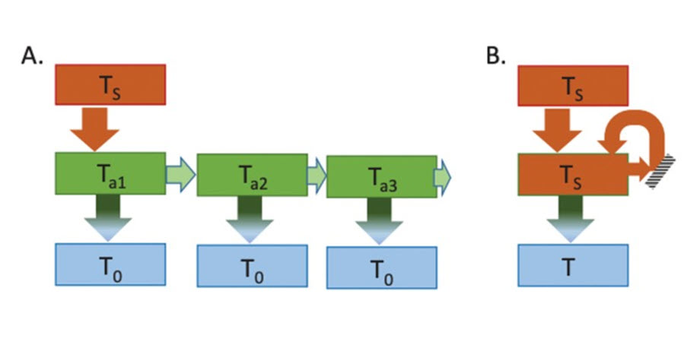
Credit: Sergeev and Sablon, doi 10.1117/1.JPE.12.032207.
Solar energy is a popular candidate for a sustainable alternative to fossil fuels. A solar cell, or photovoltaic (PV) cell, converts sunlight directly into electricity. However, the conversion efficiency has not been enough to enable widespread applications of solar cells.
A fundamental limit to the maximum efficiency of PV devices is given by thermodynamic characteristics, namely temperature and entropy (a measure of disorder in a system). More specifically, this limit, known as the Landsberg limit, is imposed by the entropy of the blackbody radiation that is often attributed to sunlight. The Landsberg limit is widely considered as the most general limit for the efficiency of any converter of sunlight.
Another limit, called the Shockley–Queisser (SQ) limit, comes from Kirchhoff’s law, which states that the absorptivity and emissivity should be equal for any photon energy and for any propagation direction. This is essentially the principle of “detailed balance” that has governed solar cell operation for decades. Kirchhoff’s law is, in fact, a consequence of what is called “time reversal symmetry.” One way to bypass the SQ limit is, therefore, to break this symmetry by allowing light to propagate only along one direction. Put simply, the SQ limit can be surpassed if the PV converter absorbs more and emits less radiation.
In a new study published in the Journal of Photonics for Energy (JPE), researchers Andrei Sergeev of the US Army Research Laboratory and Kimberly Sablon of Army Futures Command and Texas A&M University propose a way to break the SQ limit by utilizing “nonreciprocal photonic structures” that can drastically reduce emission from a PV converter without affecting its total light absorption.
The research explores a single-cell PV design integrated with nonreciprocal optical components to provide a 100-percent reuse of the emitted radiation by the same cell due to nonreciprocal photon recycling. This is in contrast with previous designs, which considered a PV converter with several multijunction cells, arranged in such a way that the light emitted by one cell was absorbed by another.
Following the seminal works of Lorentz, von Laue, Einstein, Landau, Brillouin, and Schrödinger, Sergeev and Sablon also discuss sunlight entropy in terms of coherence, relativity, nonequilibrium distributions, disorder, information, and negentropy. The authors observe that, contrary to the strongly disordered radiation inside the sun, photons in sunlight move along straight lines in a narrow solid angle. For Sergeev and Sablon, this observation suggests that sunlight provides us with real green power and its conversion efficiency only depends on how we will convert it.
The authors showed that for a quasimonochromatic radiation, the nonreciprocal single cell PV converter reached the theoretically maximum “Carnot efficiency,” the efficiency of an ideal heat engine, which exceeds the Landsberg limit. This was also the case for multicolor radiation (characteristic of sunlight).
Interestingly, this helped resolve a thermodynamic paradox related to an optical diode. The paradox stated that an optical diode could increase the temperature of the absorber above the sun temperature by allowing only one-way light propagation. This would violate the second law of thermodynamics. The study showed that an infinite number of photon recycling would be needed to reach the Carnot efficiency and, thus, violate the law.
Additionally, the researchers generalized the thermodynamic considerations to nonequilibrium photon distributions with light-induced nonzero chemical potential and derived the limiting efficiency of a nonreciprocal single-cell PV converter.
“This research was motivated by fast progress in nonreciprocal optics and by development of low-cost photovoltaic materials with high quantum efficiency,” says Sergeev, citing perovskite materials in particular and noting, “Weak nonradiative recombination in these materials would allow for advanced improvement of PV conversion via management of radiative processes.”
With nonreciprocal photonic structures on the rise, the development of high-efficiency PV converters may be expected in the near future. As the hunt for sustainable solutions to the world’s energy crisis continues, this study provides much hope for solar cell technology.
Read the Gold Open Access article by Sergeev and Sablon, “Nonreciprocal photonic management for photovoltaic conversion: design and fundamental efficiency limits,” J. Photon. Energy 12(3), 032207 (2022), doi 10.1117/1.JPE.12.032207. The article is part of a JPE Special Section on Novel Photovoltaic Device Architectures, guest edited by Fatima Toor and Ian Sellers.
Journal
Journal of Photonics for Energy
DOI
10.1117/1.JPE.12.032207
Article Title
Nonreciprocal photonic management for photovoltaic conversion: design and fundamental efficiency limits
Article Publication Date
1-Jun-2022