West Virginia University researchers are working to better understand how climate change may make an impact on a bioenergy crop that flourishes on reclaimed mining lands.
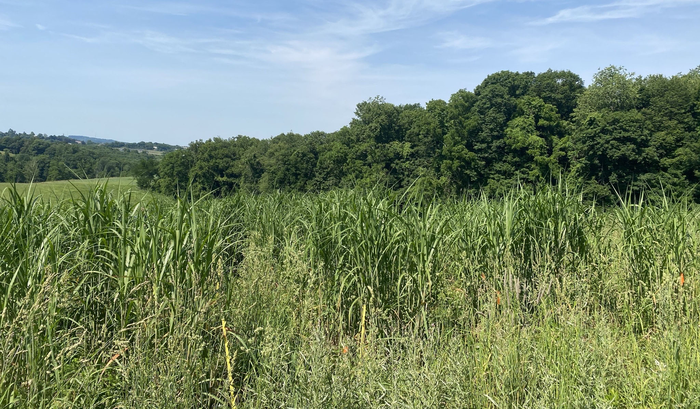
Credit: Submitted photo/Jenni Kane
West Virginia University researchers are working to better understand how climate change may make an impact on a bioenergy crop that flourishes on reclaimed mining lands.
Previously living materials, including perennial grasses like Miscanthus x giganteus, produce bioenergy. Ember Morrissey, associate professor of environmental microbiology in the Davis College of Agriculture, Natural Resources and Design, is examining the symbiotic relationship between microbes and this type of tall grass to prepare for climate change and decreasing fossil fuel usage.
The research group includes Jeff Skousen, professor of soil science, Louis McDonald, professor of environmental soil chemistry and soil fertility, and Jenni Kane, a doctoral student in plant and soil sciences.
Skousen, an expert in soil reclamation, helped Morrissey establish miscanthus stands on marginal soil for research over the next five years funded with a more than $817,000 grant from the National Institute of Food and Agriculture.
The goal is to determine if fertilization will weaken the relationship between the plant and its microbes and then determine the best way to manage the plant in unpredictable climates.
“If there’s something like a drought, then suddenly water is very limited,” Morrissey said. “Because the plant hasn’t formed those close ties with the microbes that allow it to have enhanced water uptake, it might not perform as well.”
Morrissey, Skousen, McDonald and Kane have miscanthus growing at two research centers in Morgantown. They will also use Skousen’s long-term sites of marginal land in Appalachia where miscanthus has been growing for up to 15 years.
They’re working to determine the ability of miscanthus to regenerate the damaged soils of Appalachia, which earlier studies demonstrated is possible. Production on marginal land can help improve soil health and isolate soil carbon, restoring the land and mitigating climate change.
Having grown up in the southern coalfields of West Virginia, Kane saw the impact damaged mine lands have on communities. Many people in West Virginia and throughout Appalachia own land unsuitable for crop cultivation because of past mining.
“Anyone could grow miscanthus on their land on a small scale or a larger scale,” Kane said. “This could become a crop that can be grown and sold. It could also bring back nutrients and soil structure, so the long-term impact could be economic and environmental.”
Skousen said his life’s goal is to find a way to use the hundreds of thousands of acres of reclaimed surface mines around West Virginia in a productive way to improve the state’s economy.
“We’re a little unique that we have these mined lands,” Skousen said. “We can utilize these lands that aren’t being used now and put carbon back into them. The better we can have plants grow and take CO2 from the air and put it into the ground, the better outcome we can have with climate change.”
Understanding the relationship between miscanthus and its microbes will help Morrissey and other scientists determine the optimal management practice in the future.
“If we are going to transition to using bioenergy, we need to make sure that we can make these crops reliably productive even under climate variability like drought,” Morrissey said.