New experiments conducted in mice add to mounting evidence in opposition to a popular claim that COVID-19 vaccination during early pregnancy may cause birth defects or fetal growth problems. The study also counters claims that COVID-19 vaccines reduce fertility through their effects on the protein syncytin-1. Alice Lu-Culligan of the Yale School of Medicine, US, and colleagues present these findings in the open-access journal PLOS Biology.
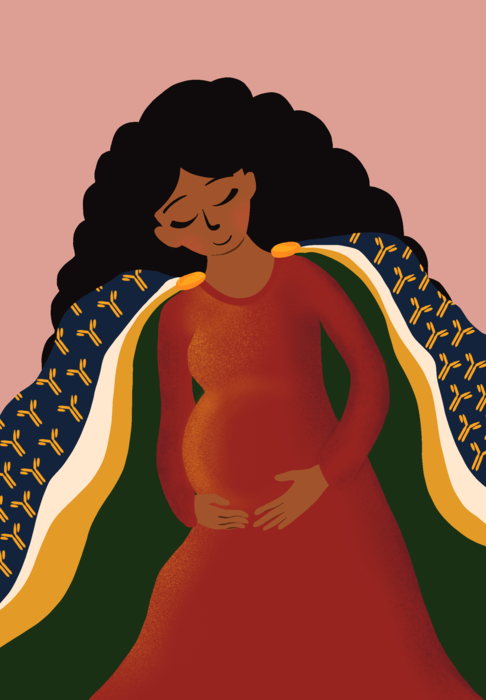
Credit: Hannah J. Lee (CC-BY 4.0, https://creativecommons.org/licenses/by/4.0/)
New experiments conducted in mice add to mounting evidence in opposition to a popular claim that COVID-19 vaccination during early pregnancy may cause birth defects or fetal growth problems. The study also counters claims that COVID-19 vaccines reduce fertility through their effects on the protein syncytin-1. Alice Lu-Culligan of the Yale School of Medicine, US, and colleagues present these findings in the open-access journal PLOS Biology.
Despite growing evidence that COVID-19 vaccination during pregnancy can benefit both mother and child, safety concerns are a significant cause of vaccine hesitancy. Popular claims in particular hold that vaccination during pregnancy could harm the fetus, and that vaccination prior to pregnancy could reduce female fertility.
To investigate those claims, Lu-Culligan and colleagues first conducted experiments in pregnant mice. They found that administering a COVID-19 vaccine early in pregnancy did not affect the size of the fetus, nor was it associated with any birth defects. In addition, they found that fetuses had high levels of antibodies against COVID-19 infection, suggesting that the protective effects of vaccination passed from pregnant mice to their fetuses. These findings are consistent with a growing body of data on pregnant humans reported by the US Centers for Disease Control and other research groups.
The scientists also injected other pregnant mice with a substance known as poly(I:C), which simulates viral infection; fetuses from these mice had reduced growth. Overall, the mouse experiments suggest that vaccination during pregnancy is safer for both mother and fetus than infection during pregnancy.
Next, the researchers collected blood samples from both vaccinated and unvaccinated human volunteers. They found that those who had been vaccinated did not have elevated levels of antibodies against the protein syncytin-1, suggesting that fears of reduced fertility due to COVID-19 vaccination’s effects on this protein are unfounded.
The authors note that, as more people are vaccinated and clinical trials progress, the resulting data will continue to help address widespread concerns about vaccination. In particular, they note, it will be useful to confirm that COVID-19 vaccination is safe at all stages of pregnancy.
“This work provides evidence in a mouse model that vaccination in early pregnancy does not harm fetal growth or development and instead protects the fetus throughout later stages of pregnancy,” Lu-Culligan adds. “It also directly challenges misinformation deterring many nonpregnant people from vaccination—we show that the antibodies generated by vaccination do not target a rumored placental protein and that these misconceptions around infertility are not supported by the data.”
#####
In your coverage, please use this URL to provide access to the freely available paper in PLOS Biology: http://journals.plos.org/plosbiology/article?id=10.1371/journal.pbio.3001506
Citation: Lu-Culligan A, Tabachnikova A, Pérez-Then E, Tokuyama M, Lee HJ, Lucas C, et al. (2022) No evidence of fetal defects or anti-syncytin-1 antibody induction following COVID-19 mRNA vaccination. PLoS Biol 20(5): e3001506. https://doi.org/10.1371/journal.pbio.3001506
Author Countries: United States, Dominican Republic, Canada
Funding: This work was supported by the National Institutes of Health (https://www.nih.gov/) grants F30HD093350 (ALC), T32GM007205 (ALC), and T32AI007019 (AT), and by the Howard Hughes Medical Institute (https://www.hhmi.org/) (AI). VSM is supported by the CAPES-Yale program (https://medicine.yale.edu/bbs/training/initiatives/capes/). The funders had no role in study design, data collection and analysis, decision to publish, or preparation of the manuscript.
Journal
PLoS Biology
DOI
10.1371/journal.pbio.3001506
Method of Research
Experimental study
Subject of Research
Animals
COI Statement
Competing interests: The authors have declared that no competing interests exist.