• HOME
  • NEWS
  • EXPLORE
    • CAREER
      • Companies
      • Jobs
    • EVENTS
    • iGEM
      • News
      • Team
    • PHOTOS
    • VIDEO
    • WIKI
  • BLOG
  • COMMUNITY
    • FACEBOOK
    • INSTAGRAM
    • TWITTER
Monday, August 31, 2026
BIOENGINEER.ORG
No Result
View All Result
  • Login
  • HOME
  • NEWS
  • EXPLORE
    • CAREER
      • Companies
      • Jobs
        • Lecturer
        • PhD Studentship
        • Postdoc
        • Research Assistant
    • EVENTS
    • iGEM
      • News
      • Team
    • PHOTOS
    • VIDEO
    • WIKI
  • BLOG
  • COMMUNITY
    • FACEBOOK
    • INSTAGRAM
    • TWITTER
  • HOME
  • NEWS
  • EXPLORE
    • CAREER
      • Companies
      • Jobs
        • Lecturer
        • PhD Studentship
        • Postdoc
        • Research Assistant
    • EVENTS
    • iGEM
      • News
      • Team
    • PHOTOS
    • VIDEO
    • WIKI
  • BLOG
  • COMMUNITY
    • FACEBOOK
    • INSTAGRAM
    • TWITTER
No Result
View All Result
Bioengineer.org
No Result
View All Result
Home NEWS Science News

Using E. coli to detect hormone disruptors in the environment

Bioengineer by Bioengineer
January 11, 2017
in Science News
Reading Time: 2 mins read
0
Share on FacebookShare on TwitterShare on LinkedinShare on RedditShare on Telegram
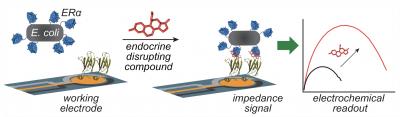
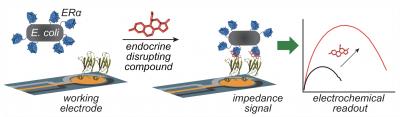
IMAGE

Credit: Please credit the American Chemical Society.

Endocrine disrupting chemicals (EDCs) have been implicated in the development of obesity, diabetes and cancer and are found in a wide array of products including pesticides, plastics and pharmaceuticals. EDCs are potentially harmful, even at low concentrations, equal in some cases to mere milligrams dissolved in in a swimming pool full of water. Now researchers report in ACS Central Science that they can quickly detect environmentally relevant concentrations of EDCs using engineered E. coli bacteria.

Detecting EDCs can be tough because the classification is based on their activity — disrupting hormone function — instead of their structures. Thus the term encompasses a broad spectrum of chemicals and often, health risks arise from aggregate exposure to several different species. Because many EDCs act on the same hormone receptors on a cell's surface, researchers have been developing tests that detect the compounds based on their ability to interfere with hormones. But these methods currently take days to produce a result or involve many complicated and expensive steps. Here, Matthew Francis and colleagues overcame these challenges by using E. coli in their device.

Non-toxic, dead E. coli cells display an estrogen receptor on the surface of the researchers' portable sensor. A protein on the sensor surface recognizes the EDC-E. coli complex, producing an electronic read-out in minutes. The inexpensive device can determine the concentration of many known EDCs individually and overall concentrations as mixtures. They tested the detection in water and in complex solutions like baby formula. It also can detect EDCs released into liquid from a plastic baby bottle following microwave heating. The team notes that their test is suitable for use in the field and can be modified to test for other types of chemicals that act on human receptors.

###

The authors acknowledge funding from the HoundLabs, the National Science Foundation and the Beckman Foundation.

The paper will be freely available on January 11th at this link: http://pubs.acs.org/doi/full/10.1021/acscentsci.6b00322

The American Chemical Society is a nonprofit organization chartered by the U.S. Congress. With nearly 157,000 members, ACS is the world's largest scientific society and a global leader in providing access to chemistry-related research through its multiple databases, peer-reviewed journals and scientific conferences. The American Chemical Society does not conduct research, but publishes and publicizes peer-reviewed scientific studies. Its main offices are in Washington, D.C., and Columbus, Ohio.

To automatically receive news releases from the American Chemical Society, contact [email protected].

Follow us: Twitter | Facebook

Media Contact

Katie Cottingham
[email protected]
301-775-8455
@ACSpressroom

http://www.acs.org

############

Story Source: Materials provided by Scienmag

Share12Tweet8Share2ShareShareShare2

Related Posts

β-Sitosterol from Ipomoea carnea Jacq. As a promising anti-inflammatory agent: Evidence from in silico modeling and in vitro validation

β-Sitosterol from Ipomoea carnea Jacq. As a promising anti-inflammatory agent: Evidence from in silico modeling and in vitro validation

August 31, 2026
Design, fabrication and characterization of a wearable Fiber Bragg grating sensor for cardiorespiratory monitoring using finger plethysmography

Design, fabrication and characterization of a wearable Fiber Bragg grating sensor for cardiorespiratory monitoring using finger plethysmography

August 31, 2026

KAIST opens the era of industrial-scale microbial foods, proposing growth strategies for the next-generation protein market

August 31, 2026

Virologist awarded $2 million NIH grant to investigate how virus-infected cells live and die

August 31, 2026
Please login to join discussion

POPULAR NEWS

  • β-Sitosterol from Ipomoea carnea Jacq. As a promising anti-inflammatory agent: Evidence from in silico modeling and in vitro validation

    29 shares
    Share 12 Tweet 7
  • Design, fabrication and characterization of a wearable Fiber Bragg grating sensor for cardiorespiratory monitoring using finger plethysmography

    29 shares
    Share 12 Tweet 7
  • KAIST opens the era of industrial-scale microbial foods, proposing growth strategies for the next-generation protein market

    29 shares
    Share 12 Tweet 7
  • Virologist awarded $2 million NIH grant to investigate how virus-infected cells live and die

    29 shares
    Share 12 Tweet 7

About

We bring you the latest biotechnology news from best research centers and universities around the world. Check our website.

Follow us

Recent News

β-Sitosterol from Ipomoea carnea Jacq. As a promising anti-inflammatory agent: Evidence from in silico modeling and in vitro validation

Design, fabrication and characterization of a wearable Fiber Bragg grating sensor for cardiorespiratory monitoring using finger plethysmography

KAIST opens the era of industrial-scale microbial foods, proposing growth strategies for the next-generation protein market

Subscribe to Blog via Email

Enter your email address to subscribe to this blog and receive notifications of new posts by email.

Join 85 other subscribers
  • Contact Us

Bioengineer.org © Copyright 2023 All Rights Reserved.

Welcome Back!

Login to your account below

Forgotten Password?

Retrieve your password

Please enter your username or email address to reset your password.

Log In
No Result
View All Result
  • Homepages
    • Home Page 1
    • Home Page 2
  • News
  • National
  • Business
  • Health
  • Lifestyle
  • Science

Bioengineer.org © Copyright 2023 All Rights Reserved.