• HOME
  • NEWS
  • EXPLORE
    • CAREER
      • Companies
      • Jobs
    • EVENTS
    • iGEM
      • News
      • Team
    • PHOTOS
    • VIDEO
    • WIKI
  • BLOG
  • COMMUNITY
    • FACEBOOK
    • INSTAGRAM
    • TWITTER
Sunday, May 24, 2026
BIOENGINEER.ORG
No Result
View All Result
  • Login
  • HOME
  • NEWS
  • EXPLORE
    • CAREER
      • Companies
      • Jobs
        • Lecturer
        • PhD Studentship
        • Postdoc
        • Research Assistant
    • EVENTS
    • iGEM
      • News
      • Team
    • PHOTOS
    • VIDEO
    • WIKI
  • BLOG
  • COMMUNITY
    • FACEBOOK
    • INSTAGRAM
    • TWITTER
  • HOME
  • NEWS
  • EXPLORE
    • CAREER
      • Companies
      • Jobs
        • Lecturer
        • PhD Studentship
        • Postdoc
        • Research Assistant
    • EVENTS
    • iGEM
      • News
      • Team
    • PHOTOS
    • VIDEO
    • WIKI
  • BLOG
  • COMMUNITY
    • FACEBOOK
    • INSTAGRAM
    • TWITTER
No Result
View All Result
Bioengineer.org
No Result
View All Result
Home NEWS Science News Chemistry

Biocompatible binary hologram with drug-elution capabilities

Bioengineer by Bioengineer
May 20, 2022
in Chemistry
Reading Time: 2 mins read
0
The main principles of binary hologram with drug-elution capabilities.
Share on FacebookShare on TwitterShare on LinkedinShare on RedditShare on Telegram

Holographic devices are used for security enhancement, entertainment, 3D display technologies and augmented reality but not limited to them. Due to their high information capacity, the ability to track ongoing external processes by assessing changes in the diffraction pattern, as well as well-established and simple methods for their production from various materials, holograms are finding new applications in various fields of science and life.
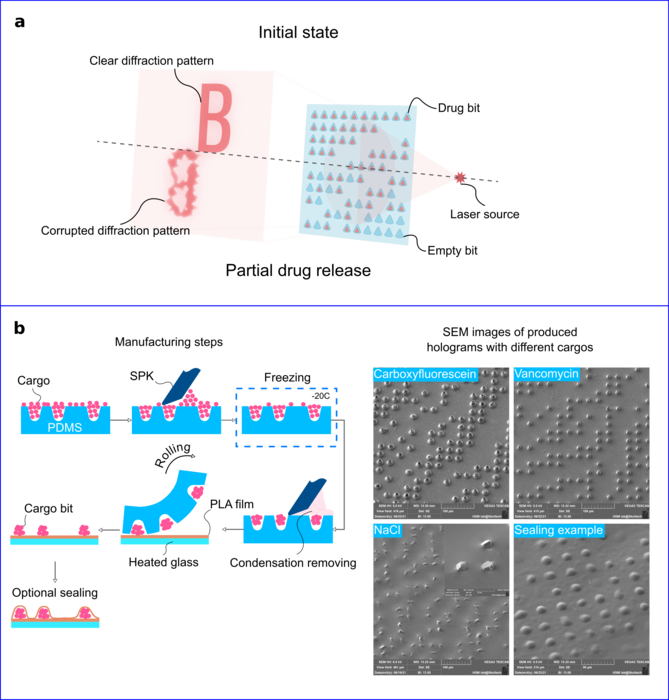
The main principles of binary hologram with drug-elution capabilities.

Credit: by Arkady S. Abdurashitov, Pavel I. Proshin, Valery V. Tuchinl Gleb Sukhorukov

Holographic devices are used for security enhancement, entertainment, 3D display technologies and augmented reality but not limited to them. Due to their high information capacity, the ability to track ongoing external processes by assessing changes in the diffraction pattern, as well as well-established and simple methods for their production from various materials, holograms are finding new applications in various fields of science and life.


In a new paper published in Light Science & Application, a team of scientists, led by Professor Gleb Sukhorukov from Laboratory of Remote Controlled Biomaterials, V. Zelman Center for Neurobiology and Brain Rehabilitation, Skolkovo Institute of Science and Technology, Moscow and co-workers have developed a new manufacturing routine and application of binary amplitude-only holograms. The proposed direct drug printing (DDP) technique works with water-soluble substances, but can be adapted to other types of drugs, if necessary. Numerically and experimentally, they have shown the ability of the diffraction pattern to reflect the amount of cargo remaining in the hologram after a certain amount of time. This unique feature of holographic packaging systems can potentially be used in a wide range of tasks requiring monitoring of the amount of emitted substance. Authors summarize their research as follows:

“We introduce an additive approach of producing bio-compatible DOEs using direct drug printing (DDP). Bio-active substances are hot-printed onto the surface of the flat polymer film as cargo bits. Spatial distribution of cargo bits forms the precomputed DOE. In our approach, the bioactive substance does not interact with any organic solvents and is placed “as is” onto the inert biopolymer, ensuring no changes in the pharmacological effect of the drug” the scientists forecast.

“The resulted film acts as a transmissive amplitude-only hologram. This cargo packaging system, that creates a clear far-field diffraction pattern when illuminated by a coherent light source, can find its place in various biomedical problems. One direct applications of payload holograms is tracking the lifespan of colorless content and measurement of the characteristic release time of active substances under various environmental conditions. The most likely application of our technology is to complement the standard antibiotic testing procedure. Adding a visual channel for tracking the drug release, which requires only the presence of a coherent light source, will significantly improve the assessment of the effect of the antibiotic and allow to control visually the release time and amount of eluted cargo” they added.


Journal

Light: Advanced Manufacturing

DOI

10.37188/lam.2022.030

Share12Tweet8Share2ShareShareShare2

Related Posts

Study Reveals How Valproate Affects Early Brain Development: Insights into the Antiepileptic Drug’s Impact — Chemistry

Study Reveals How Valproate Affects Early Brain Development: Insights into the Antiepileptic Drug’s Impact

May 22, 2026
Sustainable Chemistry: Iron Replaces Noble Metals in Catalytic Reactions — Chemistry

Sustainable Chemistry: Iron Replaces Noble Metals in Catalytic Reactions

May 22, 2026

Advancing Thin-Film Device Manufacturing with Imaging Ellipsometry for Enhanced Process Control

May 22, 2026

Simple Adjustment in 3D Printing Enhances Fit of Dental Crowns

May 22, 2026

POPULAR NEWS

  • ESMO 2025: mRNA COVID Vaccines Enhance Efficacy of Cancer Immunotherapy

    313 shares
    Share 125 Tweet 78
  • New Study Reveals Plants Can Detect the Sound of Rain

    734 shares
    Share 293 Tweet 183
  • Research Indicates Potential Connection Between Prenatal Medication Exposure and Elevated Autism Risk

    847 shares
    Share 339 Tweet 212
  • Common Food Preservatives Associated with Elevated Blood Pressure and Increased Heart Disease Risk

    55 shares
    Share 22 Tweet 14

About

We bring you the latest biotechnology news from best research centers and universities around the world. Check our website.

Follow us

Recent News

Predicting Flashover on Polluted Insulators with CNN-LSTM

Sepsis from C. difficile Infection Has Comparable Mortality

Mortality Trends in Dallas Very Preterm Neonates, 1977–2024

Subscribe to Blog via Email

Enter your email address to subscribe to this blog and receive notifications of new posts by email.

Join 83 other subscribers
  • Contact Us

Bioengineer.org © Copyright 2023 All Rights Reserved.

Welcome Back!

Login to your account below

Forgotten Password?

Retrieve your password

Please enter your username or email address to reset your password.

Log In
No Result
View All Result
  • Homepages
    • Home Page 1
    • Home Page 2
  • News
  • National
  • Business
  • Health
  • Lifestyle
  • Science

Bioengineer.org © Copyright 2023 All Rights Reserved.