• HOME
  • NEWS
  • EXPLORE
    • CAREER
      • Companies
      • Jobs
    • EVENTS
    • iGEM
      • News
      • Team
    • PHOTOS
    • VIDEO
    • WIKI
  • BLOG
  • COMMUNITY
    • FACEBOOK
    • INSTAGRAM
    • TWITTER
Monday, August 17, 2026
BIOENGINEER.ORG
No Result
View All Result
  • Login
  • HOME
  • NEWS
  • EXPLORE
    • CAREER
      • Companies
      • Jobs
        • Lecturer
        • PhD Studentship
        • Postdoc
        • Research Assistant
    • EVENTS
    • iGEM
      • News
      • Team
    • PHOTOS
    • VIDEO
    • WIKI
  • BLOG
  • COMMUNITY
    • FACEBOOK
    • INSTAGRAM
    • TWITTER
  • HOME
  • NEWS
  • EXPLORE
    • CAREER
      • Companies
      • Jobs
        • Lecturer
        • PhD Studentship
        • Postdoc
        • Research Assistant
    • EVENTS
    • iGEM
      • News
      • Team
    • PHOTOS
    • VIDEO
    • WIKI
  • BLOG
  • COMMUNITY
    • FACEBOOK
    • INSTAGRAM
    • TWITTER
No Result
View All Result
Bioengineer.org
No Result
View All Result
Home NEWS Science News Chemistry

Meteorological mechanisms behind severe drought in southwestern China during spring 2021 differ from similar historical events

Bioengineer by Bioengineer
May 17, 2022
in Chemistry
Reading Time: 2 mins read
0
Wheat grain affected by drought.
Share on FacebookShare on TwitterShare on LinkedinShare on RedditShare on Telegram

Southwestern China (SWC) is a region on the southeastern side of the Tibetan Plateau, in which both southwesterly and southeasterly winds influence weather patterns during the summer monsoon period. Spring drought before the onset of the summer rainy season is common throughout SWC, which threatens local ecology, agriculture, and economic balance.
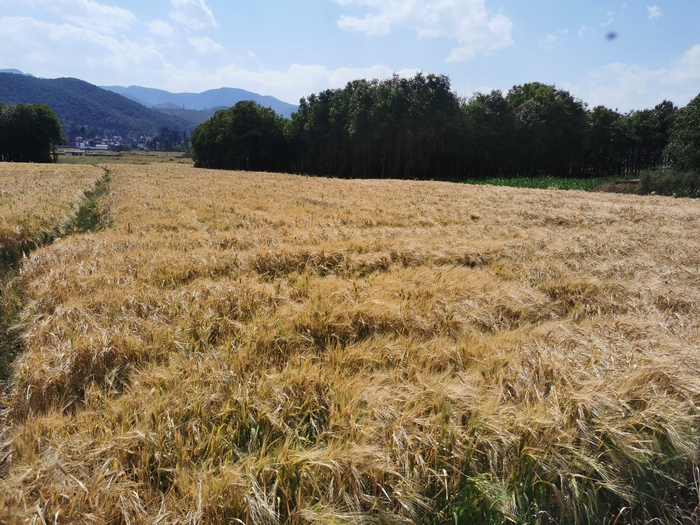
Wheat grain affected by drought.

Credit: Yong Zhu

Southwestern China (SWC) is a region on the southeastern side of the Tibetan Plateau, in which both southwesterly and southeasterly winds influence weather patterns during the summer monsoon period. Spring drought before the onset of the summer rainy season is common throughout SWC, which threatens local ecology, agriculture, and economic balance.

Due to the combined effects of deficient precipitation and high evaporation during the spring of 2021, SWC experienced extreme drought. To determine the meteorological mechanisms behind this severe season, international collaborators from world-renowned universities and research centers studied this extreme drought event. They found that climatic conditions during the extreme 2021 spring drought throughout SWC were distinct from similar historical events. Researchers published their full analysis in Advances in Atmospheric Sciences.

“This drought occurred in the decaying phase of a La Niña event with negative geopotential height anomalies over the Philippine Sea, which is distinct from the historical perspective.” said lead author Dr. Yunyun Liu from China Meteorological Administration. “Historically, spring drought over SWC is often linked to El Niño and strong western North Pacific subtropical high.”

Liu and her collaborators showed that the extreme drought in the spring of 2021 may be mainly driven by the atmospheric internal variability and amplified by the warming trend. Specifically, increased evaporation due to anomalous high temperatures contributed to about 30% of what made the drought so severe, with the contributions of its linear trend portion being nearly 20%, and the interannual variability portion being about 10%.

Dr. Zeng-Zhen Hu, a researcher with the National Centers for Environmental Prediction (NCEP) at NOAA in the United States further commented: “Since the sea surface temperature forcing from the tropical central and eastern Pacific played a minor role in the drought, it was challenging for a climate model to capture the 2021 SWC drought beyond one-month lead times.” Hu said, “Nevertheless, this study demonstrated a significant global climate warming impact on regional climate extreme events. Such an impact might be intertwined with complex ocean-land-atmosphere interactions.”

In addition, this study implies that a nonlinear relationship may exist between the SWC drought and tropical Pacific SST anomalies. Both El Niño and La Niña events can lead to drought in SWC through different mechanisms. The research team recommends further investigation through diagnosis and model experiments.

Citation: Liu, Y. Y., Z.-Z. Hu, R. G. Wu, and X. Yuan, 2022: Causes and Predictability of the 2021 Spring Southwestern China Severe Drought. Adv. Atmos. Sci., https://doi.org/10.1007/s00376-022-1428-4


Journal

Advances in Atmospheric Sciences

DOI

10.1007/s00376-022-1428-4

Article Title

Causes and Predictability of the 2021 Spring Southwestern China Severe Drought

Article Publication Date

11-May-2022

Share12Tweet8Share2ShareShareShare2

Related Posts

Butterfly-Inspired Technology Could Transform Air Quality Monitoring

August 15, 2026
Artesunate Targets GBA, Triggering Apoptosis in Liver Cancer Cells

Artesunate Targets GBA, Triggering Apoptosis in Liver Cancer Cells

August 15, 2026

New molecule may enable cleaner, more efficient metal recovery

August 15, 2026

Controlled sulfidation enhances supercapacitor electrode performance

August 15, 2026

POPULAR NEWS

  • Pilot Study Examines Personal Care Use, Social Media Engagement Among NJ Students

    29 shares
    Share 12 Tweet 7
  • KAIST develops semiconductor neuron that harnesses noise to selectively process signals

    29 shares
    Share 12 Tweet 7
  • Imagining natural and extra robotic thumbs together strengthens kinesthetic sensorimotor networks

    29 shares
    Share 12 Tweet 7
  • PARP1 Drives Neuropathic Pain Through GPX4-Dependent Ferroptosis in Injured Mice’s Sensory Neurons

    29 shares
    Share 12 Tweet 7

About

We bring you the latest biotechnology news from best research centers and universities around the world. Check our website.

Follow us

Recent News

Pilot Study Examines Personal Care Use, Social Media Engagement Among NJ Students

KAIST develops semiconductor neuron that harnesses noise to selectively process signals

Imagining natural and extra robotic thumbs together strengthens kinesthetic sensorimotor networks

Subscribe to Blog via Email

Enter your email address to subscribe to this blog and receive notifications of new posts by email.

Join 85 other subscribers
  • Contact Us

Bioengineer.org © Copyright 2023 All Rights Reserved.

Welcome Back!

Login to your account below

Forgotten Password?

Retrieve your password

Please enter your username or email address to reset your password.

Log In
No Result
View All Result
  • Homepages
    • Home Page 1
    • Home Page 2
  • News
  • National
  • Business
  • Health
  • Lifestyle
  • Science

Bioengineer.org © Copyright 2023 All Rights Reserved.