It’s often said that a little stress can be good for you. Now scientists have shown that the same may be true for cells, uncovering a newly-discovered mechanism that might help prevent the build-up of tangles of proteins commonly seen in dementia.
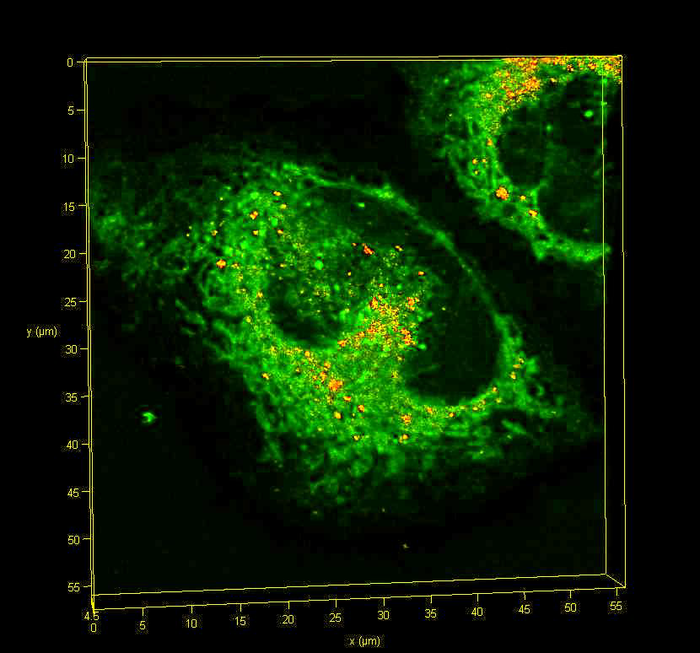
Credit: Edward Avezov/University of Cambridge
It’s often said that a little stress can be good for you. Now scientists have shown that the same may be true for cells, uncovering a newly-discovered mechanism that might help prevent the build-up of tangles of proteins commonly seen in dementia.
A characteristic of diseases such as Alzheimer’s and Parkinson’s – collectively known as neurodegenerative diseases – is the build-up of misfolded proteins. These proteins, such as amyloid and tau in Alzheimer’s disease, form ‘aggregates’ that can cause irreversible damage to nerve cells in the brain.
Protein folding is a normal process in the body, and in healthy individuals, cells carry out a form of quality control to ensure that proteins are correctly folded and that misfolded proteins are destroyed. But in neurodegenerative diseases, this system becomes impaired, with potentially devastating consequences.
As the global population ages, an increasing number of people are being diagnosed with dementia, making the search for effective drugs ever more urgent. However, progress has been slow, with no medicines yet available that can prevent or remove the build-up of aggregates.
In a study published today in Nature Communications, a team led by scientists at the UK Dementia Research Institute, University of Cambridge, has identified a new mechanism that appears to reverse the build-up of aggregates, not by eliminating them completely, but rather by ‘refolding’ them.
“Just like when we get stressed by a heavy workload, so, too, cells can get ‘stressed’ if they’re called upon to produce a large amount of proteins,” explained Dr Edward Avezov from the UK Dementia Research Institute at the University of Cambridge.
“There are many reasons why this might be, for example when they are producing antibodies in response to an infection. We focused on stressing a component of cells known as the endoplasmic reticulum, which is responsible for producing around a third of our proteins – and assumed that this stress might cause misfolding.”
The endoplasmic reticulum (ER) is a membrane structure found in mammalian cells. It carries out a number of important functions, including the synthesis, folding, modification and transport of proteins needed on the surface or outside the cell. Dr Avezov and colleagues hypothesised that stressing the ER might lead to protein misfolding and aggregation by diminishing its ability to function correctly, leading to increased aggregation.
They were surprised to discover the opposite was true.
“We were astonished to find that stressing the cell actually eliminated the aggregates – not by degrading them or clearing them out, but by unravelling the aggregates, potentially allowing them to refold correctly,” said Dr Avezov.
“If we can find a way of awakening this mechanism without stressing the cells – which could cause more damage than good – then we might be able to find a way of treating some dementias.”
The main component of this mechanism appears to be one of a class of proteins known as heat shock proteins (HSPs), more of which are made when cells are exposed to temperatures above their normal growth temperature, and in response to stress.
Dr Avezov speculates that this might help explain one of the more unusual observations within the field of dementia research. “There have been some studies recently of people in Scandinavian countries who regularly use saunas, suggesting that they may be at lower risk of developing dementia. One possible explanation for this is that this mild stress triggers a higher activity of HSPs, helping correct tangled proteins.”
One of the factors that has previous hindered this field of research has been the inability to visualise these processes in live cells. Working with teams from Pennsylvania State University and the University of Algarve, the team has developed a technique that allows them to detect protein misfolding in live cells. It relies on measuring light patterns of a glowing chemical over a scale of nanoseconds – one billionth of a second.
“It’s fascinating how measuring our probe’s fluorescence lifetime on the nanoseconds scale under a laser-powered microscope makes the otherwise invisible aggregates inside the cell obvious,” said Professor Eduardo Melo, one of the leading authors, from the University of Algarve, Portugal.
The research was supported by the UK Dementia Research Institute, which receives its funding from the Medical Research Council, Alzheimer’s Society and Alzheimer’s Research UK, as well as the Portuguese Foundation for Science and Technology.
Reference
Melo, EP, et al. Stress-induced protein disaggregation in the Endoplasmic Reticulum catalysed by BiP. Nature Comms; 6 May 2022; DOI: 10.1038/s41467-022-30238-2
Journal
Nature Communications
DOI
10.1038/s41467-022-30238-2
Method of Research
Experimental study
Subject of Research
Cells
Article Title
Stress-induced protein disaggregation in the Endoplasmic Reticulum catalysed by BiP.
Article Publication Date
6-May-2022