Restricting US foreign aid for non-governmental organizations (NGOs) that provide information on or access to abortion-related services in developing countries may have harmful effects on maternal and child mortality and HIV incidence rates on the same scale as an ongoing civil conflict.
Credit: Weiwei Chen
Restricting US foreign aid for non-governmental organizations (NGOs) that provide information on or access to abortion-related services in developing countries may have harmful effects on maternal and child mortality and HIV incidence rates on the same scale as an ongoing civil conflict.
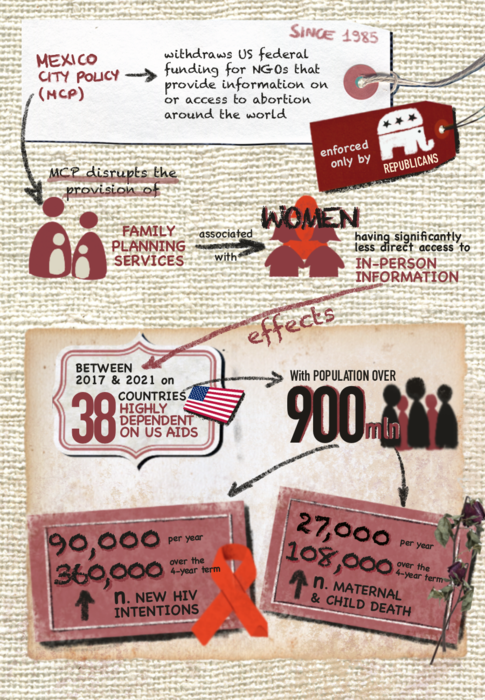
In a paper published on PNAS, Kerim Can Kavakli (Bocconi University, Milan) and Valentina Rotondi (SUPSI and University of Oxford) investigate the effects of the so-called Mexico City Policy (MCP). Since its inception in 1985, the MCP withdraws US federal funding for NGOs that provide information on or access to abortion around the world. “MCP is enforced and rescinded along partisan lines. It is one of the first policies implemented or continued by every Republican president and lifted by every Democratic president, usually in the first week of a new administration,” Kavakli and Rotondi said.
Previous studies have analyzed abortion rates under the MCP and found that, when the MCP is in place, the number of pregnancies and abortions increases. Kavakli and Rotondi study the link between the MCP and a broad set of health outcomes.
Using country-level data from 134 countries between 1990-2015, Kavakli and Rotondi find MCP to be associated with higher maternal mortality, child mortality, and HIV incidence rates. Furthermore, the effects are magnified by dependency on US aid and mitigated by aid from non-US donors, whose support is unaffected by the MCP.
For a subsample of 38 countries (population over 900mln) highly dependent on US aid, the effects imply between 1 and 4 percent increase in maternal and child mortality and HIV incidence rates. “Such figures are comparable to the effect of an ongoing civil conflict in a country,” Rotondi said.
In absolute numbers, the estimates imply that re-instating MCP between 2017 and 2021 increased the number of maternal and child deaths in these 38 countries by about 27,000 per year and a total of 108,000 over the four-year term, and the number of new HIV infections by about 90,000 per year, and 360,000 over the four years.
The authors complement these results using individual-level data from 30 low and middle-income countries to better understand the mechanisms that lead to such detrimental effects.
They find that the MCP disrupts the provision of family planning services in affected countries and is thus associated with women having significantly less direct access to in-person family planning programs and in-person AIDS-related information.
Furthermore, when MCP is in place, women are less likely to declare that they are using modern contraceptive methods, and pregnant women are more likely to report that their pregnancy is not desired. Newborns are less likely to be tested for HIV as a part of the antenatal care, and their mothers are less likely to receive health support from professional health staff after delivery.
“We conclude that by restricting access to family planning programs, the MCP makes it harder for people to get information and support on sexual and reproductive health, which results in higher maternal and child mortality as well as HIV incidence around the globe,” the authors said.
Journal
Proceedings of the National Academy of Sciences
Article Title
US foreign aid restrictions, maternal and children’s health: Evidence from the “Mexico City Policy”
Article Publication Date
2-May-2022