Newcastle University scientists have found new types of plastic loving bacteria that stick to plastic in the deep sea that may enable them to ‘hitchhike’ across the ocean.
Credit: Newcastle University
Newcastle University scientists have found new types of plastic loving bacteria that stick to plastic in the deep sea that may enable them to ‘hitchhike’ across the ocean.
The team showed for the first time that these deep-sea, plastic loving bacteria make up only 1% of the total bacterial community. Reporting their findings in the journal Environmental Pollution, the team found that these bacteria only stick to plastic and not the non-plastic control of stone.
The research highlights these bacteria may be able to ‘hitchhike’ across the deep sea by attaching to plastic, enhancing microbial connectivity across seemingly isolated environments.
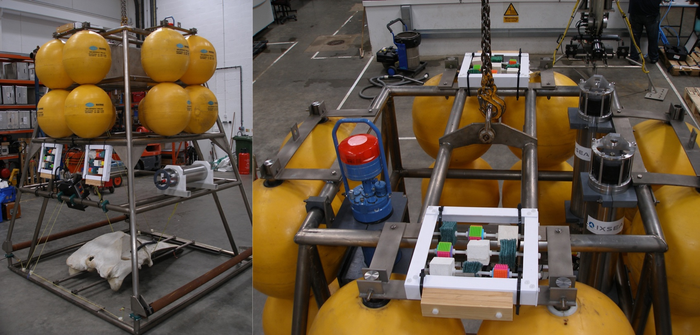
To uncover these mysteries of the deep-sea ‘plastisphere’, the team used a deep-sea ‘lander’ in the North-East Atlantic to deliberately sink two types of plastic, polyurethane and polystyrene, in the deep (1800m) and then recover the material to reveal a group of plastic loving bacteria. This method helps tackle the issue of how plastics and subsequently, our understanding of the ‘plastisphere’ (microbial community attached to plastic) are sampled in the environment to provide consistent results.
The scientists observed a mix of diverse and extreme living bacteria, including Calorithrix, which is also found in deep-sea hydrothermal vent systems and Spirosoma, which has been isolated from the Arctic permafrost. Other bacteria included the Marine Methylotrophic Group 3 – a group of bacteria isolated from deep-sea methane seeps, and Aliivibrio, a pathogen that has negatively affected the fish farming industry, highlighting a growing concern for the presence of plastic in the ocean.
In their most recent work, they have also found a strain originally isolated from RMS Titanic named Halomonas titanicae. While the rust-eating microbe was originally found on the shipwreck, the researchers have now shown it also loves to stick to plastic and is capable of low crystallinity plastic degradation.
The research was led by Max Kelly, a PhD student at Newcastle University’s School of Natural and Environmental Sciences.
He said: “The deep sea is the largest ecosystem on earth and likely a final sink for the vast majority of plastic that enters the marine environment, but it is a challenging place to study. Combining deep-sea experts, engineers, and marine microbiologists, our team is helping to elucidate the bacterial community that can to stick to plastic to reveal the final fate of deep-sea plastic.”
Microplastics (fragments with a diameter smaller than 5mm) make up 90% of the plastic debris found at the ocean surface and the amount of plastic entering our ocean is significantly larger than the estimates of floating plastic on the surface of the ocean. Although the plastic loving bacteria found in the study here represent a small fraction of the community colonising plastic, they highlight the emerging ecological impacts of plastic pollution in the environment.
Reference:
Kelly, M., Whitworth, P., Jamieson, A., & Burgess, J. (2022). Bacterial colonisation of plastic in the Rockall Trough, North-East Atlantic: An improved understanding of the deep-sea plastisphere. Environmental Pollution, 119314. doi: 10.1016/j.envpol.2022.119314
Journal
Environmental Pollution
DOI
10.1016/j.envpol.2022.119314
Method of Research
Observational study
Subject of Research
Not applicable
Article Title
Bacterial colonisation of plastic in the Rockall Trough, North-East Atlantic: An improved understanding of the deep-sea plastisphere
Article Publication Date
29-Apr-2022