• HOME
  • NEWS
  • EXPLORE
    • CAREER
      • Companies
      • Jobs
    • EVENTS
    • iGEM
      • News
      • Team
    • PHOTOS
    • VIDEO
    • WIKI
  • BLOG
  • COMMUNITY
    • FACEBOOK
    • INSTAGRAM
    • TWITTER
Saturday, February 7, 2026
BIOENGINEER.ORG
No Result
View All Result
  • Login
  • HOME
  • NEWS
  • EXPLORE
    • CAREER
      • Companies
      • Jobs
        • Lecturer
        • PhD Studentship
        • Postdoc
        • Research Assistant
    • EVENTS
    • iGEM
      • News
      • Team
    • PHOTOS
    • VIDEO
    • WIKI
  • BLOG
  • COMMUNITY
    • FACEBOOK
    • INSTAGRAM
    • TWITTER
  • HOME
  • NEWS
  • EXPLORE
    • CAREER
      • Companies
      • Jobs
        • Lecturer
        • PhD Studentship
        • Postdoc
        • Research Assistant
    • EVENTS
    • iGEM
      • News
      • Team
    • PHOTOS
    • VIDEO
    • WIKI
  • BLOG
  • COMMUNITY
    • FACEBOOK
    • INSTAGRAM
    • TWITTER
No Result
View All Result
Bioengineer.org
No Result
View All Result
Home NEWS Science News

New species of ground beetle described from a 147-year-old specimen

Bioengineer by Bioengineer
January 10, 2017
in Science News
Reading Time: 2 mins read
0
Share on FacebookShare on TwitterShare on LinkedinShare on RedditShare on Telegram
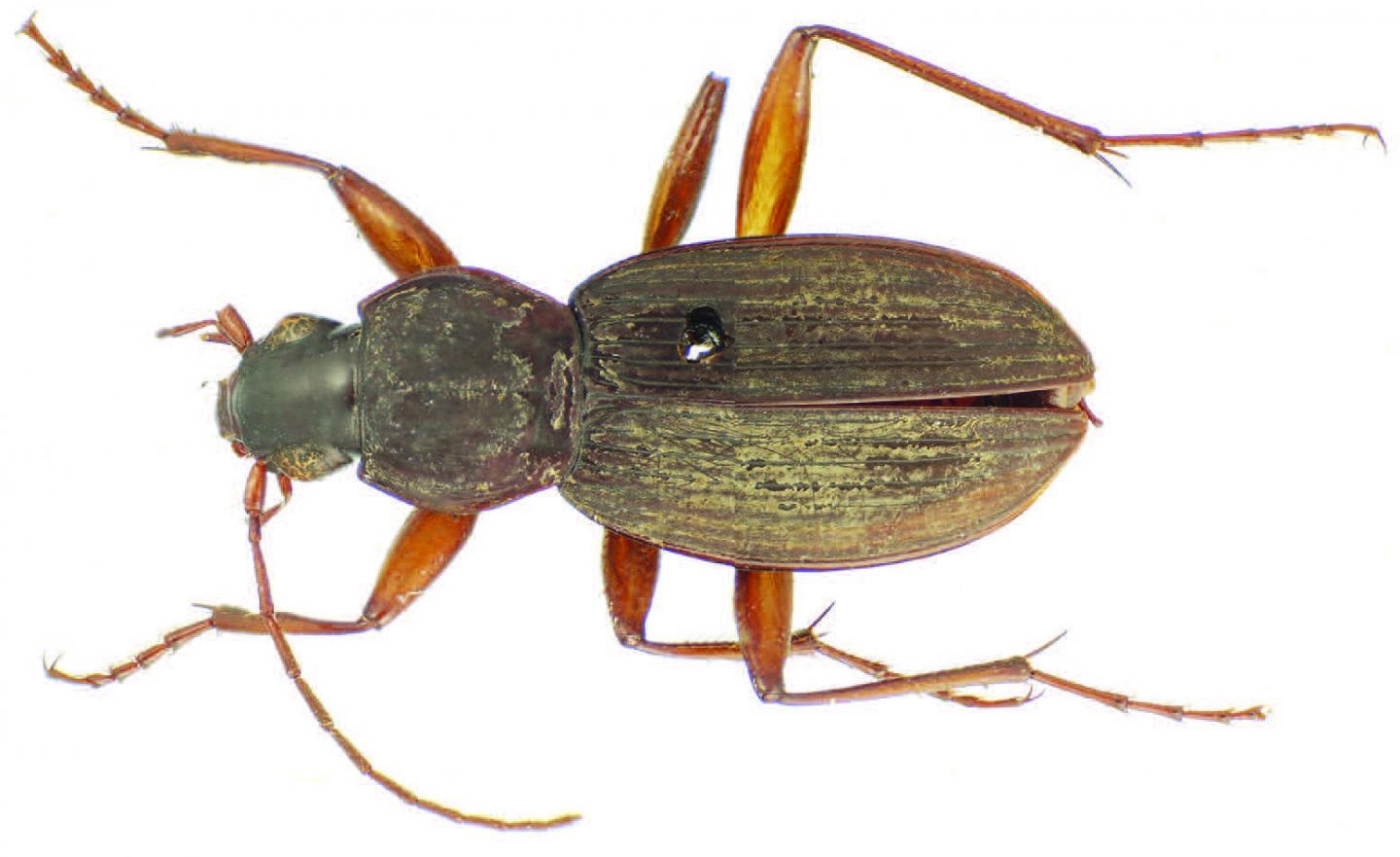
IMAGE

Credit: James K. Liebherr

While new species are most commonly described based on recent field collections, undertaken at poorly explored places, some are identified in museum collections, where they have spent decades before being recognised as new to science. Such is the case of an unusually large and likely extinct ground beetle found at the Muséum national d'Histoire naturelle, Paris, whose story began in the distant 1860s with Dr. Eduard Graeffe's trip to Samoa. Now, a century and a half later, the beetle is finally described by Dr. James K. Liebherr, Cornell University, USA, in the open access journal Zoosystematics and Evolution.

Much like the rest of the species within the genus, the beetle now going under the name Bryanites graeffi showed vestigial flight wings and other traits associated with flight-wing loss. However, at length of 16.2 mm it is the largest for the taxonomic group it is now assigned to. Although this may seem way too obvious for taxonomists to overlook, the beetle's relatives are just as obscure. The Bryanites genus was previously known from two species represented by two specimens only, collected in 1924 from Savai?i Island by Edwin H. Bryan, Jr., Bernice P. Bishop Museum in Honolulu, during the Bishop Museum's Whitney South Seas Expedition.

As a result, we now have three species representing an evolutionary radiation in Samoa, all known from single specimens collected long ago. The phylogenetics of these three species link them to other groups from Fiji and New Zealand.

What is the advantage of knowledge about species that existed some 90-150 years ago, but no longer? It might actually point us to the actual level of impact mankind has on natural ecosystems. The cause of the likely extermination of Bryanites graeffi might never be known with certainty, however, the colonization of many Pacific islands by the Polynesian rat has always been followed by the diminution or elimination of native insect species. Thus, we can add another likely victim to the list of species that have been adversely impacted by mankind's commensal voyagers.

The species bears the name of its original collector to pay tribute to Dr. Graeffe and his hard work while collecting insects in the rain forest of Samoa well over a century ago .

###

Original source:

Liebherr JK (2017) Bryanites graeffii sp. n. (Coleoptera, Carabidae): museum rediscovery of a relict species from Samoa. Zoosystematics and Evolution 93(1): 1-11. https://doi.org/10.3897/zse.93.10802

Media Contact

James K. Liebherr
[email protected]
@Pensoft

http://www.pensoft.net

############

Story Source: Materials provided by Scienmag

Share12Tweet8Share2ShareShareShare2

Related Posts

Evaluating Pediatric Emergency Care Quality in Ethiopia

February 7, 2026

TPMT Expression Predictions Linked to Azathioprine Side Effects

February 7, 2026

Improving Dementia Care with Enhanced Activity Kits

February 7, 2026

Decoding Prostate Cancer Origins via snFLARE-seq, mxFRIZNGRND

February 7, 2026
Please login to join discussion

POPULAR NEWS

  • Robotic Ureteral Reconstruction: A Novel Approach

    Robotic Ureteral Reconstruction: A Novel Approach

    82 shares
    Share 33 Tweet 21
  • Digital Privacy: Health Data Control in Incarceration

    63 shares
    Share 25 Tweet 16
  • Study Reveals Lipid Accumulation in ME/CFS Cells

    57 shares
    Share 23 Tweet 14
  • Breakthrough in RNA Research Accelerates Medical Innovations Timeline

    53 shares
    Share 21 Tweet 13

About

We bring you the latest biotechnology news from best research centers and universities around the world. Check our website.

Follow us

Recent News

Evaluating Pediatric Emergency Care Quality in Ethiopia

TPMT Expression Predictions Linked to Azathioprine Side Effects

Improving Dementia Care with Enhanced Activity Kits

Subscribe to Blog via Email

Enter your email address to subscribe to this blog and receive notifications of new posts by email.

Join 73 other subscribers
  • Contact Us

Bioengineer.org © Copyright 2023 All Rights Reserved.

Welcome Back!

Login to your account below

Forgotten Password?

Retrieve your password

Please enter your username or email address to reset your password.

Log In
No Result
View All Result
  • Homepages
    • Home Page 1
    • Home Page 2
  • News
  • National
  • Business
  • Health
  • Lifestyle
  • Science

Bioengineer.org © Copyright 2023 All Rights Reserved.