• HOME
  • NEWS
  • EXPLORE
    • CAREER
      • Companies
      • Jobs
    • EVENTS
    • iGEM
      • News
      • Team
    • PHOTOS
    • VIDEO
    • WIKI
  • BLOG
  • COMMUNITY
    • FACEBOOK
    • INSTAGRAM
    • TWITTER
Tuesday, May 5, 2026
BIOENGINEER.ORG
No Result
View All Result
  • Login
  • HOME
  • NEWS
  • EXPLORE
    • CAREER
      • Companies
      • Jobs
        • Lecturer
        • PhD Studentship
        • Postdoc
        • Research Assistant
    • EVENTS
    • iGEM
      • News
      • Team
    • PHOTOS
    • VIDEO
    • WIKI
  • BLOG
  • COMMUNITY
    • FACEBOOK
    • INSTAGRAM
    • TWITTER
  • HOME
  • NEWS
  • EXPLORE
    • CAREER
      • Companies
      • Jobs
        • Lecturer
        • PhD Studentship
        • Postdoc
        • Research Assistant
    • EVENTS
    • iGEM
      • News
      • Team
    • PHOTOS
    • VIDEO
    • WIKI
  • BLOG
  • COMMUNITY
    • FACEBOOK
    • INSTAGRAM
    • TWITTER
No Result
View All Result
Bioengineer.org
No Result
View All Result
Home NEWS Science News Biology

Cofactor engineering drives natural product synthesis

Bioengineer by Bioengineer
April 28, 2022
in Biology
Reading Time: 2 mins read
0
Engineering cofactor supply and recycling to drive phenolic acid biosynthesis in yeast
Share on FacebookShare on TwitterShare on LinkedinShare on RedditShare on Telegram

In the past decade, advances in synthetic biology paved the way toward the sustainable synthesis of complex natural products.
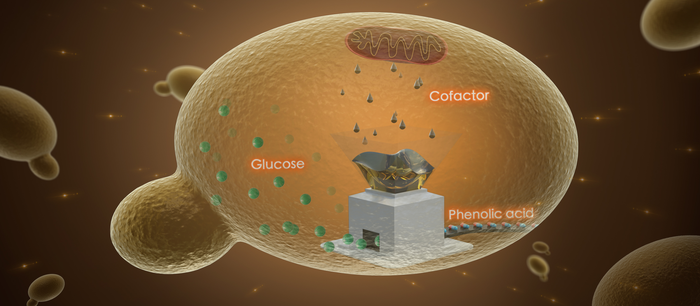
Engineering cofactor supply and recycling to drive phenolic acid biosynthesis in yeast

Credit: DICP

In the past decade, advances in synthetic biology paved the way toward the sustainable synthesis of complex natural products.

The baking yeast Saccharomyces cerevisiae has been widely used in food industry and has become one of the main platforms for building cell factories due to its robustness, convenient cellular engineering, and reliable safety.

Recently, a research group led by Prof. ZHOU Yongjin from the Dalian Institute of Chemical Physics (DICP) of the Chinese Academy of Sciences (CAS), in collaboration with Prof. ZHANG Lei from Naval Medical University, has developed efficient cofactor engineering strategies to derive phenolic acid biosynthesis in yeast.

This study was published in Nature Chemical Biology on April 28.

The cofactor metabolism is tightly regulated and complicatedly distributed in sub-organelles in eukaryotic cell such as yeast. Thus, it requires novel and feasible engineering strategies to cope with the complex cofactor regulation.

The researchers developed tailored engineering strategies to enhance the supply, re-localization, and recycling of cofactors NADPH, FAD(H2), and SAM, which enabled high-level production of caffeic acid (5.5 g/L) and ferulic acid (3.8 g/L).

“This work reveals the regulation of different cofactors in yeast, especially the distribution of cofactors between different organelles in cells, and provides theoretical guidance for cofactor engineering,” said Prof. ZHOU. “It also provides sufficient precursors for the efficient synthesis of complex active natural products.”

The study was supported by the National Key Research and Development Program of China, the National Natural Science Foundation of China, the Liaoning Revitalization Talents Program, and the Innovation Grant from DICP.


Journal

Nature Chemical Biology

DOI

10.1038/s41589-022-01014-6

Method of Research

Commentary/editorial

Subject of Research

Not applicable

Article Title

Engineering cofactor supply and recycling to drive phenolic acid biosynthesis in yeast

Share12Tweet8Share2ShareShareShare2

Related Posts

New Study from The Morton Arboretum Reveals Why Mexico and Central America’s Mountain Forests Are Oak Tree Hotspots — Biology

New Study from The Morton Arboretum Reveals Why Mexico and Central America’s Mountain Forests Are Oak Tree Hotspots

May 5, 2026
Gerald Joyce Elected to Prestigious American Philosophical Society — Biology

Gerald Joyce Elected to Prestigious American Philosophical Society

May 5, 2026

Author Correction: Lipopeptide Immunity Linked to Membrane Remodelling

May 4, 2026

Study Reveals Connection Between Prenatal Chemical Exposure and Chromosomal Abnormalities in Adult Sperm

May 4, 2026

POPULAR NEWS

  • Research Indicates Potential Connection Between Prenatal Medication Exposure and Elevated Autism Risk

    834 shares
    Share 334 Tweet 209
  • New Study Reveals Plants Can Detect the Sound of Rain

    719 shares
    Share 287 Tweet 180
  • Scientists Investigate Possible Connection Between COVID-19 and Increased Lung Cancer Risk

    67 shares
    Share 27 Tweet 17
  • Salmonella Haem Blocks Macrophages, Boosts Infection

    61 shares
    Share 24 Tweet 15

About

We bring you the latest biotechnology news from best research centers and universities around the world. Check our website.

Follow us

Recent News

SIRT3-DsbA-L-TFAM Axis Limits Fatty Liver Disease

Advances in Neonatal Cell Therapies: 2025 Update

New Study from The Morton Arboretum Reveals Why Mexico and Central America’s Mountain Forests Are Oak Tree Hotspots

Subscribe to Blog via Email

Enter your email address to subscribe to this blog and receive notifications of new posts by email.

Join 82 other subscribers
  • Contact Us

Bioengineer.org © Copyright 2023 All Rights Reserved.

Welcome Back!

Login to your account below

Forgotten Password?

Retrieve your password

Please enter your username or email address to reset your password.

Log In
No Result
View All Result
  • Homepages
    • Home Page 1
    • Home Page 2
  • News
  • National
  • Business
  • Health
  • Lifestyle
  • Science

Bioengineer.org © Copyright 2023 All Rights Reserved.