CHAPEL HILL, NC – Inside embryonic cells, specific proteins control the rate at which genetic information is transcribed from DNA to messenger RNA – a crucial regulatory step before proteins are created. Then, organs develop and hopefully function properly. Those specific “regulatory” proteins are called transcription factors, and they do their thing by binding to specific DNA sequences at just the right time.
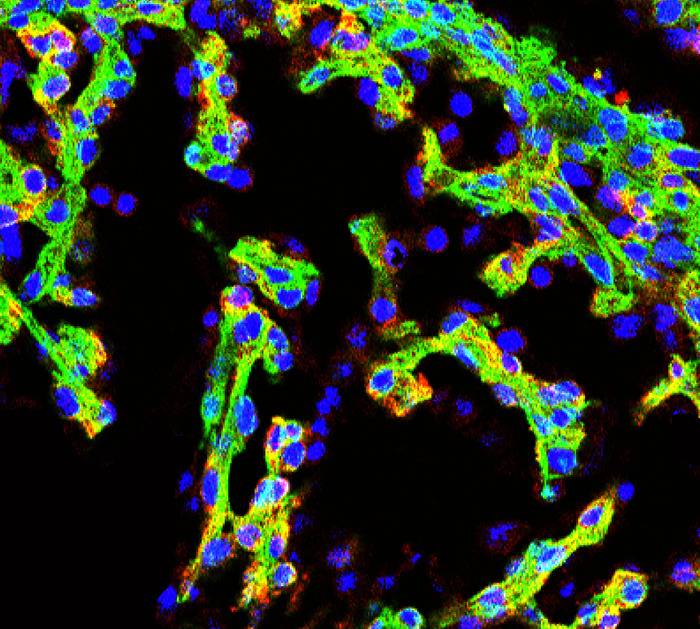
Credit: Frank Conlon Lab (UNC-Chapel Hill)
CHAPEL HILL, NC – Inside embryonic cells, specific proteins control the rate at which genetic information is transcribed from DNA to messenger RNA – a crucial regulatory step before proteins are created. Then, organs develop and hopefully function properly. Those specific “regulatory” proteins are called transcription factors, and they do their thing by binding to specific DNA sequences at just the right time.
Scientists have known that mutations to three cardiac transcription factors – GATA4, NKX2-5 and TBX5 – lead to a range of congenital heart disease states. Researchers have thought that an inability of these mutated genes to “turn on” cardiac genes is what led to heart disease.
Now, the lab of Frank Conlon, PhD, professor of biology and genetics at the University of North Carolina at Chapel Hill, discovered there’s more to the story. It involves non-cardiac genes, as well as answering a question researchers have struggled with for years.
Aside from the aforementioned transcription factors, past research showed that a protein complex subunit called CHD4 seems to play a major role in congenital heart disease. Deleting it causes embryonic death in animal models. Mutations to it cause major problems with proteins involved in skeletal and muscle development.
Turns out, CHD4 is essential for numerous developmental events, such as ensuring proper timing of the switch from stem cell lineages to differentiated cell types – that is, the moment when stem cells turn into, say, heart cells or leg muscle cells. CDH4 also is essential for maintaining cell differentiation – keeping heart cells healthy heart cells. And CDH4 is a player in activating cellular processes to deal with DNA damage.
Yet, CHD4 cannot bind DNA. It needs to be brought to a specific location, or genetic loci, of a cardiac gene to do its things. So, scientists could not answer the key question of how CHD4 played its role in cardiac disease.
Conlon’s lab, in collaboration with colleagues at UNC-Chapel Hill, Princeton, and Boston Children’s Hospital, shows that GATA4, NKX2-5 and TBX5 interact with CHD4 inside the embryonic heart, recruiting it for action, and that’s how CHD4 plays its role in heart health and disease.
These findings, published in the journal Genes & Development, imply that heart disease states are not only due to loss of cardiac gene expression, but that these genes’ recruitment of CHD4 can lead to a misexpression of non-cardiac genes, leading in the end to faulty heart development.
To put this implication to the test, Conlon and his collaborators removed the binding site for Nkx2-5 in the skeletal muscle gene Acta1 in mice and, independently, the GATA4 binding site in the smooth muscle gene Myh11.
“In both instances, the mutation led to the inappropriate expression of the non-cardiac genes in the heart in a dominant manner,” said Conlon, a member of the UNC McAllister Heart Institute. “This provides a mechanism for the prevalence of congenital heart disease in humans with just one mutated copy of Nkx2-5, Gata4 or Tbx5.”
Other authors include, co-first authors Zachary L. Robbe and Wei Shi in the Conlon lab; Lauren K. Wasson, Angel P. Scialdone, Caralynn M. Wilczewski1, Austin J. Hepperla, and Ian J. Davis at UNC-Chapel Hill; Brynn N. Akerberg and William T. Pu at Boston Children’s Hospital; and Ileana M. Cristea and Xinlei Sheng at Princeton University.
This work was supported by grants from the NIH/NHLBI (R01HL156424) to Frank Conlon, and (R01HD089275) to Frank Conlon and and Ileana Cristae, and (NIH-2UM1HL098166) to William Pu.
Journal
Genes & Development
DOI
10.1101/gad.349154.121