Genetic risk factors and diet quality are independently associated with type 2 diabetes; a healthy diet is linked to lower diabetes risk across all levels of genetic risk. That’s the conclusion of a study of more than 35,000 US adults publishing April 26th in PLOS Medicine by Jordi Merino of Massachusetts General Hospital, US, and colleagues.
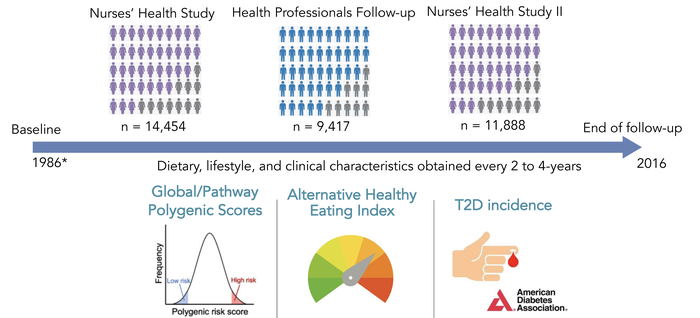
Credit: Jordi Merino, Merino J. et al., 2022, PLOS Medicine, CC-BY 4.0 (https://creativecommons.org/licenses/by/4.0/)
Genetic risk factors and diet quality are independently associated with type 2 diabetes; a healthy diet is linked to lower diabetes risk across all levels of genetic risk. That’s the conclusion of a study of more than 35,000 US adults publishing April 26th in PLOS Medicine by Jordi Merino of Massachusetts General Hospital, US, and colleagues.
Both genetic and lifestyle factors are known to contribute to individual susceptibility to type 2 diabetes. Previous studies have shown that adherence to a healthy lifestyle is associated with reduced risk of type 2 diabetes across genetic profiles, but whether genetic profiles, in part, interact with lifestyle factors was unclear. In the new study, researchers analyzed data from three extensive cohort studies, including 35,759 U.S. health professionals followed for 902,386 person-years of follow-up.
The team found that, irrespective of genetic risk, a low diet quality, as compared to high diet quality, was associated with a 30% increased risk of type 2 diabetes (Pinteraction=0.69). The relative risk of type 2 diabetes was 1.29 (95% CI 1.25-1.32, P<0.001) per standard deviation increase in the global polygenic score—one measure of genetic risk—and was 1.13 (1.09-1.17, P<0.001) per 10-unit decrease in Alternate Healthy Eating Index, a measure of diet quality. The joint association of low diet quality and increased genetic risk was similar to the sum of the risk for each factor alone (Pinteraction =0.30), further supporting independent associations. That said, one limitation of the study was that the cohort sampling might not necessarily generalize to other populations.
Merino adds, “This study provided evidence that the risk of type 2 diabetes attributed to increased genetic risk and low diet quality is similar to the sum of the risks associated with each factor alone. Such knowledge could serve to inform and design future strategies to advance the prevention of diabetes.”
#####
In your coverage, please use this URL to provide access to the freely available paper in PLOS Medicine:
http://journals.plos.org/plosmedicine/article?id=10.1371/journal.pmed.1003972
Citation: Merino J, Guasch-Ferré M, Li J, Chung W, Hu Y, Ma B, et al. (2022) Polygenic scores, diet quality, and type 2 diabetes risk: An observational study among 35,759 adults from 3 US cohorts. PLoS Med 19(4): e1003972. https://doi.org/10.1371/journal.pmed.1003972
Author Countries: United States, China, Sweden
Funding: This study was funded by research grants from the National Institutes of Health CA186107 (J.E.M.), CA176726 (W.C.W.), CA167552 (W.C.W.), HL034594 (J.E.M.), HL035464 (Q.S.), EY015473 (F.B.H.), DK112940 (F.B.H.), DK120870 (F.B.H.), DK40561 (J.M), and DK110550 (J.C.F.), the American Diabetes Association 1-18-PMF-029 (M.G-F.), and the National Natural Science Foundation of China 61471078 (B.M.). The funders had no role in study design, data collection and analysis, decision to publish, or preparation of the manuscript.
Journal
PLoS Medicine
DOI
10.1371/journal.pmed.1003972
Method of Research
Observational study
Subject of Research
People
COI Statement
Competing interests: I have read the journal’s policy and the authors of this manuscript have the following competing interests: Y.L. have received research supports from the California Walnut Commission and Swiss Reinsurance Company, which were both unrelated with current research project. P.W.F. has received honoraria from Lilly Inc, Novo Nordisk A/S, and Zoe Global Ltd, with stock options. All other authors declare no competing interests.