


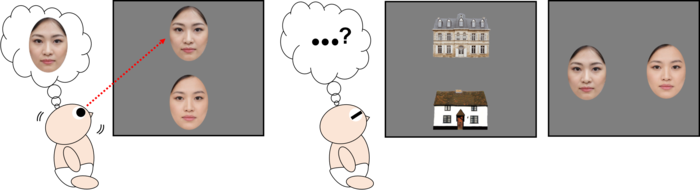
It has previously been reported that the human visual system has an asymmetry in the visual field. For example, humans are better at finding faces in the upper visual field than lower visual field (called upper visual field bias for faces). The underlying mechanisms of this visual field bias are subject to much debate, but a recent infant study suggests that the visual experience in daily life contribute to the emergence of upper visual field bias for faces.
Credit: Chuo University, LAIMAN
It has previously been reported that the human visual system has an asymmetry in the visual field. For example, humans are better at finding faces in the upper visual field than lower visual field (called upper visual field bias for faces). The underlying mechanisms of this visual field bias are subject to much debate, but a recent infant study suggests that the visual experience in daily life contribute to the emergence of upper visual field bias for faces.
In this study from Chuo University, Japan Women’s University, and Hokkaido University, infants aged 5 to 8 months were presented with two face images vertically or horizontally. Researchers tested which face they first looked at, and found that infants aged over 7 months first looked at the top face more frequently while infants aged under 6 months equally looked at both faces. There was no difference in horizontal meridian regardless of ages. This result suggests that the upper visual field bias for faces emerges around 7 months. This bias is specific to faces: the infants were also presented with images of houses, but no bias was observed. This indicates that is the face is important factor inducing the visual field bias. Furthermore, infants aged over 7 months preferentially memorized the top face even when they spent an equal amount of time viewing two face images. These results suggest that there is a developmental change in the upper visual field bias for faces between the ages of 6 and 7 months, implying that experience with faces in daily life is related to the emergence of upper visual field bias for faces.
“Throughout the development, what infants see in daily life changes. The experience with the spatial relationship between the face and body (that the face is attached to the body) is accumulated during the development. We assume that the proportion of viewing face and body relationship leads to the upper visual field bias for faces,” said Shuma Tsurumi from Chuo University.
“Interestingly, we also found that infants prioritize to remember the top face,” said Jun Kawahara from Hokkaido University. “This bias could be a basis for our indispensable drive to find people to communicate and interact with others.”
###
This is a joint release by Chuo University and Hokkaido University. The study, published in Developmental Science, was supported by a Grant-in-Aid from the Japan Society for the Promotion of Science (JSPS) Fellows (19J21422), a Grant-in-Aid for Scientific Research on Innovative Areas, ‘‘Construction of the Face–Body Studies in Transcultural Conditions” (17H06343), from the Ministry of Education, Culture, Sports, Science, and Technology (MEXT), and a Grant-in-Aid for Scientific Research (B) from the JSPS (19H01774).
Journal
Developmental Science
DOI
10.1111/desc.13262
Article Title
Development of upper visual field bias for faces in infants
Article Publication Date
27-Mar-2022

![Tuning Endergonic Triplet Photosensitization Enables Bicyclo[1.1.0]butane–Alkene Cycloadditions](https://bioengineer.org/wp-content/uploads/2026/08/Tuning-Endergonic-Triplet-Photosensitization-Enables-Bicyclo110butane–Alkene-Cycloadditions-120x86.jpg)
