Sounds made by humpback whales – including a previously unknown call – have given researchers a glimpse of their lives in the high seas.
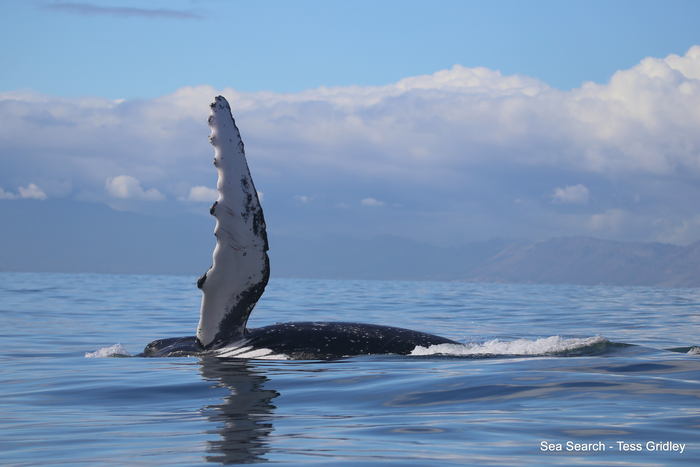
Credit: Sea Search/Tess Gridley
Sounds made by humpback whales – including a previously unknown call – have given researchers a glimpse of their lives in the high seas.
Scientists recorded sounds at the Vema Seamount in the Atlantic Ocean, hundreds of miles west of South Africa.
The “whup” and “grumble” calls captured suggest this location could be an important stop on the whales’ migration to polar feeding grounds.
Whale sounds are categorised into continuous “song” and shorter “non-song” calls – and the study recorded 600 non-song calls over 11 days.
These included an “impulsive sound” – dubbed “gunshot” by the researchers – that has never been recorded before.
The research team – from the universities of Stellenbosch (South Africa) and Exeter (UK), and Greenpeace Research Laboratories – say their study highlights the importance of current negotiations over a UN treaty to govern the high seas.
“50 years ago, governments came together to turn around the fate of humpback whales,” said Dr Kirsten Thompson, of the University of Exeter.
“Now they have a chance to secure the progress already made and protect the high-seas habitats that whales rely on.
“While such large areas of our oceans remain unprotected, these ecosystems are highly vulnerable.
“A coherent and connected network of Marine Protected Areas (MPAs) across our oceans is urgently needed to ensure seamounts like Vema are protected.”
The study used moored hydrophones deployed during the Southern Hemisphere spring of 2019.
Most of the whale calls were detected during three consecutive nights, with low “whups” the most common sound. The “whup” is known to be used between mother-calf pairs as a contact call that helps them locate each other. Humpbacks also “whup” while feeding.
The area around the Vema Seamount was heavily overfished after its discovery in 1959, but it is now closed for fishing and is recognised as a vulnerable marine ecosystem due to its unique biodiversity.
However, no legally binding international agreements exist to protect the network of seamounts in the high seas, despite the fact that many are hotspots for biodiversity and are important for migrating species.
Will McCallum, Head of Oceans at Greenpeace, said the UN treaty currently under negotiation (called Marine Biodiversity of Areas Beyond National Jurisdiction, or BBNJ) could provide a framework for creating an MPA network in the high seas.
“Once upon a time, the high seas were thought of as barren,” he said.
“Ground-breaking research like this shows they are teeming with life – and what’s more that biodiversity moves across the ocean, which is why we need to create a network of MPAs covering at least 30% of representative ecosystems.”
The paper, published in the journal JASA Express Letters, is entitled: “Detection of humpback whale (Megaptera novaeangliae) non-song vocalizations around the Vema Seamount, southeast Atlantic ocean.”
Journal
JASA Express Letters
DOI
10.1121/10.0010072
Method of Research
Observational study
Subject of Research
Animals
Article Title
Detection of humpback whale (Megaptera novaeangliae) non-song vocalizations around the Vema Seamount, southeast Atlantic Ocean
Article Publication Date
20-Apr-2022