Mitochondria release chemical energy and influence metabolic pathways that keep our cells and tissues healthy. Damage to these multifunctional powerhouses promotes cell death and disease.
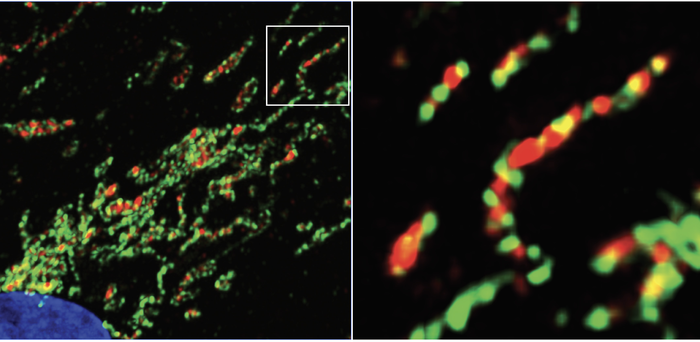
Credit: McWilliams Lab (Fumi Suomi and Homa Ehsan)
Mitochondria release chemical energy and influence metabolic pathways that keep our cells and tissues healthy. Damage to these multifunctional powerhouses promotes cell death and disease.
To prevent “mitochondrial meltdown,” our cells destroy defective mitochondria using a specialised recycling process termed “mitophagy”. Mitophagy is implicated in many diseases and is a major pharmaceutical target for neurodegenerative disorders such as Parkinson’s disease.
Unexpected insights into metabolism, mitophagy and movement
An international team of researchers studied a therapeutic molecule used to promote high levels of mitophagy and found that many metabolic pathways involving lipids were rapidly “rewired” before mitochondrial recycling took place. The results are now published in the EMBO Journal.
“Surprisingly, the activity of a protein called DGAT1 is switched on to generate specialised structures known as lipid droplets, typically used to store fat. By impairing DGAT activity, we observed the disappearance of lipid droplets and reduced mitochondrial recycling, and cells were more vulnerable to stress and death,” says Assistant Professor Thomas McWilliams, who led the study.
Remarkably, when the DGAT1 gene was switched off in the brains of reporter flies, both mitophagy and motor function of the animals were severely impacted.
A discovery forged from iron
The study also makes unexpected insights into iron, an essential cofactor for life. The therapeutic molecule used to induce mitophagy is a chelator, a potent drug that depletes cellular iron and researchers found surprisingly rapid effects of its depletion on cellular metabolism. McWilliams says:
“Iron homeostasis represents an ancient function of the mitochondrial network, and iron depletion after many hours promotes mitochondrial recycling. Postdoctoral researcher Maeve Long performed a series of ambitious experiments in my lab, profiling human cells after mere minutes of deferiprone exposure. Our collaborators then mapped very dynamic changes in metabolism in advance of mitophagy. This led us to study lipid crosstalk in further detail, with our Cambridge collaborators highlighting the significance of this synergy in vivo.”
Little is known about the factors that regulate physiological mitophagy, and this work opens new avenues for targeting this process. Commenting further, McWilliams adds:
“Defective mitochondrial recycling is problematic for cell types that are very long-lived, such as nerve cells in the brain. Neurodegenerative pathology is often progressive, taking place over many years. When mitophagy is defective, it’s reasonable that cells might adapt and utilise additional strategies to stay alive. Much more work is needed, but this is an unexpected and exciting find”.
The study was led by Assistant Professor Thomas McWilliams at the University of Helsinki in collaboration with Academy Professor Elina Ikonen and researchers at the Swedish Metabolomics Centre (Umeå, SE), Dr Alex Whitworth at the MRC Mitochondrial Biology Unit (Cambridge, UK) and Dr Ian Ganley at the MRC Protein Phosphorylation and Ubiquitylation Unit (Dundee, Scotland).
Journal
The EMBO Journal
DOI
10.15252/embj.2021109390
Article Title
DGAT1 activity synchronises with mitophagy to protect cells from metabolic rewiring by iron depletion.
Article Publication Date
12-Apr-2022