Bisphenol A (BPA) is an anthropogenic chemical used as a raw material for plastics such as polycarbonate and epoxy resins, and for the inner coating of canned foods. BPA has been detected in human specimens, including fetuses. In addition, BPA contaminates soil, water, air, and wildlife.
Credit: ©Ecotoxicology laboratory, Center for Marine Environmental Studies (CMES), Ehime University
Bisphenol A (BPA) is an anthropogenic chemical used as a raw material for plastics such as polycarbonate and epoxy resins, and for the inner coating of canned foods. BPA has been detected in human specimens, including fetuses. In addition, BPA contaminates soil, water, air, and wildlife.
The ecotoxicology research group at the Center for Marine Environmental Studies (CMES) of Ehime University, Japan administered 0, 50, and 5000 μg/kg body weight/day of BPA to pregnant rats to investigate the effects of prenatal BPA exposure on the liver transcriptome, proteome, and lipidome of the neonates (Nguyen et al., 2020, 2021). The results showed that prenatal BPA exposure affects lipid and hormone homeostasis in neonates in a sex- and growth-dependent manner. BPA exposure also affected the expression levels of cell cycle- and insulin resistance-related genes in offspring, and females showed a decrease in the hepatic lipid content and an increase in body weight. However, the effects of BPA on rat dams had not yet been explored.
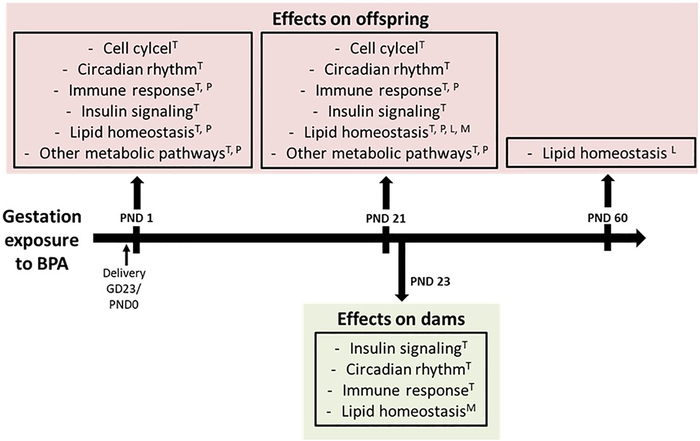
In this study, to investigate the effects of BPA exposure during pregnancy on rat dams, the CMES group examined changes in the transcriptome and lipidome of the liver of mother rats on postnatal day 23 (after weaning of the newborns). In addition, the effects were compared with those of their offspring. The CMES group also performed multivariate analyses (DIABLO: Data Integration Analysis for Biomarker discovery using Latent cOmponents) to integrate the hepatic transcriptome and lipidome data and attempted to comprehensively understand the effects of BPA exposure.
The effects of BPA exposure during pregnancy on dams were compared to the effects on offspring exposed during the fetal period. The results showed that even 4 weeks after exposure, maternal rats showed effects on insulin signaling, circadian rhythm, and immune response at the transcriptome level. On the other hand, no effects on the lipid composition or body weight of the dams were observed, indicating that the effects on the mother rats were slight compared to those of the offspring. These results suggest that BPA exposure in utero poses a higher risk than exposure in adulthood.
DIABLO successfully discriminated the BPA exposure groups of dams and their offspring based on differences in the effects of the hepatic transcriptome and lipidome. The discrimination accuracy between the 5000 μg BPA/kg body weight/day exposure group and the control group was higher than that between the 50 μg BPA/kg body weight/day exposure group and the control group, suggesting a dose-dependent effect of BPA. In addition, genes and lipids associated with BPA exposure were predicted, and palmitic acid and genes related to circadian rhythm, insulin response, and lipid metabolism were identified as novel biomarker candidates of BPA effects across two generations of mothers and offspring. This is the first report to integrate multi-omics data using the multivariate analysis tool, DIABLO, to comprehensively understand the effects of BPA exposure during pregnancy on mother rats and their offspring.
This study was published in Science of the Total Environment on February 19, 2022.
References
Nguyen, H.T., Yamamoto, K., Iida, M., Agusa, T., Ochiai, M., Guo, J., Karthikraj, R., Kannan, K., Kim, E.-Y., Iwata, H., 2020. Effects of prenatal bisphenol A exposure on the hepatic transcriptome and proteome in rat offspring. Sci. Total Environ. 720, 137568. https://doi.org/10.1016/j.scitotenv.2020.137568.
Nguyen, H.T., Li, L., Eguchi, A., Kannan, K., Kim, E.-Y., Iwata, H., 2021. Effects on the liver lipidome of rat offspring prenatally exposed to bisphenol A. Sci. Total Environ. 759, 143466. https://doi.org/10.1016/j.scitotenv.2020.143466.
Journal
Science of The Total Environment
DOI
10.1016/j.scitotenv.2022.153990
Article Title
Bisphenol A (BPA) impacted rat offspring more seriously than their dams