A grant renewal for a University of Cincinnati researcher will help continue the study of genetic drivers of breast cancer and potential therapeutic targets.
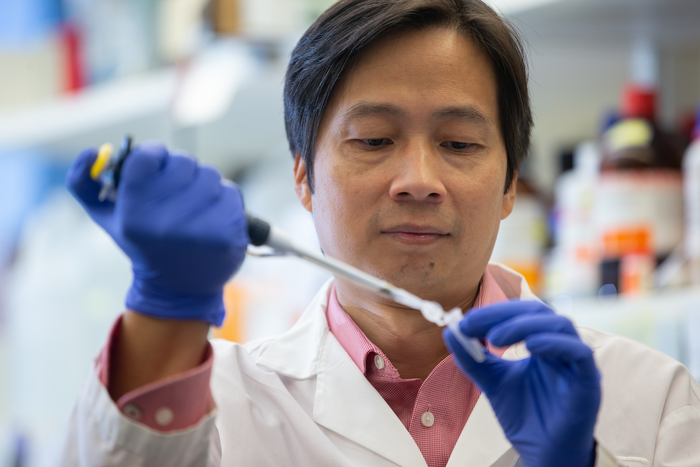
Credit: Photo/Andrew Higley/University of Cincinnati
A grant renewal for a University of Cincinnati researcher will help continue the study of genetic drivers of breast cancer and potential therapeutic targets.
Xiaoting Zhang, PhD, was awarded a five-year, $1,923,750 competing renewal R01 grant from the National Institutes of Health’s National Cancer Institute (NCI) on April 1 to continue his research.
In the grant’s previous funding period, Zhang and his team discovered that a gene called MED1 functions as a cancer co-driver of another gene called HER2 in promoting breast tumor growth, spread and treatment resistance. Zhang and his colleagues also developed a multifunctional RNA nanoparticle that shuts down MED1 specifically in the cancer cells, preventing it from being able to work to promote tumor growth and therapy resistance.
“It’s like MED1 is downstream and HER2 is upstream,” said Zhang, professor and Thomas Boat Endowed Chair in UC’s Department of Cancer Biology, director of the Breast Cancer Research Program and member of the University of Cincinnati Cancer Center. “So if you take this downstream thing out, then the HER2 and other kinases frequently aberrantly activated in breast cancers cannot come down to drive the tumor growth and spread.”
The new RNA nanoparticle therapy was patented last year and is currently under commercialization development through the support of the 1819 Innovation Hub and Ohio Third Frontier funds.
With this new round of funding, Zhang said he will further research another “downstream” gene, called Jab1, that has recently been shown to work closely together with MED1 to accelerate breast cancer cell spread and develop resistance to treatments. Researchers will seek to better define Jab1’s role, how it regulates MED1 turnover and activities to achieve breast cancer metastasis and therapy resistance and how that can be interrupted.
The research will also include further study of the effectiveness of RNA nanotherapeutics through RNA nanotechnology-based approaches that target Jab1 and MED1 to prevent tumor growth and treatment resistance. With the recent increased FDA approvals and broad use of RNA vaccines and medicines, these multifunctional RNA nanotherapeutics could represent a highly promising next-generation therapy to benefit patient care through better efficacy, fewer unwanted side effects, and improved patient quality of life and treatment compliance.
“We really appreciate the recognition of our achievements in the previous funding cycle and our proposed new and innovative work by the NCI,” Zhang said. “We are very fortunate to continue to be supported by multiple concurrent NCI R01 grants, which allows us to focus our efforts more on uncovering fundamental molecular mechanisms of breast cancer metastasis and therapy resistance and further translating our findings into clinics.”
Research reported in this publication was supported by the National Cancer Institute of the National Institutes of Health under Award Number R01CA197865. The content is solely the responsibility of the authors and does not necessarily represent the official views of the National Institutes of Health.