• HOME
  • NEWS
  • EXPLORE
    • CAREER
      • Companies
      • Jobs
    • EVENTS
    • iGEM
      • News
      • Team
    • PHOTOS
    • VIDEO
    • WIKI
  • BLOG
  • COMMUNITY
    • FACEBOOK
    • INSTAGRAM
    • TWITTER
Friday, March 27, 2026
BIOENGINEER.ORG
No Result
View All Result
  • Login
  • HOME
  • NEWS
  • EXPLORE
    • CAREER
      • Companies
      • Jobs
        • Lecturer
        • PhD Studentship
        • Postdoc
        • Research Assistant
    • EVENTS
    • iGEM
      • News
      • Team
    • PHOTOS
    • VIDEO
    • WIKI
  • BLOG
  • COMMUNITY
    • FACEBOOK
    • INSTAGRAM
    • TWITTER
  • HOME
  • NEWS
  • EXPLORE
    • CAREER
      • Companies
      • Jobs
        • Lecturer
        • PhD Studentship
        • Postdoc
        • Research Assistant
    • EVENTS
    • iGEM
      • News
      • Team
    • PHOTOS
    • VIDEO
    • WIKI
  • BLOG
  • COMMUNITY
    • FACEBOOK
    • INSTAGRAM
    • TWITTER
No Result
View All Result
Bioengineer.org
No Result
View All Result
Home NEWS Science News Biology

Better crime scene testing

Bioengineer by Bioengineer
March 31, 2022
in Biology
Reading Time: 2 mins read
0
Flinders PhD candidate Todd Kaesler
Share on FacebookShare on TwitterShare on LinkedinShare on RedditShare on Telegram

Skin cells and their DNA varies between individuals, but new data from Flinders University shows that some groups of people have higher variability in their cell deposits.  
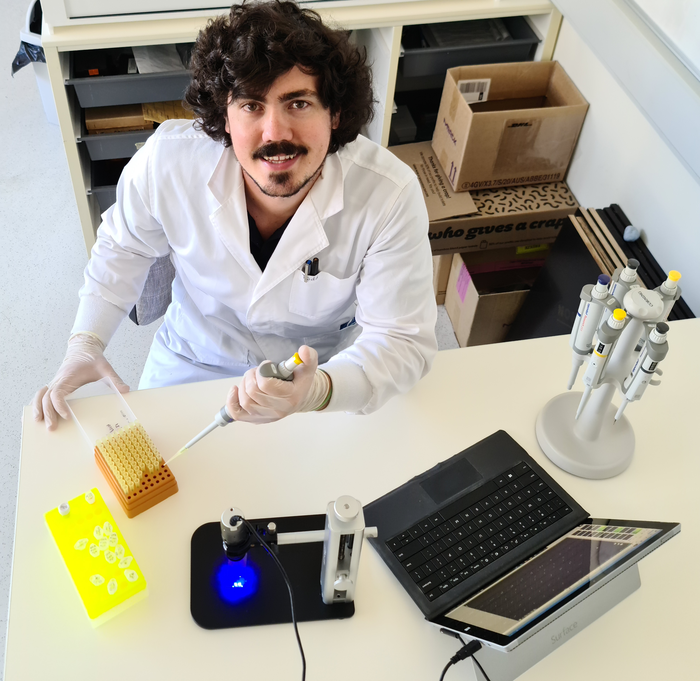
Flinders PhD candidate Todd Kaesler

Credit: Flinders University

Skin cells and their DNA varies between individuals, but new data from Flinders University shows that some groups of people have higher variability in their cell deposits.  

The South Australian forensic science researchers are building a suite of new insights into crime scene investigation – including the difference between high, intermediate and low skin ‘shedders’ that will help understanding of trace or ‘touch DNA’.  

The latest research, ‘DNA deposited in whole thumbprints’ (just published in Forensic Science International: Genetics), further studies inter-variation of DNA shedding obtained from experiments on samples gathered from 10 different people and 30 of their thumbprints.  

“The first challenge at a scene is finding touch DNA, which is why we have developed an accurate special aerosol fluorescent dye ‘marker’,” says Professor Adrian Linacre, who leads Flinders University’s forensic DNA technology research group.  

“A further challenge is evaluating the value of the evidence, and that’s where shedders are a factor.  

“Data like this new study allows a growing understanding of differences in DNA ‘shedding’ between people, and why we might find traces of people’s DNA a long time after an event.”    

Flinders University PhD candidate Todd Kaesler says: “We have found that some people have higher intra-variability, indicating that these individuals will not always reliably pass on similar amounts of cellular material and DNA.  This is individual-dependent. 

“Any new data on cell deposition goes to strengthen our understanding of how cells are deposited and why some are found well after a criminal event.”

The study used a nucleic acid binding dye that shows the number of cells deposited when a person touches an object. 

“Our work leads to more reliable touch DNA collection methods, which can be key in forensic casework,” says Professor Linacre.  

“We look forward to producing more accurate methods and informative research to help forensic scientists to fulfill their roles in a challenging environment.”   

The article on touch DNA by the Flinders University researchers has been published in the latest Forensic Science International: Genetics (2022) – entitled ‘DNA deposited in whole thumbprints: A reproducibility study’ by T Kaesler, KP Kirkbride and A Linacre DOI: 10.1016/j.fsigen.2022.102683 


Journal

Forensic Science International Genetics

DOI

10.1016/j.fsigen.2022.102683

Method of Research

Experimental study

Subject of Research

Cells

Article Title

DNA deposited in whole thumbprints: A reproducibility study

Article Publication Date

9-Mar-2022

COI Statement

The authors declare no conflict of interest

Share12Tweet8Share2ShareShareShare2

Related Posts

How to sway group opinions: Encourage opponents to stay undecided

How to sway group opinions: Encourage opponents to stay undecided

March 23, 2026
Deep Learning Model Maps How Individual Cells Shape Disease Outcomes

Deep Learning Model Maps How Individual Cells Shape Disease Outcomes

March 20, 2026

Removing only 15 female sharks annually could endanger the entire population, scientists warn

March 20, 2026

Scientists Urge Fragrance Industry to Transition from Sustainability Talk to Active Funding of Plant Conservation

March 20, 2026

POPULAR NEWS

  • blank

    Revolutionary AI Model Enhances Precision in Detecting Food Contamination

    96 shares
    Share 38 Tweet 24
  • Imagine a Social Media Feed That Challenges Your Views Instead of Reinforcing Them

    1003 shares
    Share 397 Tweet 248
  • Uncovering Functions of Cavernous Malformation Proteins in Organoids

    54 shares
    Share 22 Tweet 14
  • Promising Outcomes from First Clinical Trials of Gene Regulation in Epilepsy

    51 shares
    Share 20 Tweet 13

About

We bring you the latest biotechnology news from best research centers and universities around the world. Check our website.

Follow us

Recent News

In-Sensor Cryptography Links Physical Process to Digital Identity

Can Psychosocial Factors Influence Cancer Risk?

Depression Factors in Elderly: Pre vs. Post-COVID Analysis

Subscribe to Blog via Email

Success! An email was just sent to confirm your subscription. Please find the email now and click 'Confirm' to start subscribing.

Join 78 other subscribers
  • Contact Us

Bioengineer.org © Copyright 2023 All Rights Reserved.

Welcome Back!

Login to your account below

Forgotten Password?

Retrieve your password

Please enter your username or email address to reset your password.

Log In
No Result
View All Result
  • Homepages
    • Home Page 1
    • Home Page 2
  • News
  • National
  • Business
  • Health
  • Lifestyle
  • Science

Bioengineer.org © Copyright 2023 All Rights Reserved.