• HOME
  • NEWS
  • EXPLORE
    • CAREER
      • Companies
      • Jobs
    • EVENTS
    • iGEM
      • News
      • Team
    • PHOTOS
    • VIDEO
    • WIKI
  • BLOG
  • COMMUNITY
    • FACEBOOK
    • INSTAGRAM
    • TWITTER
Saturday, February 7, 2026
BIOENGINEER.ORG
No Result
View All Result
  • Login
  • HOME
  • NEWS
  • EXPLORE
    • CAREER
      • Companies
      • Jobs
        • Lecturer
        • PhD Studentship
        • Postdoc
        • Research Assistant
    • EVENTS
    • iGEM
      • News
      • Team
    • PHOTOS
    • VIDEO
    • WIKI
  • BLOG
  • COMMUNITY
    • FACEBOOK
    • INSTAGRAM
    • TWITTER
  • HOME
  • NEWS
  • EXPLORE
    • CAREER
      • Companies
      • Jobs
        • Lecturer
        • PhD Studentship
        • Postdoc
        • Research Assistant
    • EVENTS
    • iGEM
      • News
      • Team
    • PHOTOS
    • VIDEO
    • WIKI
  • BLOG
  • COMMUNITY
    • FACEBOOK
    • INSTAGRAM
    • TWITTER
No Result
View All Result
Bioengineer.org
No Result
View All Result
Home NEWS Science News Biology

Remote Indian Ocean reefs bounce back quickly after bleaching

Bioengineer by Bioengineer
March 24, 2022
in Biology
Reading Time: 3 mins read
0
A recovering reef in the Chagos Archipelago
Share on FacebookShare on TwitterShare on LinkedinShare on RedditShare on Telegram

Coral reefs in remote or protected areas can recover quickly after mass coral bleaching events, new research shows.
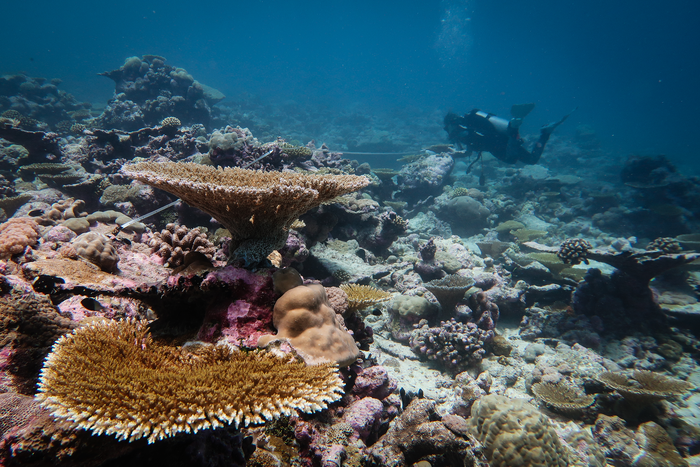
A recovering reef in the Chagos Archipelago

Credit: Dr Ines Lange

Coral reefs in remote or protected areas can recover quickly after mass coral bleaching events, new research shows.

University of Exeter researchers are investigating “reef carbonate budgets” – the net production or erosion of reef structure over time.

To study the impacts of climate change on reef functions, they examined 12 reefs in the remote Chagos Islands in the Indian Ocean before and after the global coral bleaching event in 2015/16.

In 2018, the formerly thriving reefs were “shrinking”, with coral cover and carbonate production down by more than 70% and erosion processes exceeding new coral growth.

When the researchers returned in 2021, all reefs were on a trajectory of recovery, although the speed varied from place to place.

Where key coral species returned quickly and the underlying physical reef structure had stayed intact, reefs showed a rapid transition back to positive growth only six years after the bleaching event.

Bleaching is caused by warmer water temperatures, which can trigger corals to expel their symbiotic algae and turn white. Corals can survive this, but an extreme heat wave causes large-scale mortality.

The speed of subsequent recovery is an important indicator of a reef’s health and resilience.

“Such high rates of coral recruitment and the rapid restoration of reef functions are a very nice surprise and imply that this location is showing some resilience, thus far, to ongoing ocean warming,” said lead author Dr Ines Lange, a postdoctoral research fellow in a multi-institutional project funded by the Bertarelli Program in Marine Science.

“A full recovery of reefs across the Chagos Archipelago over the next few years is likely if the region is spared from reoccurring marine heating events.”

Dr Lange added: “The study shows that in remote and protected areas without local impacts such as fishing or pollution from land, coral reefs and the important functions they provide are able to recover relatively quickly, even after large-scale disturbances.

“Proximity to healthy coral populations and the maintenance of a complex reef structure seems to boost recovery speed, which may help to manage reefs under the threat of increasing frequency of bleaching events predicted for the near future.”

Co-author Professor Chris Perry, from the University of Exeter, developed the census-based ReefBudget method to quantify reef carbonate budgets.

These carbonate budgets are important indicators of a reef’s ability to provide habitat to marine life, protect shorelines from wave energy and help reef islands to keep up with future sea level rise.

Over the last years, Prof Perry and Dr Lange optimised the method for the central Indian Ocean by quantifying and integrating local rates of coral growth and parrotfish erosion.

The paper, “Recovery trends of reef carbonate budgets at remote coral atolls six years post-bleaching” is published in Limnology and Oceanography by Ines Lange, Chris Perry and Marleen Stuhr.


Journal

Limnology and Oceanography

Method of Research

Observational study

Subject of Research

Not applicable

Article Title

Recovery trends of reef carbonate budgets at remote coral atolls six years post-bleaching

Article Publication Date

24-Mar-2022

Share12Tweet8Share2ShareShareShare2

Related Posts

Florida Cane Toad: Complex Spread and Selective Evolution

Florida Cane Toad: Complex Spread and Selective Evolution

February 7, 2026
New Study Uncovers Mechanism Behind Burn Pit Particulate Matter–Induced Lung Inflammation

New Study Uncovers Mechanism Behind Burn Pit Particulate Matter–Induced Lung Inflammation

February 6, 2026

DeepBlastoid: Advancing Automated and Efficient Evaluation of Human Blastoids with Deep Learning

February 6, 2026

Navigating the Gut: The Role of Formic Acid in the Microbiome

February 6, 2026

POPULAR NEWS

  • Robotic Ureteral Reconstruction: A Novel Approach

    Robotic Ureteral Reconstruction: A Novel Approach

    82 shares
    Share 33 Tweet 21
  • Digital Privacy: Health Data Control in Incarceration

    63 shares
    Share 25 Tweet 16
  • Study Reveals Lipid Accumulation in ME/CFS Cells

    57 shares
    Share 23 Tweet 14
  • Breakthrough in RNA Research Accelerates Medical Innovations Timeline

    53 shares
    Share 21 Tweet 13

About

We bring you the latest biotechnology news from best research centers and universities around the world. Check our website.

Follow us

Recent News

Phage-Antibiotic Combo Beats Resistant Peritoneal Infection

Boosting Remote Healthcare: Stepped-Wedge Trial Insights

Barriers and Boosters of Seniors’ Physical Activity in Karachi

Subscribe to Blog via Email

Enter your email address to subscribe to this blog and receive notifications of new posts by email.

Join 73 other subscribers
  • Contact Us

Bioengineer.org © Copyright 2023 All Rights Reserved.

Welcome Back!

Login to your account below

Forgotten Password?

Retrieve your password

Please enter your username or email address to reset your password.

Log In
No Result
View All Result
  • Homepages
    • Home Page 1
    • Home Page 2
  • News
  • National
  • Business
  • Health
  • Lifestyle
  • Science

Bioengineer.org © Copyright 2023 All Rights Reserved.