Suppose that we could watch twenty generations of whales or sharks adapting to climate change—measuring how they evolve and how their biology changes as temperatures and carbon dioxide levels rise. That could tell us a lot about how resilient life in the oceans might be to a warmer world. But it would also take hundreds of years—not very useful to scientists or policymakers trying to understand our warming world today.
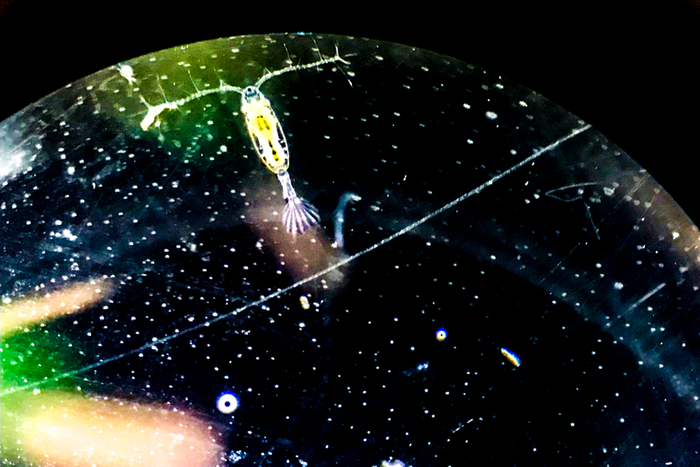
Credit: UVM/Pespeni Lab
Suppose that we could watch twenty generations of whales or sharks adapting to climate change—measuring how they evolve and how their biology changes as temperatures and carbon dioxide levels rise. That could tell us a lot about how resilient life in the oceans might be to a warmer world. But it would also take hundreds of years—not very useful to scientists or policymakers trying to understand our warming world today.
Instead, consider the life of the copepod Acartia tonsa, a tiny and humble sea creature near the bottom of the food web. It reproduces, matures, and creates a new generation in about twenty days. Twenty copepod generations pass in about one year.
A team of six scientists, led by University of Vermont biologist Melissa Pespeni and postdoctoral scientist Reid Brennan, did just that: in a first-of-its kind laboratory experiment, they exposed thousands of copepods to the high temperatures and high carbon dioxide levels that are predicted for the future of the oceans. And watched as twenty generations passed. Then they took some of the copepods and returned them to the baseline conditions—the temperature and CO2 levels that the first generation started in, which are like ocean conditions today. And then they kept watching as three more generations passed.
The results, published in the journal Nature Communications, “show that there is hope,” Pespeni says, “but also complexity in how life responds to climate change.”
The price of plasticity
Her hope comes from the team’s observation that the copepods did not die in the climate-change conditions. Instead, they persisted and even thrived. The scientists—from UVM; University of Connecticut; GEOMAR Helmholtz Center for Ocean Research in Germany; and University of Colorado, Boulder—recorded many changes in the copepods’ genes related to how they manage heat stress, grow their skeletons in more acidic waters, produce energy, and other cellular processes affected by climate change. This shows that these creatures have the capacity in their genetic make-up—using the variation that exist in natural populations—to adapt over twenty generations, evolving to maintain their fitness in a radically changed environment. The team’s observations support the idea that copepods—a globally-distributed group of crustaceans eaten by many commercially important fish species—could be resilient to the unprecedented rapid warming and acidification now being unleashed in the oceans by human fossil-fuel use.
The complexity—“it’s a caution, really,” Pespeni says—comes from the team’s observation of what happened to the copepods that were returned to the baseline conditions. These creatures revealed the hidden cost of the earlier twenty generations of adaptation. The flexibility that helped the copepods to evolve over twenty generations—what the scientists call “phenotypic plasticity”—was eroded when they tried to return to what had previously been benign conditions. Brought “home,” in a sense, the copepods were less healthy and produced smaller populations. They were able, after three generations, to re-evolve back to their ancestral conditions—but they had lost the ability to tolerate limited food supply and showed reduced resilience to other new forms of stress.
“If copepods or other creatures have to go down this adaptive path—and spend some of their genetic variation to deal with climate change—will they be able to tolerate some new environmental stressor, some other change in the environment?” Pespeni wonders. Copepods are among a broad group of species predicted to be resilient to rapid climate change—and this new study, supported by the National Science Foundation, upholds that view.
“But we need to be careful of overly simple models—about how well species will do and which ones will persist into the future—that look at just one variable,” said Reid Brennan who completed this study in Melissa Pespeni’s lab at the University of Vermont and is now at the GEOMAR Helmholtz Centre for Ocean Research in Kiel, Germany. And the scientists’ new study of copepods points to a larger truth about the intricate economy of evolution: There may be unforeseen costs to quickly evolving in a suddenly-hot world.
Journal
Nature Communications
DOI
10.1038/s41467-022-28742-6
Method of Research
Experimental study
Subject of Research
Animals
Article Title
Loss of transcriptional plasticity but sustained adaptive capacity after adaptation to global change conditions in a marine copepod
Article Publication Date
3-Mar-2022
COI Statement
The authors declare no competing interests.