Immune cells could help predict the prognosis of patients with the rare neurological disease amyotrophic lateral sclerosis (ALS), says a study published today in eLife.
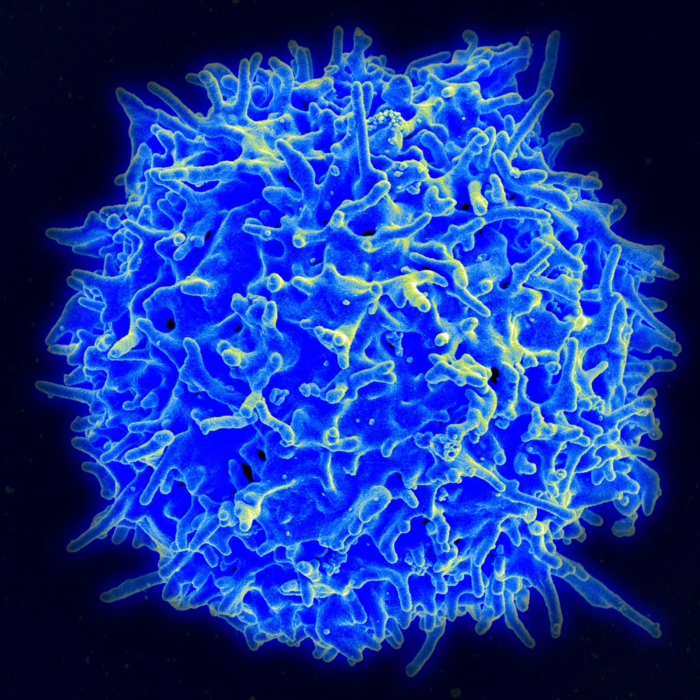
Credit: NIAID (CC BY 2.0)
Immune cells could help predict the prognosis of patients with the rare neurological disease amyotrophic lateral sclerosis (ALS), says a study published today in eLife.
The findings suggest that measuring changes in immune cell populations may help physicians monitor the status of patients with ALS. They also hint at a protective role that some immune cells might play in the disease, while others speed up disease progression. These new insights could help scientists find novel ways to treat ALS.
There are currently no effective treatments or cures for ALS, and the exact cause of the disease remains unclear. “Some studies implicate the immune system in ALS, but few have tracked immune cell populations in patients over time,” explains first author Can Cui, a PhD graduate at the Unit of Integrative Epidemiology, Karolinska Institutet, Stockholm, Sweden. “We set out to track immune changes in patients with ALS and determine if they could predict the patients’ prognosis.”
Cui and colleagues recruited 288 ALS patients living in Stockholm to participate in the study. They collected blood samples from the patients at the start of the study and at regular intervals afterward. They then tracked the relationship between immune cells in the samples and the participants’ disease progression for up to five years.
They found that the number of immune cells called leukocytes, neutrophils and monocytes increased in the participants during this period. As this happened, it became more difficult for the patients to complete basic physical tasks such as swallowing, holding utensils, or walking up and down stairs. However, there was no link between the levels of these cells in the body and a patient’s risk of death.
In a subsample of 92 patients – the ‘FlowC cohort’, in which 88% of participants were also included in the main cohort of 288 – the team measured 23 subpopulations of lymphocytes (a type of white blood cell) in the patients’ blood. They found that those with higher counts of natural killer cells and higher proportions of Th2-differentiated CD4+ T cells were likely to have better survival. However, higher proportions of CD8+ T cells and CD4+ EMRA T cells were associated with worse survival.
“Immune cells appear to play a dual role in ALS,” Cui explains. “Higher numbers of neutrophils and monocytes reflect worsening motor function in patients, while higher T-cell levels may be associated more clearly with survival.”
“These discoveries have important implications for understanding ALS and may contribute to the development of treatments that target specific immune cells,” adds co-author Caroline Ingre, Head of the ALS Center at Karolinska University Hospital, Solna, Sweden.
The authors add that there are a number of limitations to their study. For example, their analysis of cell types and proportions in the participants should be interpreted with caution, as not all patients were able to contribute repeated cell measurements due to high mortality rates in ALS.
Despite the limitations, the research paves the way for learning more about how ALS progresses and finding potential new ways for monitoring patients. “Our results also suggest the need for further studies on whether targeting specific immune cells could help improve patient outcomes,” Ingre concludes.
##
Media contact
Emily Packer, Media Relations Manager
eLife
+44 (0)1223 855373
About eLife
eLife transforms research communication to create a future where a diverse, global community of scientists and researchers produces open and trusted results for the benefit of all. Independent, not-for-profit and supported by funders, we improve the way science is practised and shared. From the research we publish, to the tools we build, to the people we work with, we’ve earned a reputation for quality, integrity and the flexibility to bring about real change. eLife receives financial support and strategic guidance from the Howard Hughes Medical Institute, Knut and Alice Wallenberg Foundation, the Max Planck Society and Wellcome. Learn more at https://elifesciences.org/about.
To read the latest Immunology and Inflammation research published in eLife, visit https://elifesciences.org/subjects/immunology-inflammation.
And for the latest in Neuroscience, see https://elifesciences.org/subjects/neuroscience.
Journal
eLife
DOI
10.7554/eLife.74065
Article Title
Correlation between leukocyte phenotypes and prognosis of amyotrophic lateral sclerosis
Article Publication Date
15-Mar-2022