• HOME
  • NEWS
  • EXPLORE
    • CAREER
      • Companies
      • Jobs
    • EVENTS
    • iGEM
      • News
      • Team
    • PHOTOS
    • VIDEO
    • WIKI
  • BLOG
  • COMMUNITY
    • FACEBOOK
    • INSTAGRAM
    • TWITTER
Sunday, May 10, 2026
BIOENGINEER.ORG
No Result
View All Result
  • Login
  • HOME
  • NEWS
  • EXPLORE
    • CAREER
      • Companies
      • Jobs
        • Lecturer
        • PhD Studentship
        • Postdoc
        • Research Assistant
    • EVENTS
    • iGEM
      • News
      • Team
    • PHOTOS
    • VIDEO
    • WIKI
  • BLOG
  • COMMUNITY
    • FACEBOOK
    • INSTAGRAM
    • TWITTER
  • HOME
  • NEWS
  • EXPLORE
    • CAREER
      • Companies
      • Jobs
        • Lecturer
        • PhD Studentship
        • Postdoc
        • Research Assistant
    • EVENTS
    • iGEM
      • News
      • Team
    • PHOTOS
    • VIDEO
    • WIKI
  • BLOG
  • COMMUNITY
    • FACEBOOK
    • INSTAGRAM
    • TWITTER
No Result
View All Result
Bioengineer.org
No Result
View All Result
Home NEWS Science News Biology

Prof. Zhu Tong’s team reveals the association between short-term exposure to ultrafine particles (UFPs) and fasting blood glucose (FBG) levels increase

Bioengineer by Bioengineer
March 10, 2022
in Biology
Reading Time: 3 mins read
0
Figure 1. Percentage difference in FBG levels associated with the increase in air pollutant concentrations 1–13 d prior to clinical visits, and FBG levels remained significantly associated with UFPs.
Share on FacebookShare on TwitterShare on LinkedinShare on RedditShare on Telegram

Professor Zhu Tong’s team from the College of Environmental Sciences and Engineering, Peking University, reveals how short-term exposure to ultrafine particles (UFPs) may contributes to an increase in fasting blood glucose (FBG) levels. The study, tilted with “Transcriptional pathways of elevated fasting blood glucose associated with short-term exposure to ultrafine particles: A panel study in Beijing, China”, is published in Journal of Hazardous Materials (Doi: 10.1016/j.jhazmat.2022.128486). 
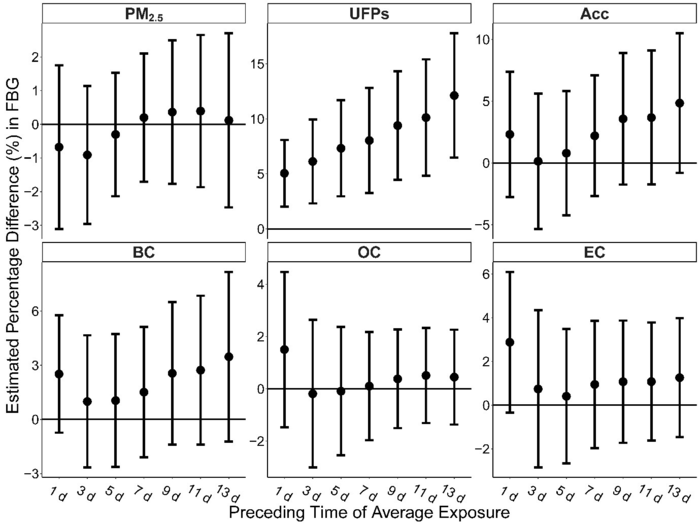
Figure 1. Percentage difference in FBG levels associated with the increase in air pollutant concentrations 1–13 d prior to clinical visits, and FBG levels remained significantly associated with UFPs.

Credit: the College of Environmental Sciences and Engineering, Peking University

Professor Zhu Tong’s team from the College of Environmental Sciences and Engineering, Peking University, reveals how short-term exposure to ultrafine particles (UFPs) may contributes to an increase in fasting blood glucose (FBG) levels. The study, tilted with “Transcriptional pathways of elevated fasting blood glucose associated with short-term exposure to ultrafine particles: A panel study in Beijing, China”, is published in Journal of Hazardous Materials (Doi: 10.1016/j.jhazmat.2022.128486). 


UFPs, particles with aerodynamic diameters less than 100 nm, is an important toxic component of ambient particulate matter (PM). UFPs have negligible mass but contribute substantially to the ambient PM pollution. There is a growing concern about the health effects of UFPs on human health. Epidemiological studies have suggested that both short- and long-term exposure to ambient PM may be risk factors for FBG variation. However, the potential biological mechanisms underlying the elevated levels of FBG associated with PM exposure are still unclear.


To examine the association between short-term UPFs exposure and FBG levels, Zhu Tong’s team conducted a panel study in the Shi Cha Hai Community, Beijing from 2016 to 2017, in collaborate with PKU First Hospital and Shi Cha Hai Community Health Service Center. They recruited 135 participants and monitored the air pollution near them. After completing 410 clinical visits, they observed a consistent, robust increase in FBG levels following exposure to average 1–13 d UFPs concentrations, which peaked in the 13-d time-window (figure 1).


In order to explore the potential mechanism associated with FBG increase following UFP exposure, the research team measured FBG and the whole blood transcriptome repeatedly. They discovered that transcripts were significantly associated with UPFs exposure and elevated FGB (Figure 2). Further enrichment analysis suggests the potential biological pathways between FBG increase and UFP exposure, such as pro-opiomelanocortin processing, negative regulation of hypoxia-inducible factor 1 A function (Figure 3). 


This study adds to the epidemiological evidence of health damage caused by short-term UFPs exposure. Furthermore, it provides new insights into the potential mechanism of changes in health indicator levels following exposure to pollutants, suggesting that future research should focus more on the effects and mechanisms of UFPs exposure in the air on human health.


Ph.D student Yao Yuan and Dr. Chen Xi from PKU College of Environmental Sciences and Engineering are the co-first authors of the paper, and Zhu Tong is the corresponding author. The work was supported by several big national projects. 


Journal

Journal of Hazardous Materials

DOI

10.1016/j.jhazmat.2022.128486

Article Title

Transcriptional pathways of elevated fasting blood glucose associated with short-term exposure to ultrafine particles: A panel study in Beijing, China

Article Publication Date

12-Feb-2022

Share12Tweet8Share2ShareShareShare2

Related Posts

Ancient Plant Populations Reveal Fresh Insights into Climate Resilience — Biology

Ancient Plant Populations Reveal Fresh Insights into Climate Resilience

May 8, 2026
Rare Brain Disorders in Children Linked to Mutations in Lesser-Known Protein Complex — Biology

Rare Brain Disorders in Children Linked to Mutations in Lesser-Known Protein Complex

May 8, 2026

From Odd Insect to Underwater Predator: The Remarkable Evolution of a Bloodthirsty Fruit Fly

May 8, 2026

SNU Professor Sangwoo Seo’s Team Develops Next-Generation CRISPR Biocontainment Technology to Control Microbial Survival Without DNA Cleavage

May 8, 2026

POPULAR NEWS

  • Research Indicates Potential Connection Between Prenatal Medication Exposure and Elevated Autism Risk

    840 shares
    Share 336 Tweet 210
  • New Study Reveals Plants Can Detect the Sound of Rain

    727 shares
    Share 290 Tweet 181
  • Scientists Investigate Possible Connection Between COVID-19 and Increased Lung Cancer Risk

    68 shares
    Share 27 Tweet 17
  • Salmonella Haem Blocks Macrophages, Boosts Infection

    61 shares
    Share 24 Tweet 15

About

We bring you the latest biotechnology news from best research centers and universities around the world. Check our website.

Follow us

Recent News

Evaluating Digoxin Use in Patients with Symptomatic Rheumatic Heart Disease

Evaluating the Effectiveness and Safety of Digitalis Glycosides in Treating Heart Failure

Urdu Fall Risk Questionnaire Adapted for Elderly

Subscribe to Blog via Email

Enter your email address to subscribe to this blog and receive notifications of new posts by email.

Join 82 other subscribers
  • Contact Us

Bioengineer.org © Copyright 2023 All Rights Reserved.

Welcome Back!

Login to your account below

Forgotten Password?

Retrieve your password

Please enter your username or email address to reset your password.

Log In
No Result
View All Result
  • Homepages
    • Home Page 1
    • Home Page 2
  • News
  • National
  • Business
  • Health
  • Lifestyle
  • Science

Bioengineer.org © Copyright 2023 All Rights Reserved.