The only references we have for “life” are the forms we know on Earth. Astrobiologists suspect that the search for alien life, and even for the origins of life on Earth, may require a broader scope. A NASA-funded team of researchers is developing tools to predict the features of life as we don’t know it. In a new study published in the Proceedings of the National Academy of Sciences, the team identifies universal patterns in the chemistry of life that do not appear to depend on specific molecules.
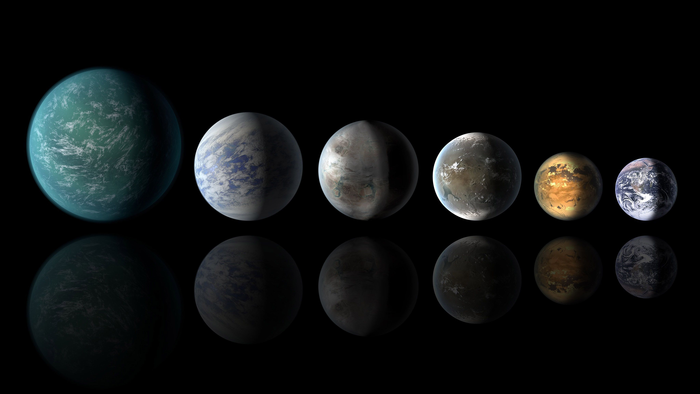
Credit: NASA/Ames/JPL-Caltech
The only references we have for “life” are the forms we know on Earth. Astrobiologists suspect that the search for alien life, and even for the origins of life on Earth, may require a broader scope. A NASA-funded team of researchers is developing tools to predict the features of life as we don’t know it. In a new study published in the Proceedings of the National Academy of Sciences, the team identifies universal patterns in the chemistry of life that do not appear to depend on specific molecules.
“We want to have new tools for identifying and even predicting features of life as we don’t know it,” says Santa Fe Institute External Professor Sara Imari Walker (Arizona State University), a co-author on the paper. “To do so, we are aiming to identify the universal laws that should apply to any biochemical system. This includes developing quantitative theory for the origins of life, and using theory and statistics to guide our search for life on other planets.”
On Earth, life emerges from the interplay of hundreds of chemical compounds and reactions. Some of these compounds and reactions are found universally across Earth’s organisms. Using the Integrated Microbial Genomes and Microbiomes database, the team investigated the enzymes — the functional drivers of biochemistry — found in bacteria, archaea, and eukarya to reveal a new kind of biochemical universality.
Enzymes can be categorized into a taxonomy of broad functional classes — groups designated by what they do, from using water molecules to break chemical bonds (hydrolases) to rearranging molecular structures (isomerases) to joining large molecules together (ligases). The team compared how the abundance of enzymes in each of these functional categories changed in relation to the overall abundance of enzymes in an organism. They discovered various scaling laws — almost algorithmic relationships — between the number of enzymes in different enzyme classes and the size of an organism’s genome. They also found that these laws don’t depend on the particular enzymes in those classes.
“Here we find that you get these scaling relationships without needing to conserve exact membership. You need a certain number of transferases, but not particular transferases,” says SFI Professor Chris Kempes, a co-author on the paper. “There are a lot ‘synonyms,’ and those synonyms scale in systematic ways.”
On Earth, organisms use DNA and, through RNA, create proteins. But will the macromolecules of DNA, RNA, and proteins help us identify life across the universe, understand the origins of life on Earth, or develop synthetic biology? “As a team, we think that’s not likely,” says Kempes. The functions those macromolecules serve, however, and the metabolic scaling relationships observed in organic, Earth-based life, just might be. “Even if life elsewhere used really different molecules, these sort of functional categories and scaling laws might be conserved throughout the universe,” says Kempes.
Additional authors on this study are first author Dylan Gagler (New York University Langone Health); Hyunju Kim, Bradley Karas, John Malloy, and Veronica Mierzejewski (Arizona State University); and Aaron Goldman (Oberlin College and the Blue Marble Space Institute for Science).
Journal
Proceedings of the National Academy of Sciences
DOI
10.1073/pnas.2106655119
Method of Research
Data/statistical analysis
Subject of Research
Not applicable
Article Title
Scaling laws in enzyme function reveal a new kind of biochemical universality
Article Publication Date
1-Mar-2022
COI Statement
No conflict of interest