• HOME
  • NEWS
  • EXPLORE
    • CAREER
      • Companies
      • Jobs
    • EVENTS
    • iGEM
      • News
      • Team
    • PHOTOS
    • VIDEO
    • WIKI
  • BLOG
  • COMMUNITY
    • FACEBOOK
    • INSTAGRAM
    • TWITTER
Saturday, February 7, 2026
BIOENGINEER.ORG
No Result
View All Result
  • Login
  • HOME
  • NEWS
  • EXPLORE
    • CAREER
      • Companies
      • Jobs
        • Lecturer
        • PhD Studentship
        • Postdoc
        • Research Assistant
    • EVENTS
    • iGEM
      • News
      • Team
    • PHOTOS
    • VIDEO
    • WIKI
  • BLOG
  • COMMUNITY
    • FACEBOOK
    • INSTAGRAM
    • TWITTER
  • HOME
  • NEWS
  • EXPLORE
    • CAREER
      • Companies
      • Jobs
        • Lecturer
        • PhD Studentship
        • Postdoc
        • Research Assistant
    • EVENTS
    • iGEM
      • News
      • Team
    • PHOTOS
    • VIDEO
    • WIKI
  • BLOG
  • COMMUNITY
    • FACEBOOK
    • INSTAGRAM
    • TWITTER
No Result
View All Result
Bioengineer.org
No Result
View All Result
Home NEWS Science News Biology

Thalamic cortices mediate nostalgia-induced pain relief

Bioengineer by Bioengineer
February 28, 2022
in Biology
Reading Time: 2 mins read
0
The model of thalamus-centered pathways affected by the analgesic effect associated with nostalgia.
Share on FacebookShare on TwitterShare on LinkedinShare on RedditShare on Telegram

Ever noticed that looking at photos of good times with family or friends diminishes the pain of your headache? Nostalgia has already been shown to be helpful with pain relief, and a new study has now revealed the thalamocortical mechanism for nostalgia-induced analgesia.
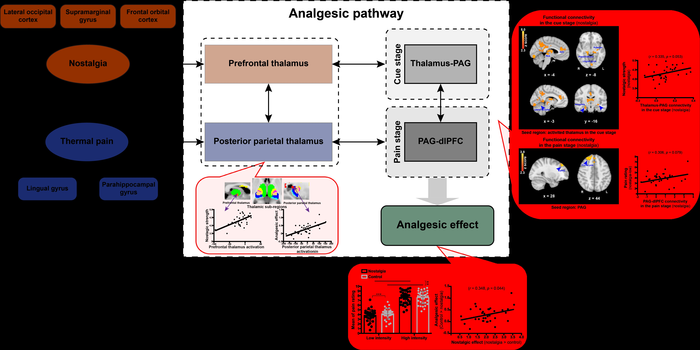
The model of thalamus-centered pathways affected by the analgesic effect associated with nostalgia.

Credit: Institute of Psychology

Ever noticed that looking at photos of good times with family or friends diminishes the pain of your headache? Nostalgia has already been shown to be helpful with pain relief, and a new study has now revealed the thalamocortical mechanism for nostalgia-induced analgesia.

Led by Dr. KONG Yazhuo from the Institute of Psychology of the Chinese Academy of Sciences, the research team found that the thalamus, a critical brain region for pain modulation, is also related to the analgesic effect associated with nostalgia.

Nostalgia, a sentimental longing for one’s past, is a self-conscious, perhaps bittersweet but predominantly positive social emotion. Nostalgia helps us maintain a positive psychological status when counteracting the negative impact of difficult situations. The adaptive functions of nostalgia are many, with one effect being pain relief.

In the current study, a nostalgia-related functional MRI paradigm (i.e., nostalgia vs. control cues when people were viewing pictures) was combined with heat-pain stimulation (i.e., low heat vs. high heat when people were feeling pain) to examine how brain responses elicited by pain stimulation were modulated after people experienced nostalgic emotion.

After observing triggers of childhood memories, participants reported experiencing weaker feelings of pain in response to the thermal stimuli, particularly at low stimulus intensities.

Most importantly, the anterior thalamus encoded nostalgia, and the posterior parietal thalamus encoded pain perception. Anterior thalamic activation can predict posterior parietal thalamus activation. “The thalamus plays a key role as a central functional linkage in the analgesic effect,” said Dr. ZHANG Ming, first author of the study.

When people were looking at pictures, the strength of the nostalgia they experienced was also strongly associated with connectivity between the thalamus and the periaqueductal gray (PAG), an area of gray matter found in the midbrain. In this situation, coupling between PAG and the dorsal-lateral prefrontal cortex predicted pain perception when people were feeling pain. This indicates that the thalamus modulates nociceptive inputs and plays a crucial role in triggering the brain-stem analgesic pathway.

Sometimes people experience mild clinical pain that’s uncomfortable, but not enough to require medication. In these cases, non-drug analgesic pain relief methods can be helpful or even necessary.

This study sheds light on the neural mechanisms underlying nostalgia-induced pain relief, providing novel insights into the further development and improvement of non-drug, psychological analgesia.

This work was published in the Journal of Neuroscience on Feb. 28 and was funded by the National Natural Science Foundation of China and the National Social Science Fund of China.


DOI

10.1523/JNEUROSCI.2123-21.2022

Share13Tweet8Share2ShareShareShare2

Related Posts

Florida Cane Toad: Complex Spread and Selective Evolution

Florida Cane Toad: Complex Spread and Selective Evolution

February 7, 2026
New Study Uncovers Mechanism Behind Burn Pit Particulate Matter–Induced Lung Inflammation

New Study Uncovers Mechanism Behind Burn Pit Particulate Matter–Induced Lung Inflammation

February 6, 2026

DeepBlastoid: Advancing Automated and Efficient Evaluation of Human Blastoids with Deep Learning

February 6, 2026

Navigating the Gut: The Role of Formic Acid in the Microbiome

February 6, 2026

POPULAR NEWS

  • Robotic Ureteral Reconstruction: A Novel Approach

    Robotic Ureteral Reconstruction: A Novel Approach

    82 shares
    Share 33 Tweet 21
  • Digital Privacy: Health Data Control in Incarceration

    63 shares
    Share 25 Tweet 16
  • Study Reveals Lipid Accumulation in ME/CFS Cells

    57 shares
    Share 23 Tweet 14
  • Breakthrough in RNA Research Accelerates Medical Innovations Timeline

    53 shares
    Share 21 Tweet 13

About

We bring you the latest biotechnology news from best research centers and universities around the world. Check our website.

Follow us

Recent News

Evaluating Pediatric Emergency Care Quality in Ethiopia

TPMT Expression Predictions Linked to Azathioprine Side Effects

Improving Dementia Care with Enhanced Activity Kits

Subscribe to Blog via Email

Success! An email was just sent to confirm your subscription. Please find the email now and click 'Confirm' to start subscribing.

Join 73 other subscribers
  • Contact Us

Bioengineer.org © Copyright 2023 All Rights Reserved.

Welcome Back!

Login to your account below

Forgotten Password?

Retrieve your password

Please enter your username or email address to reset your password.

Log In
No Result
View All Result
  • Homepages
    • Home Page 1
    • Home Page 2
  • News
  • National
  • Business
  • Health
  • Lifestyle
  • Science

Bioengineer.org © Copyright 2023 All Rights Reserved.