An anti-tumor drug promotes weight loss in mice at low doses by activating a natural hunger-suppressing pathway, according to a new study publishing February 24th in the open-access journal PLOS Biology by Jiang Wei Wu and colleagues at Northwest A&F University in Shaanxi, China. The results provide a promising new avenue for development of anti-obesity treatments.
Credit: Jun Feng Lu (CC BY 4.0, https://creativecommons.org/licenses/by/4.0/)
An anti-tumor drug promotes weight loss in mice at low doses by activating a natural hunger-suppressing pathway, according to a new study publishing February 24th in the open-access journal PLOS Biology by Jiang Wei Wu and colleagues at Northwest A&F University in Shaanxi, China. The results provide a promising new avenue for development of anti-obesity treatments.
Growth differentiation factor 15 (GDF15) is a hormone that circulates in response to a wide variety of stimuli, including stress. Previous work has shown that elevation of GDF15 leads to a drop in body weight, while suppression of it leads to obesity.
To search for drugs that could increase GDF15 production, the authors turned to the “Connectivity Map,” a database of gene expression profiles of human cells in response to drug exposure. They found that cells exposed to a drug called camptothecin increased their expression of GDF15. Camptothecin is derived from the Asian tree Camptotheca acuminata, and is a known inhibitor of a DNA repair enzyme (hence its use as an anti-tumor drug).
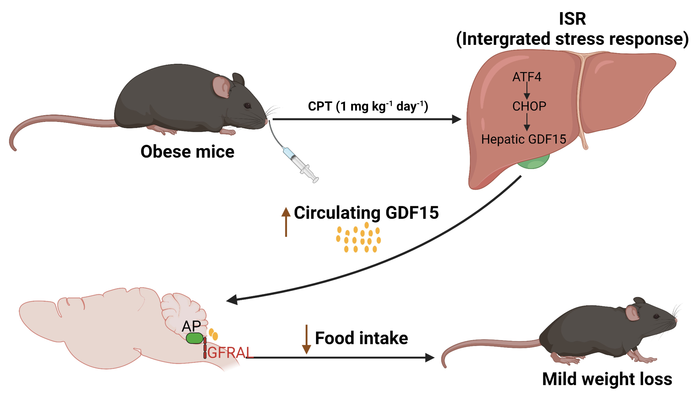
In obese mice, the authors showed that oral administration of camptothecin rapidly elevated the level of GDF15 in the blood, and over the course of 30 days, reduced food intake by about 12% and body weight by about 11%. In contrast, in lean mice, camptothecin did not elevate GDF15 and there was no effect on either food intake or body weight.
Camptothecin’s effect was specific to GDF15, and GDF15 exerted its effect through its receptor, called GFRAL, the team showed, since an antibody against GDF15 prevented the weight loss, as did knocking down GFRAL expression.
Camptothecin has been studied in anti-cancer trials, but was ultimately set aside due to safety concerns. Its safety as an anti-obesity drug has yet to be determined, Wu said, but noted that the dose used in this study, if scaled up to a human, would be about one-thirtieth of the lowest dose used in human anti-cancer trials. Additionally, the anti-obesity mechanism appears to be separate from the anti-cancer mechanism, which involves blocking the function of the DNA-repair enzyme topoisomerase, and to function at a much lower drug concentration.
“We believe our results convincingly argue that camptothecin may have therapeutic benefits for obesity and its associated metabolic disorders,” Wu says. “Further study is needed to evaluate its efficacy and safety in advanced models to increase the translational impact.”
Wu adds, “In this study, by using in silico drug-screening approach, we discovered that Camptothecin (CPT), a previously identified anti-tumor drug by the US National Cancer Institute, is a GDF15 inducer. CPT elevates circulating GDF15 via activation of hepatic ISR pathway, this activates the GDF15 receptor GFRAL in the hindbrain AP, which subsequently suppresses food intake and reduces body weight in obese mice.”
#####
In your coverage, please use this URL to provide access to the freely available paper in PLOS Biology: http://journals.plos.org/plosbiology/article?id=10.1371/journal.pbio.3001517
Citation: Lu JF, Zhu MQ, Xie BC, Shi XC, Liu H, Zhang RX, et al. (2022) Camptothecin effectively treats obesity in mice through GDF15 induction. PLoS Biol 20(2): e3001517. https://doi.org/10.1371/journal.pbio.3001517
Author Countries: China
Funding: This work was supported by National Natural Science Foundation of China (32070602), National Key Research and Development Program of China (2021YFF1000602), Programs for Shaanxi Science & Technology (2020NY-012), and Special Talent Recruitment Fund of China to Jiang Wei Wu. The funders had no role in study design, data collection and analysis, decision to publish, or preparation of the manuscript.
Journal
PLoS Biology
DOI
10.1371/journal.pbio.3001517
Method of Research
Experimental study
Subject of Research
Animals
COI Statement
Competing Interests: The authors have declared that no competing interests exist.