Parents face a trade-off between putting resources into their offspring versus using resources to enhance their chances of survival so they can have more offspring. The best allocation of resources depends on age. More experienced parents are better at getting food, so they can pass on more to their offspring. However, resources are needed to combat ‘wear and tear’, so in old age less can be passed on.
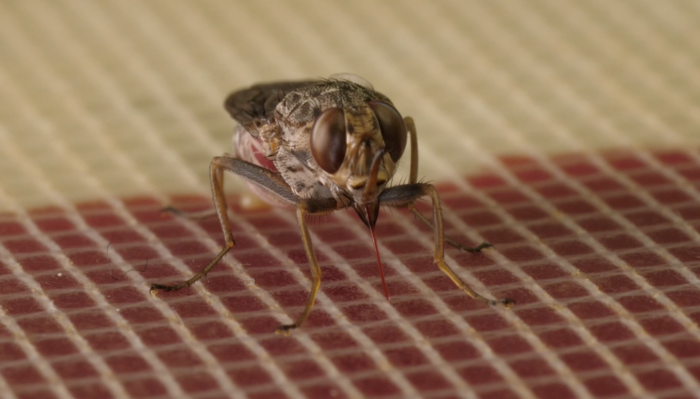
Credit: Daniel Hargrove
Parents face a trade-off between putting resources into their offspring versus using resources to enhance their chances of survival so they can have more offspring. The best allocation of resources depends on age. More experienced parents are better at getting food, so they can pass on more to their offspring. However, resources are needed to combat ‘wear and tear’, so in old age less can be passed on.
This increase-decrease pattern of allocation to offspring is seen in many mammals, birds and insects. Scientists at Bristol, with colleagues at Exeter and Oxford, found this pattern in an important disease-carrying insect, the tsetse fly. Tsetse flies give birth to live young that are nearly as big as their mother.
With colleagues at the Liverpool School of Tropical Medicine, the team studied tsetse mothers in the laboratory for their whole lives. Now, the team has made a mathematical model, published in the journal Proceedings of the Royal Society B, which to show how the pattern can be explained by changes the mothers experience as they get older.
Tsetse live on blood, which is a rich food supply but hard to get. The insects have to fly a long way to find an animal and avoid its defences, such as a swatting tail. Tsetse probably get better at acquiring food through experience, but the energy they need to fly increases as their wings become worn. Tsetse mothers have evolved to respond to these effects when passing on fat to their offspring.
“We expect that parents have evolved optimal patterns of resources allocation to maximise their reproductive success,” said lead author Dr. Antoine Barreaux, research associate at the University of Bristol and now lecturer in Intertryp at Cirad in France. “Our work takes into account age-dependence in many factors, such as feeding ability, energetic costs, and mortality.”
Dr. Sinead English from the School of Biological Sciences at the University of Bristol and leader of the team added: “Our model is the first to predict the initial increase and subsequent decrease with age of the allocation of resources by parents to their offspring.”
The mathematical model applies to all animals that have more than one offspring during their lives.
It predicts what strategic choices individuals will make depending on their ecology. Some species will allocate nearly everything to each breeding event, whereas others will build up their resources and reproduce less often. Explaining this diversity is an aim of the project.
“We hope that this theory inspires future tests with the data from long-term studies of wild populations such as red deer, bison or terns. This would allow scientists to come up with a general theory of investment by parents over their lives,” said Dr Barreaux
The team is developing the model to include the parasites that tsetse transmit. The hope is that a better understanding of these important insects will be used to reduce the transmission of diseases, such as sleeping sickness, to humans and livestock.
Paper:
“Incorporating effects of age on energy dynamics predicts nonlinear maternal allocation patterns in iteroparous animals,” by Barreaux, A.; English, S. et al. in Proceedings of the Royal Society B.
https://dx.doi.org/10.1098/rspb.2021.1884.
Journal
Proceedings of the Royal Society B Biological Sciences
DOI
10.1098/rspb.2021.1884
Method of Research
Experimental study
Subject of Research
Animals
Article Title
Incorporating effects of age on energy dynamics predicts nonlinear maternal allocation patterns in iteroparous animals
Article Publication Date
16-Feb-2022