• HOME
  • NEWS
  • EXPLORE
    • CAREER
      • Companies
      • Jobs
    • EVENTS
    • iGEM
      • News
      • Team
    • PHOTOS
    • VIDEO
    • WIKI
  • BLOG
  • COMMUNITY
    • FACEBOOK
    • INSTAGRAM
    • TWITTER
Wednesday, July 8, 2026
BIOENGINEER.ORG
No Result
View All Result
  • Login
  • HOME
  • NEWS
  • EXPLORE
    • CAREER
      • Companies
      • Jobs
        • Lecturer
        • PhD Studentship
        • Postdoc
        • Research Assistant
    • EVENTS
    • iGEM
      • News
      • Team
    • PHOTOS
    • VIDEO
    • WIKI
  • BLOG
  • COMMUNITY
    • FACEBOOK
    • INSTAGRAM
    • TWITTER
  • HOME
  • NEWS
  • EXPLORE
    • CAREER
      • Companies
      • Jobs
        • Lecturer
        • PhD Studentship
        • Postdoc
        • Research Assistant
    • EVENTS
    • iGEM
      • News
      • Team
    • PHOTOS
    • VIDEO
    • WIKI
  • BLOG
  • COMMUNITY
    • FACEBOOK
    • INSTAGRAM
    • TWITTER
No Result
View All Result
Bioengineer.org
No Result
View All Result
Home NEWS Science News

A colorful yet little known snout moth genus from China with 5 new species

Bioengineer by Bioengineer
January 5, 2017
in Science News
Reading Time: 1 min read
0
Share on FacebookShare on TwitterShare on LinkedinShare on RedditShare on Telegram
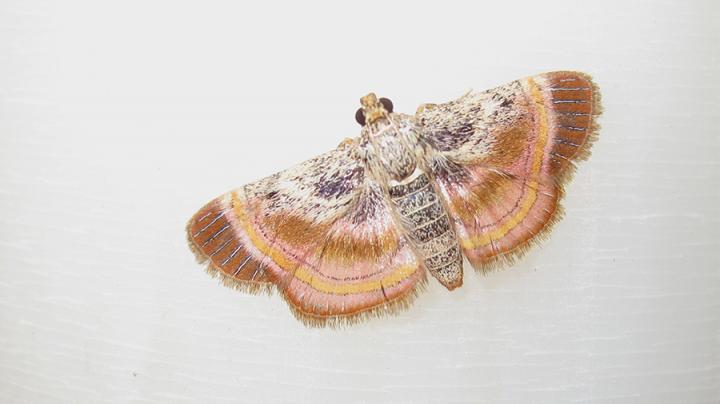
IMAGE

Credit: Dr. Mingqiang Wang

A group of beautiful snout moths from China was revised by three scientists from the Institute of Zoology at the Chinese Academy of Sciences.

In their study, recently published in the open access journal Zookeys, entomologists Dr. Mingqiang Wang, Dr. Fuqiang Chen and Prof. Chunsheng Wu describe five new species and two newly recorded for the country.

Despite being morphologically interesting, the snout moth genus Lista remains little known. Usually, its members have bright-coloured wings, often pink, orange, or yellow, which makes them strikingly different from the rest in their subfamily (Epipaschiinae). In fact, it is because of the beautiful coloration that these moths are sometimes favourably compared to butterflies. However, these moths are indifferentiable from one another on the outside.

As a result of the present study, there are now ten species of Lista snout moths known from China, with their world fauna amounting to thirteen. Mostly distributed in the south the East-Asian country, the genus likely originates from there.

###

Original source:

Wang M, Chen F, Wu C (2017) A review of Lista Walker, 1859 in China, with descriptions of five new species (Lepidoptera, Pyralidae, Epipaschiinae). ZooKeys 642: 97-113. 10.3897/zookeys.642.7157

Media Contact

Chunsheng Wu
[email protected]
@Pensoft

http://www.pensoft.net

############

Story Source: Materials provided by Scienmag
Share12Tweet8Share2ShareShareShare2

Related Posts

Flame retardant BDE-209 targets molecularly linked to ulcerative colitis

July 6, 2026
Ultra-high frequency particle impacts mimic rockbursts to shatter hard rock

Ultra-high frequency particle impacts mimic rockbursts to shatter hard rock

July 6, 2026

Kidney transplant outcomes in older adults studied by German researchers

July 6, 2026

Embodied cognition yields interpretable trajectory predictions for autonomous systems.

July 6, 2026
Please login to join discussion

POPULAR NEWS

  • Detection of EDCs in Breast Milk and Infant Urine Up to Six Months Highlights Early Exposure Risks

    77 shares
    Share 31 Tweet 19
  • New Drug Candidate Developed at McMaster Shows Potential for Treating Brain Cancer

    58 shares
    Share 23 Tweet 15
  • Saying Goodbye to PGY-6: Pediatric Fellowship Realities

    103 shares
    Share 41 Tweet 26
  • KTU Researchers Explore Ultrasound’s Role in Enhancing Blood Flow Beyond Diagnostics

    53 shares
    Share 21 Tweet 13

About

We bring you the latest biotechnology news from best research centers and universities around the world. Check our website.

Follow us

Recent News

Flame retardant BDE-209 targets molecularly linked to ulcerative colitis

Ultra-high frequency particle impacts mimic rockbursts to shatter hard rock

Kidney transplant outcomes in older adults studied by German researchers

Subscribe to Blog via Email

Success! An email was just sent to confirm your subscription. Please find the email now and click 'Confirm' to start subscribing.

Join 83 other subscribers
  • Contact Us

Bioengineer.org © Copyright 2023 All Rights Reserved.

Welcome Back!

Login to your account below

Forgotten Password?

Retrieve your password

Please enter your username or email address to reset your password.

Log In
No Result
View All Result
  • Homepages
    • Home Page 1
    • Home Page 2
  • News
  • National
  • Business
  • Health
  • Lifestyle
  • Science

Bioengineer.org © Copyright 2023 All Rights Reserved.