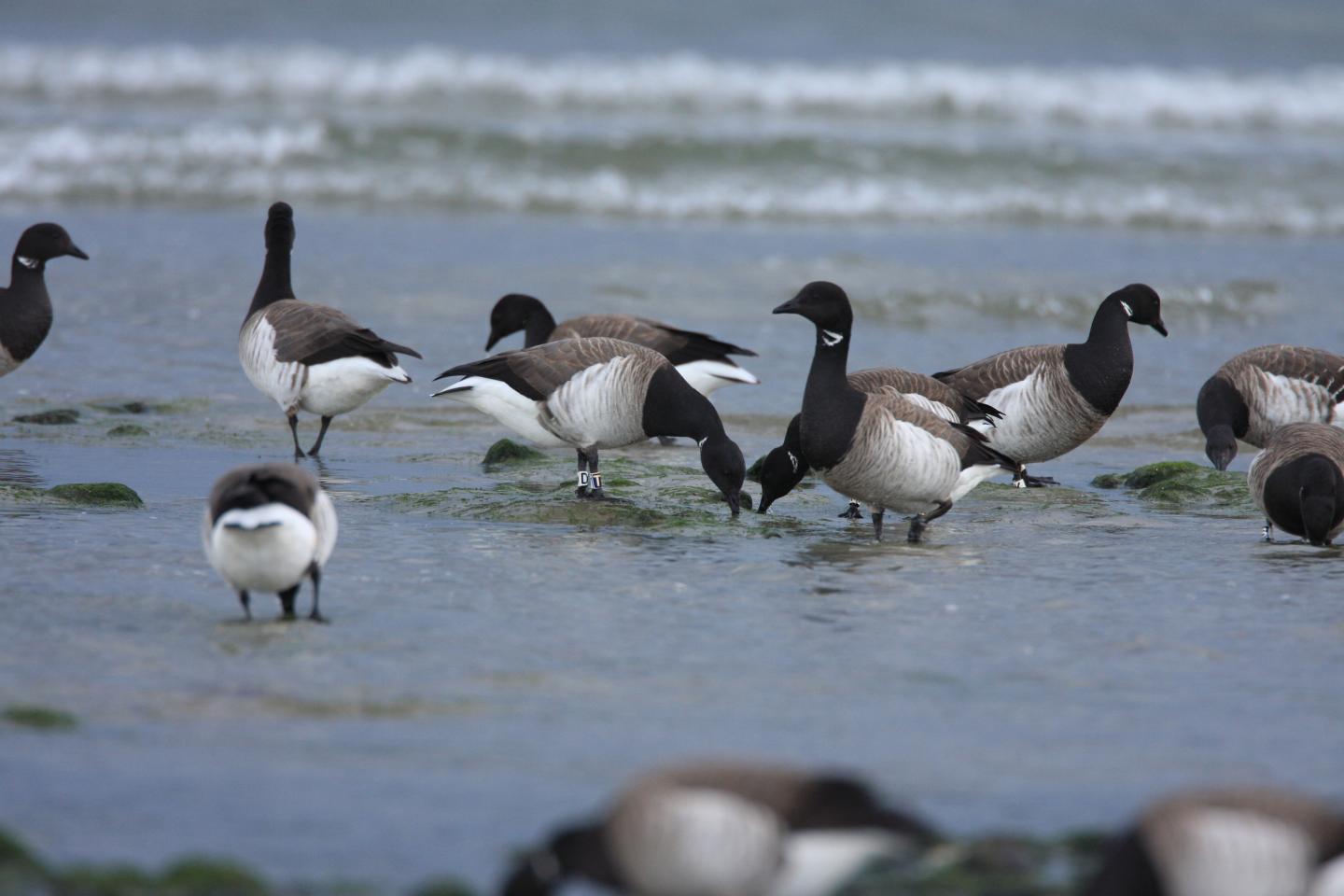
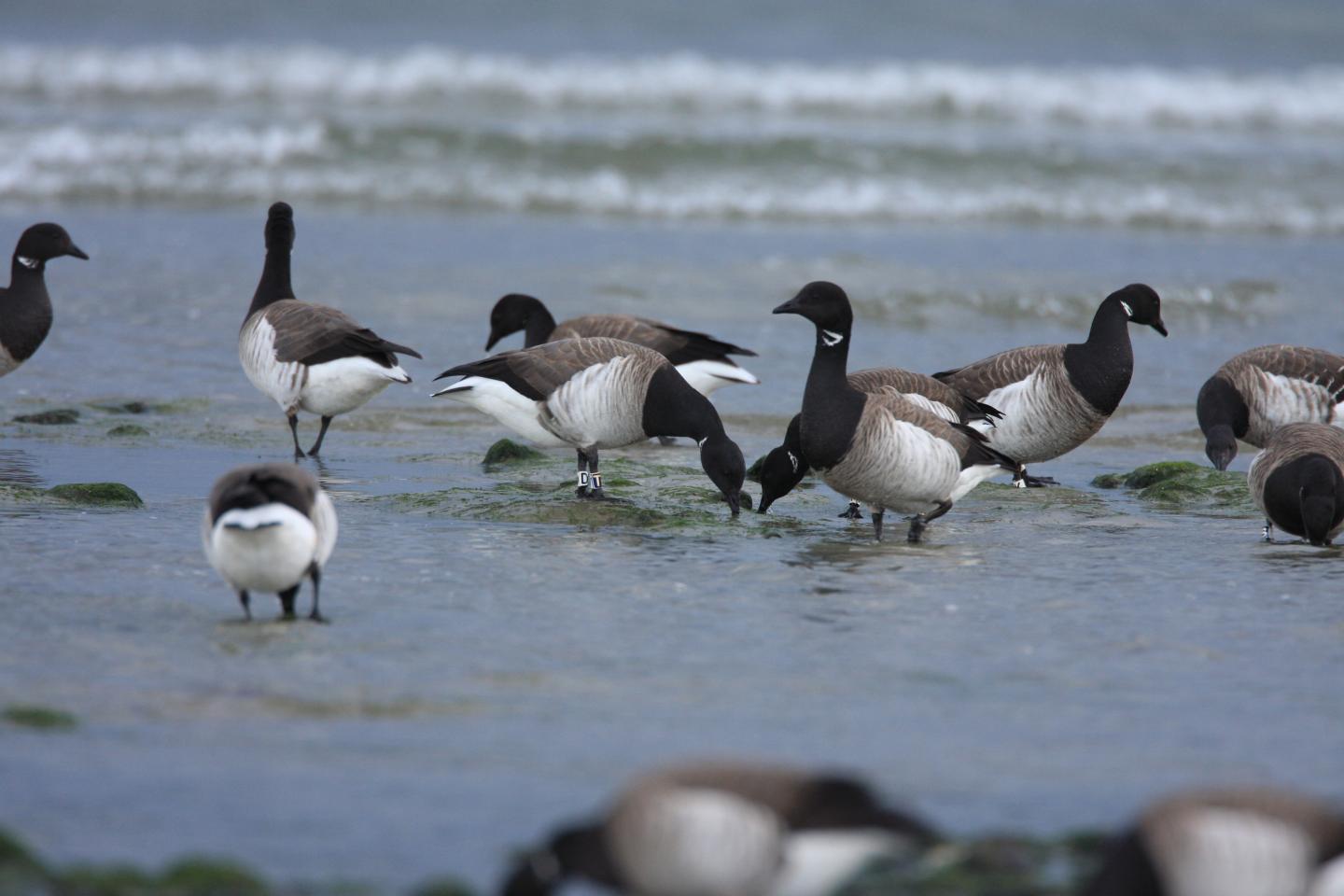
Credit: Kendrew Colhoun
Climate change improves the breeding chances of migratory geese in the Arctic – but puts mother geese at more risk of death, according to a new study.
Warmer conditions at breeding grounds in north-east Canada help light-bellied Brent geese produce more young, researchers from the University of Exeter found.
But in years when productivity is highest, the death rate among mothers also increases.
The researchers believe this happens because mothers use extra energy laying eggs and face more risk from predators while sitting on their nests, which they make on the ground.
Though the incubation period does not change, colder years mean more mothers abandon nests after failing in early incubation, or do not breed at all.
Meanwhile, in warmer years mothers breed more successfully – so more of them remain sitting on nests or waiting on the ground until their offspring are ready to fly.
"We tend to think of climate change as being all one way, but here we've got a population being affected in conflicting ways," said Dr Ian Cleasby, of the Centre for Ecology and Conservation on the University of Exeter's Penryn Campus in Cornwall.
"This population is sensitive to changes in adult survival, so the increased breeding may not be enough to offset the loss of more adult females.
"Research like this is important because we have to understand how animal populations will respond to the changing climate if we want to make decisions about protecting biodiversity."
The geese in question spend their winters in Ireland – many of them in and around Dublin – then visit Iceland each May before reaching their breeding grounds in the Canadian High Arctic in June. They make the return journey in August.
The study, supported by the Irish Brent Goose Research Group, found that conditions in a relatively short window at the start of June played a critical role in goose breeding and survival.
"Migratory species are likely to be particularly sensitive to climatic conditions, and in this case better breeding conditions appear to put the mother geese at risk," said senior author Professor Stuart Bearhop, also of the University of Exeter.
"They nest on the ground and tend to sit tight and rely on camouflage when predators come near, so better breeding conditions mean more mothers sitting on nests and therefore at risk.
"Breeding also takes a lot of energy, and delaying departure from the Arctic to wait for offspring to be ready to fly could make the journey south more dangerous."
The study, funded by a grant to Professor Bearhop from the European Research Council, looked at key demographic parameters: adult survival, first-year survival and productivity.
More than 4,000 geese in this population have been marked as part of research projects since 2001.
The paper, entitled "Climatic conditions produce contrasting influences on demographic traits in a long distance Arctic migrant", is published in the Journal of Animal Ecology.
###
Media Contact
Press Office
[email protected]
01-392-722-405
@uniofexeter
http://www.exeter.ac.uk
############
Story Source: Materials provided by Scienmag