• HOME
  • NEWS
  • EXPLORE
    • CAREER
      • Companies
      • Jobs
    • EVENTS
    • iGEM
      • News
      • Team
    • PHOTOS
    • VIDEO
    • WIKI
  • BLOG
  • COMMUNITY
    • FACEBOOK
    • INSTAGRAM
    • TWITTER
Saturday, February 7, 2026
BIOENGINEER.ORG
No Result
View All Result
  • Login
  • HOME
  • NEWS
  • EXPLORE
    • CAREER
      • Companies
      • Jobs
        • Lecturer
        • PhD Studentship
        • Postdoc
        • Research Assistant
    • EVENTS
    • iGEM
      • News
      • Team
    • PHOTOS
    • VIDEO
    • WIKI
  • BLOG
  • COMMUNITY
    • FACEBOOK
    • INSTAGRAM
    • TWITTER
  • HOME
  • NEWS
  • EXPLORE
    • CAREER
      • Companies
      • Jobs
        • Lecturer
        • PhD Studentship
        • Postdoc
        • Research Assistant
    • EVENTS
    • iGEM
      • News
      • Team
    • PHOTOS
    • VIDEO
    • WIKI
  • BLOG
  • COMMUNITY
    • FACEBOOK
    • INSTAGRAM
    • TWITTER
No Result
View All Result
Bioengineer.org
No Result
View All Result
Home NEWS Science News Biology

PKU School of Stomatology reports new phenotype of LRP6 mutation

Bioengineer by Bioengineer
November 29, 2021
in Biology
Reading Time: 2 mins read
0
Figure 1. Clinical features and pedigree of families with tooth agenesis caused by LRP6 mutations
Share on FacebookShare on TwitterShare on LinkedinShare on RedditShare on Telegram

A group led by Prof. Han Dong of Peking University School of Stomatology reported for the first time hand preaxial polydactyly in patients with tooth agenesis carrying a previously unknown mutation of low-density lipoprotein receptor-related protein 6 (LRP6). The study, which was titled “Rare phenotype: Hand preaxial polydactyly associated with LRP6-related tooth agenesis in humans” (npj Genomic Medicine (2021)6:93; https://rdcu.be/cA9kT), was published November 10 in NPJ Genomic Medicine, a high-quality Nature Portfolio journal.
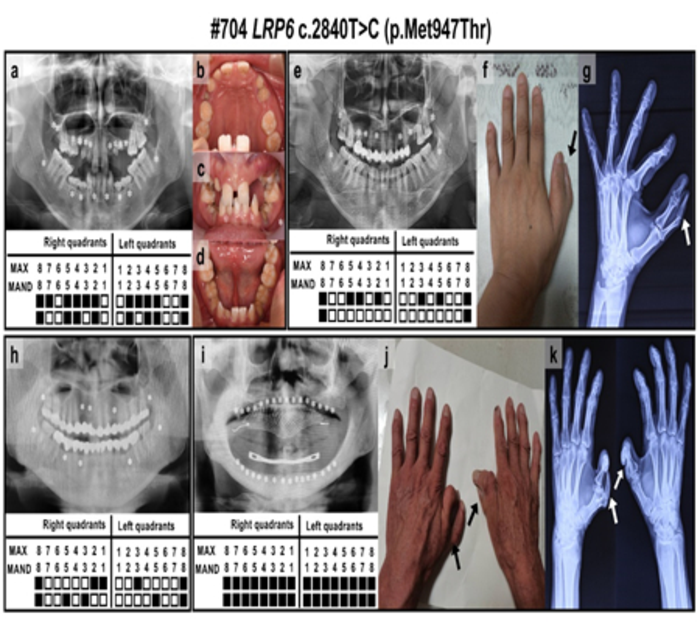
Figure 1. Clinical features and pedigree of families with tooth agenesis caused by LRP6 mutations

Credit: Peking University School of Stomatology

A group led by Prof. Han Dong of Peking University School of Stomatology reported for the first time hand preaxial polydactyly in patients with tooth agenesis carrying a previously unknown mutation of low-density lipoprotein receptor-related protein 6 (LRP6). The study, which was titled “Rare phenotype: Hand preaxial polydactyly associated with LRP6-related tooth agenesis in humans” (npj Genomic Medicine (2021)6:93; https://rdcu.be/cA9kT), was published November 10 in NPJ Genomic Medicine, a high-quality Nature Portfolio journal.

In the study, the researchers performed whole-exome sequencing and clinical assessment of three families with inherited tooth agenesis to investigate the genetic causes and clinical phenotypes, and reported (1) a rare phenotype of hand preaxial polydactyly in a tooth agenesis family with an unreported autosomal dominant LRP6 heterozygous mutation (c.2840 T > C;p.Met947Thr) and (2) another unreported autosomal dominant LRP6 heterozygous mutation (c.1154 G > C;p.Arg385Pro) in a non-syndromic tooth agenesis family.

The findings enlarged the LRP6 mutation spectrum of tooth agenesis and broadened the phenotypic spectrum of LRP6-related disorders, which may help clinicians to differentiate diagnosis, target pathogenic genes in advance, and facilitate the genetic studies of tooth agenesis patients.

Prof. Han served as corresponding author of the paper, and Dr. Zhang Liutao from the 2021 Class of the school’s integrated 8-year MD/PhD program and Assistant Fellow Yu Miao were first authors.

The research group on developmental dental anomalies at Peking University was initiated by Prof. Feng Hailan, and is currently led by Prof. Han. The group has long been devoted to research in the molecular mechanism of developmental dental anomalies and its clinical translation, and boasts the world’s biggest biobank and digital information database of tooth agenesis.


Journal

npj Genomic Medicine

DOI

10.1038/s41525-021-00262-0

Article Title

Rare phenotype: Hand preaxial polydactyly associated with LRP6-related tooth agenesis in humans

Article Publication Date

10-Nov-2021

Share12Tweet8Share2ShareShareShare2

Related Posts

Florida Cane Toad: Complex Spread and Selective Evolution

Florida Cane Toad: Complex Spread and Selective Evolution

February 7, 2026
New Study Uncovers Mechanism Behind Burn Pit Particulate Matter–Induced Lung Inflammation

New Study Uncovers Mechanism Behind Burn Pit Particulate Matter–Induced Lung Inflammation

February 6, 2026

DeepBlastoid: Advancing Automated and Efficient Evaluation of Human Blastoids with Deep Learning

February 6, 2026

Navigating the Gut: The Role of Formic Acid in the Microbiome

February 6, 2026

POPULAR NEWS

  • Robotic Ureteral Reconstruction: A Novel Approach

    Robotic Ureteral Reconstruction: A Novel Approach

    82 shares
    Share 33 Tweet 21
  • Digital Privacy: Health Data Control in Incarceration

    63 shares
    Share 25 Tweet 16
  • Study Reveals Lipid Accumulation in ME/CFS Cells

    57 shares
    Share 23 Tweet 14
  • Breakthrough in RNA Research Accelerates Medical Innovations Timeline

    53 shares
    Share 21 Tweet 13

About

We bring you the latest biotechnology news from best research centers and universities around the world. Check our website.

Follow us

Recent News

Evaluating Pediatric Emergency Care Quality in Ethiopia

TPMT Expression Predictions Linked to Azathioprine Side Effects

Improving Dementia Care with Enhanced Activity Kits

Subscribe to Blog via Email

Enter your email address to subscribe to this blog and receive notifications of new posts by email.

Join 73 other subscribers
  • Contact Us

Bioengineer.org © Copyright 2023 All Rights Reserved.

Welcome Back!

Login to your account below

Forgotten Password?

Retrieve your password

Please enter your username or email address to reset your password.

Log In
No Result
View All Result
  • Homepages
    • Home Page 1
    • Home Page 2
  • News
  • National
  • Business
  • Health
  • Lifestyle
  • Science

Bioengineer.org © Copyright 2023 All Rights Reserved.