• HOME
  • NEWS
  • EXPLORE
    • CAREER
      • Companies
      • Jobs
    • EVENTS
    • iGEM
      • News
      • Team
    • PHOTOS
    • VIDEO
    • WIKI
  • BLOG
  • COMMUNITY
    • FACEBOOK
    • INSTAGRAM
    • TWITTER
Friday, May 1, 2026
BIOENGINEER.ORG
No Result
View All Result
  • Login
  • HOME
  • NEWS
  • EXPLORE
    • CAREER
      • Companies
      • Jobs
        • Lecturer
        • PhD Studentship
        • Postdoc
        • Research Assistant
    • EVENTS
    • iGEM
      • News
      • Team
    • PHOTOS
    • VIDEO
    • WIKI
  • BLOG
  • COMMUNITY
    • FACEBOOK
    • INSTAGRAM
    • TWITTER
  • HOME
  • NEWS
  • EXPLORE
    • CAREER
      • Companies
      • Jobs
        • Lecturer
        • PhD Studentship
        • Postdoc
        • Research Assistant
    • EVENTS
    • iGEM
      • News
      • Team
    • PHOTOS
    • VIDEO
    • WIKI
  • BLOG
  • COMMUNITY
    • FACEBOOK
    • INSTAGRAM
    • TWITTER
No Result
View All Result
Bioengineer.org
No Result
View All Result
Home NEWS Science News Biology

Human Brain Project: Researchers outline in Science how brain research makes new demands on supercomputing

Bioengineer by Bioengineer
November 25, 2021
in Biology
Reading Time: 2 mins read
0
Big Brain Data and Supercomputing
Share on FacebookShare on TwitterShare on LinkedinShare on RedditShare on Telegram

“Understanding the brain in all its complexity requires insights from multiple scales – from genomics, cells and synapses to the whole-organ level. This means working with large amounts of data, and supercomputing is becoming an indispensable tool to tackle the brain,” says Katrin Amunts, Scientific Director of the Human Brain Project (HBP), Director of the C. and O. Vogt-Institute of Brain Research, Universitätsklinikum Düsseldorf and Director of the Institute of Neuroscience and Medicine (INM-1) at Research Centre Jülich. 
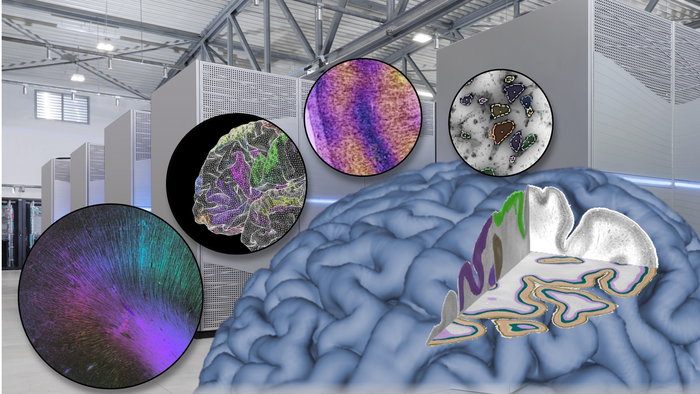
Big Brain Data and Supercomputing

Credit: Timo Dickscheid, Sascha Kreklau / Forschungszentrum Juelich

“Understanding the brain in all its complexity requires insights from multiple scales – from genomics, cells and synapses to the whole-organ level. This means working with large amounts of data, and supercomputing is becoming an indispensable tool to tackle the brain,” says Katrin Amunts, Scientific Director of the Human Brain Project (HBP), Director of the C. and O. Vogt-Institute of Brain Research, Universitätsklinikum Düsseldorf and Director of the Institute of Neuroscience and Medicine (INM-1) at Research Centre Jülich. 

“It’s an exciting time in supercomputing,” says Thomas Lippert, Director of the Jülich Supercomputing Centre and leader of supercomputing in the Human Brain Project. “We get a lot of new requests from researchers of the neuroscience community that need powerful computing to tackle the brain’s complexity. In response, we are developing new tools tailored to investigating the brain.” 

The human brain contains around 86 billion neurons that form trillions of contact points. Imaging an entire brain at cellular resolutions produces data in the range of several Petabytes; electron microscopy of a whole brain would amount to more than one Exabyte of data. “Brain research, medicine and information technologies face challenges that can only be addressed by joining the forces of all three domains,” says Amunts.

In Europe, the big data challenge of neuroscience is addressed by the Human Brain Project’s research infrastructure EBRAINS. It provides a range of tools, data-, and compute-services to brain researchers. This includes access to supercomputing systems via the Fenix federated Infrastructure, which has been set up by Europe’s leading Supercomputing Centres as part of the Human Brain Project and will serve communities beyond brain research.

Within the next five years, Europe is aiming to deploy its first two exascale supercomputers. They will be acquired by the European High Performance Computing Joint Undertaking (EuroHPC JU), a joint initiative between the EU, European countries and private partners. “The brain research community stands ready to use these exascale systems,” says Amunts.


Journal

Science

Method of Research

Commentary/editorial

Subject of Research

People

Article Title

Brain research challenges supercomputing

Article Publication Date

25-Nov-2021

Share12Tweet8Share2ShareShareShare2

Related Posts

Viruses Develop Virulence in Mice Based on Genetics and Sex — Biology

Viruses Develop Virulence in Mice Based on Genetics and Sex

April 30, 2026
New Report Warns: Nature Loss Poses Catastrophic Risks — Biology

New Report Warns: Nature Loss Poses Catastrophic Risks

April 30, 2026

Kangaroos Reveal ‘Upside-Down’ Evolution in Australia

April 30, 2026

Study Reveals Evolution Has Reused the Same Genes for 120 Million Years

April 30, 2026

POPULAR NEWS

  • Research Indicates Potential Connection Between Prenatal Medication Exposure and Elevated Autism Risk

    830 shares
    Share 332 Tweet 208
  • New Study Reveals Plants Can Detect the Sound of Rain

    712 shares
    Share 284 Tweet 178
  • Scientists Investigate Possible Connection Between COVID-19 and Increased Lung Cancer Risk

    67 shares
    Share 27 Tweet 17
  • Salmonella Haem Blocks Macrophages, Boosts Infection

    60 shares
    Share 24 Tweet 15

About

We bring you the latest biotechnology news from best research centers and universities around the world. Check our website.

Follow us

Recent News

Stroke Biomarkers: More Translational Research Needed

The Way Cells Replicate DNA Is More Crucial Than Previously Believed

Unlocking Selective Hydrogenation: The Synergistic Power of Ni and Fe

Subscribe to Blog via Email

Enter your email address to subscribe to this blog and receive notifications of new posts by email.

Join 82 other subscribers
  • Contact Us

Bioengineer.org © Copyright 2023 All Rights Reserved.

Welcome Back!

Login to your account below

Forgotten Password?

Retrieve your password

Please enter your username or email address to reset your password.

Log In
No Result
View All Result
  • Homepages
    • Home Page 1
    • Home Page 2
  • News
  • National
  • Business
  • Health
  • Lifestyle
  • Science

Bioengineer.org © Copyright 2023 All Rights Reserved.