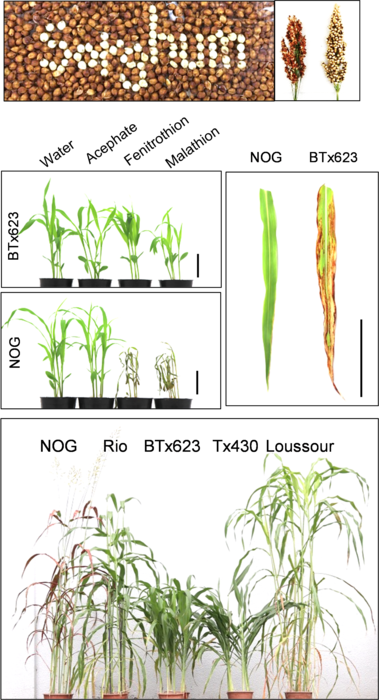
Sorghum, an underrated ancient grain, is slowly becoming well known as a superfood due to its nutrient-dense and gluten-free nature. Sorghum syrup is widely used as a healthy alternative to molasses in the food industry, and this cereal is also used to make gluten-free flour. In addition, sorghum commonly serves as high-quality animal fodder while also being an effective renewable source of biofuel and chemicals. Improving the cultivation of sorghum is essential for continuing to reap the benefits of this cereal and for leveraging its economic advantages. However, sorghum—like other crops—has some undesirable traits that reduce its yield. One such trait is sensitivity to organophosphates, which are commonly used pesticides. In sorghum crop, organophosphates cause leaf browning, cell death, and wilting.
Credit: 確認中
Sorghum, an underrated ancient grain, is slowly becoming well known as a superfood due to its nutrient-dense and gluten-free nature. Sorghum syrup is widely used as a healthy alternative to molasses in the food industry, and this cereal is also used to make gluten-free flour. In addition, sorghum commonly serves as high-quality animal fodder while also being an effective renewable source of biofuel and chemicals. Improving the cultivation of sorghum is essential for continuing to reap the benefits of this cereal and for leveraging its economic advantages. However, sorghum—like other crops—has some undesirable traits that reduce its yield. One such trait is sensitivity to organophosphates, which are commonly used pesticides. In sorghum crop, organophosphates cause leaf browning, cell death, and wilting.
Researchers from Okayama University, Japan, have been studying the cellular mechanisms that cause organophosphate sensitivity (OPS) in sorghum plants. In their recent study published in Scientific Reports, they reveal that the genes encoding the NB-LRR protein are responsible for OPS in sorghum. Moreover, they found that the mechanism of organophosphate-induced damage in sorghum was similar to the mechanism through which plants suffer damage during pathogenic infections.
Explaining the motivation behind this study, Prof. Wataru Sakamoto—who has been studying the genes controlling “leaf greenness” for over 10 years and who led this the research—comments, “Sorghum has many benefits. It is also interesting from a research standpoint because of its high tolerance against drought and harsh environments, its small genome size, and its genetic similarity to rice.” Further describing what prompted this investigation, he adds, “If a gene causes an undesirable trait in plants, removing or inactivating the gene could help eliminate the negative trait. During our research, we saw that a Japanese variety of sorghum called Takakibi exhibited leaf browning after pesticide treatment. So, we set out to understand the genetic cause of pesticide sensitivity in this plant.”
To do this, the researchers first crossed (i.e., mated) the organophosphate-sensitive Takakibi (or NOG) variety with the organophosphate-resistant sorghum variety BTx623. Interestingly, they found that all the progeny showed OPS. This implied that OPS was a “dominant” trait, meaning that plants would be sensitive to organophosphates even if they had one copy of an OPS-related gene.
Next, to understand which genes actually caused OPS in sorghum, they used a technique called “Quantitative trait locus mapping” and examined the genetic locations associated with OPS in the NOG variety. They found that a region on chromosome 5, which has been linked to OPS in previous studies, was associated with OPS in NOG. Expanding on their findings, they identified three genes present in this region. Further, they found that these genes likely encoded a protein called NB-LRR, which is present on the outer membrane of plant cells and recognizes external agents, including pathogens. Finally, they concluded that the NLR-C gene—which was functional in NOG but not in BTx623—was responsible for OPS in a dominant manner.
The work by Prof. Sakamoto and his team provides an improved understanding of the diverse roles played by the NB-LRR protein in sorghum. But more importantly, it lays the foundation for much-needed improvements in the breeding of sorghum. “Pesticides like organophosphates are very useful in protecting plants from insects, but they should not damage the plant itself. Our findings could help in the development of sorghum varieties that can be grown safely with organophosphate treatment, thus improving the longevity of this crop. Moreover, this OPS trait is not specific to sorghum but can also be observed in other important plants, including tomato. Our findings could therefore help in the development of sustainable agriculture with the proper use of pesticides,” explains Prof. Sakamoto.
And while further research is necessary to understand how OPS differs among different varieties of sorghum and other plants, the work by Prof. Sakamoto’s team represents an important advance in not only food security but also biomass and biofuel generation.
###
About Okayama University, Japan
As one of the leading universities in Japan, Okayama University aims to create and establish a new paradigm for the sustainable development of the world. Okayama University offers a wide range of academic fields, which become the basis of the integrated graduate schools. This not only allows us to conduct the most advanced and up-to-date research, but also provides an enriching educational experience.
Website: https://www.okayama-u.ac.jp/index_e.html
About Professor Wataru Sakamoto from Okayama University, Japan
Dr. Wataru Sakamoto is a Professor at the Institute of Plant Science and Resources, Okayama University, leading the Plant Light Acclimation Research Group. He received his PhD from Tokyo University and completed his postdoctoral training at Cornell University. His research career, which spans over thirty years, has largely focused on plant genetics and physiology, and mainly organelle biogenesis. He is an Executive Director of the Japanese Society of Plant Physiologists (JSPP) and is currently serving as Editor-in-Chief of Plant and Cell Physiology, the international journal that the Japanese Society of Plant Physiologists publishes.
Journal
Scientific Reports
DOI
10.1038/s41598-021-98908-7
Method of Research
Experimental study
Subject of Research
Not applicable
Article Title
NB-LRR-encoding genes conferring susceptibility to organophosphate pesticides in sorghum
Article Publication Date
6-Oct-2021
COI Statement
The authors declare no competing interests.