In our efforts to reduce greenhouse gas emissions, carbon capture is mentioned as a possible technology. CO2 can, for example, be captured from large industrial companies and from incineration plants.
However, like all other technologies, carbon capture leaves its own imprint on the outside world. DTU Environment has therefore conducted a life cycle analysis, which has systematically assessed the impact from a possible carbon capture plant installed at the Amager Bakke incineration plant in Copenhagen. Not just from the pilot plant currently installed by DTU, but from a plant that would cover the entire Amager Bakke facility. The assessment has made it possible to examine the advantages and disadvantages of the carbon capture plant from the point of view of the climate impact.
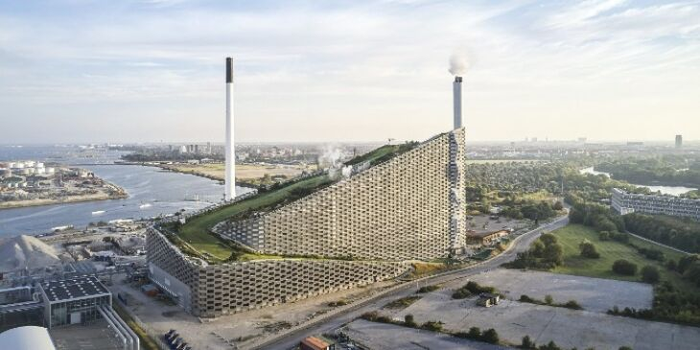
Amager Bakke incineration plant burns, among other things, household waste that has not been sorted for recycling. The energy generated is used to produce electricity and heat. During incineration, CO2 is released from the waste, which includes food waste and textiles.
Energy production changing
The focus of the life cycle assessment has been to investigate the impact of the carbon capture plant on the energy generated by the incineration plant as well as other environmental impacts. The analysis looked at a number of waste composition scenarios.
“Carbon capture reduces CO2 emissions from the incineration plant. However, electricity production is reduced by approx. 50 per cent. For some incineration plants, this would have a considerable impact on their overall CO2 accounts, but at Amager Bakke, the steam from the carbon capture in fact increases the heat output utilized in the district heating system by 20 per cent. The overall net energy efficiency is thus not affected, but there is a shift from less electricity to more heat,” explains Assistant Professor Valentina Bisinella, DTU Environment, who carried out the analysis.
Transport and storage may result in emissions
The other drawbacks for the climate highlighted by the analysis are primarily associated with the transport and storage of the captured CO2 in the subsoil. These activities may cause unintentional emissions of the greenhouse gas into the atmosphere, while sea transport also causes CO2 emissions.
“Even when factoring in the CO2 emissions that may occur both during transport and storage in the subsoil, carbon capture clearly results in net climate benefits,” says Valentina Bisinella.
In the past, Valentina Bisinella has conducted life cycle analyses of incineration plants across Europe, leading to the same overall conclusions. Those analyses also included the recycling of the captured CO2, which currently only takes place at three incineration plants in the world, two in the Netherlands and one in Japan. Use of the captured CO2 to produce, for example, chemicals and fuels such as methanol and DME would naturally increase the overall climate gain further, provided there is access to green electricity. Such use may also be an option for Amager Bakke in the future.
Credit: Hufton&Crow
In our efforts to reduce greenhouse gas emissions, carbon capture is mentioned as a possible technology. CO2 can, for example, be captured from large industrial companies and from incineration plants.
However, like all other technologies, carbon capture leaves its own imprint on the outside world. DTU Environment has therefore conducted a life cycle analysis, which has systematically assessed the impact from a possible carbon capture plant installed at the Amager Bakke incineration plant in Copenhagen. Not just from the pilot plant currently installed by DTU, but from a plant that would cover the entire Amager Bakke facility. The assessment has made it possible to examine the advantages and disadvantages of the carbon capture plant from the point of view of the climate impact.
Amager Bakke incineration plant burns, among other things, household waste that has not been sorted for recycling. The energy generated is used to produce electricity and heat. During incineration, CO2 is released from the waste, which includes food waste and textiles.
Energy production changing
The focus of the life cycle assessment has been to investigate the impact of the carbon capture plant on the energy generated by the incineration plant as well as other environmental impacts. The analysis looked at a number of waste composition scenarios.
“Carbon capture reduces CO2 emissions from the incineration plant. However, electricity production is reduced by approx. 50 per cent. For some incineration plants, this would have a considerable impact on their overall CO2 accounts, but at Amager Bakke, the steam from the carbon capture in fact increases the heat output utilized in the district heating system by 20 per cent. The overall net energy efficiency is thus not affected, but there is a shift from less electricity to more heat,” explains Assistant Professor Valentina Bisinella, DTU Environment, who carried out the analysis.
Transport and storage may result in emissions
The other drawbacks for the climate highlighted by the analysis are primarily associated with the transport and storage of the captured CO2 in the subsoil. These activities may cause unintentional emissions of the greenhouse gas into the atmosphere, while sea transport also causes CO2 emissions.
“Even when factoring in the CO2 emissions that may occur both during transport and storage in the subsoil, carbon capture clearly results in net climate benefits,” says Valentina Bisinella.
In the past, Valentina Bisinella has conducted life cycle analyses of incineration plants across Europe, leading to the same overall conclusions. Those analyses also included the recycling of the captured CO2, which currently only takes place at three incineration plants in the world, two in the Netherlands and one in Japan. Use of the captured CO2 to produce, for example, chemicals and fuels such as methanol and DME would naturally increase the overall climate gain further, provided there is access to green electricity. Such use may also be an option for Amager Bakke in the future.
Journal
Waste Management & Research The Journal for a Sustainable Circular Economy
DOI
10.1177/0734242X211048125
Article Title
Environmental assessment of amending the Amager Bakke incineration plant in Copenhagen with carbon capture and storage
Article Publication Date
29-Sep-2021
COI Statement
The authors declared no potential conflicts of interest with respect to the research, authorship and/or publication of this article.