The world’s largest fish, the whale shark (Rhincodon typus), is a plankton-loving giant that can be found alone or in groups in all tropical oceans. However, despite being a highly migratory species, little is known about how the different populations worldwide interact with each other. This lack of knowledge hinders conservation efforts aimed at protecting this endangered animal. Héctor Guzmán, a marine biologist at the Smithsonian Tropical Research Institute, alongside Caitlin Beaver of the U.S. Geological Survey and Edgardo Díaz-Ferguson of Coiba Scientific Station, set out to start bridging this knowledge gap.
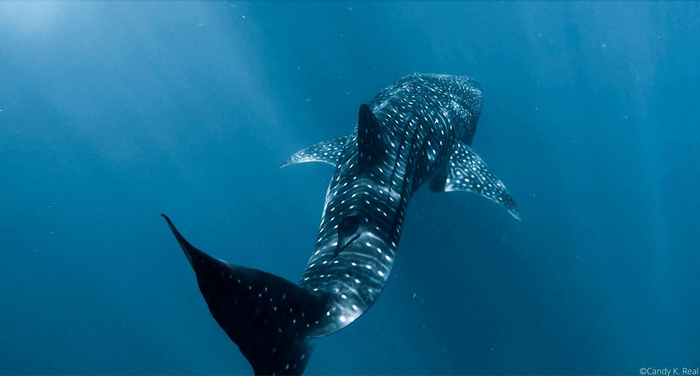
Credit: Candy K. Real
The world’s largest fish, the whale shark (Rhincodon typus), is a plankton-loving giant that can be found alone or in groups in all tropical oceans. However, despite being a highly migratory species, little is known about how the different populations worldwide interact with each other. This lack of knowledge hinders conservation efforts aimed at protecting this endangered animal. Héctor Guzmán, a marine biologist at the Smithsonian Tropical Research Institute, alongside Caitlin Beaver of the U.S. Geological Survey and Edgardo Díaz-Ferguson of Coiba Scientific Station, set out to start bridging this knowledge gap.
By snorkeling around Coiba National Park and in the Gulf of Chiriquí, in Pacific Panama, Guzmán collected tissue samples from 21 solitary sharks. The team conducted genetic analyses on them and found out that they were highly diverse, with similarities to populations of whale sharks found in the Arabian Gulf, Western Indian Ocean, Mexico and the Gulf of California.
These results, which were published in Frontiers in Marine Science, suggest that whale sharks can travel over long distances and that transboundary conservation measures such as marine corridors may be effective for species conservation.
“Imagine Qatar: a possible journey of more than 27,000 kilometers from Panama for this species,” said Guzman. “This observed connectivity amazed us, revealing a real political challenge for the protection and conservation of whale sharks. It seems no longer a local or regional concern, but a global issue.”
Despite its small sample size, this study serves as a baseline for understanding the genetic diversity and population connectivity of this species, whose numbers have declined by half over the last forty years according to the International Union for the Conservation of Nature (IUCN). This type of data is necessary for deciphering the migration patterns of whale sharks, which are difficult to observe directly over the long term.
“With this publication we contribute to unravel migration and genetic connectivity patterns of transient whale sharks, evidencing the importance of Pacific Panama as a key area for connectivity of the species,” said Diaz-Ferguson.
This research was partially funded by the MarViva Foundation (Panama), the International Community Foundation-CANDEO, the Secretaria Nacional de Ciencia, Tecnología e Innovación de Panamá, and the Research Opportunity Fund of the Smithsonian Tropical Research Institute.
The Smithsonian Tropical Research Institute, headquartered in Panama City, Panama, is part of the Smithsonian Institution. The institute furthers the understanding of tropical nature and its importance to human welfare, trains students to conduct research in the tropics and promotes conservation by increasing public awareness of the beauty and importance of tropical ecosystems.
Journal
Frontiers in Marine Science
DOI
10.3389/fmars.2021.744109
Article Title
Novel Insights Into the Genetic Population Connectivity of Transient Whale Sharks (Rhincodon typus) in Pacific Panama Provide Crucial Data for Conservation Efforts
Article Publication Date
22-Oct-2021