Reducing ship speed and noise levels would increase the probability that endangered West Coast southern resident killer whales will spend more time hunting for Chinook salmon, a new Simon Fraser University study has found.
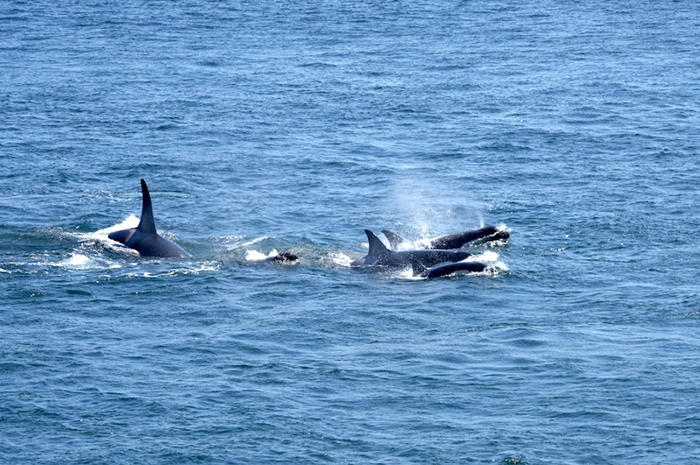
Credit: Photo credit: SFU grad students Azadeh Gheibi & Kaitlin Baril
Reducing ship speed and noise levels would increase the probability that endangered West Coast southern resident killer whales will spend more time hunting for Chinook salmon, a new Simon Fraser University study has found.
The research, published in the journal Marine Pollution Bulletin, provides insights to guide conservation efforts and protect the estimated 73 remaining whales in the population.
Research shows that these whales spend between 70 and 84 per cent of their time foraging in the absence of ships and boats to meet their daily energy needs.
“Killer whales rely on echolocation to hunt for Chinook salmon and ship noise interferes with their ability to send out ‘clicks’ and locate their prey,” says study collaborator Ruth Joy, a statistical ecologist and assistant professor in SFU’s School of Environmental Science.
Researchers studied the whales’ foraging behaviour in Haro Strait during a 2018 voluntary vessel slowdown, as part of a broader effort to reduce human-generated noise disturbance. The strait is a critical summer foraging habitat for the endangered whales.
The ECHO program was led by the Vancouver Fraser Port Authority and followed a successful earlier trial, which saw 55 per cent of vessels voluntarily reduce their speed to 11-knots when transiting through the strait, resulting in an overall noise reduction of 2.5 decibels.
Using a surveying instrument known as ‘theodolite tracking’ to determine the whales’ positions, researchers observed and categorized the group’s behaviour as either traveling, resting, socializing or foraging during each five-minute scan.
Researches also recorded the number, type and position of vessels in the area, then combined the data collected on vessels and whales with a sound propagation model, to predict the noise level of the ships and boats that whales were exposed to when they surfaced.
As noise levels increased, the whales were less likely to start foraging and more likely to stop the activity. The researchers suggest reducing vessel speed, lateral displacement within shipping lanes, replacing the noisiest ships in the fleet and rerouting shipping lanes are actions that industry can take to help these marine mammals.
Taking immediate action is more crucial than ever, following recent reports of three pregnant J pod whales now eating for two and will be raising their young in the years ahead.
“These three pregnant females and members of J-pod cast a ray of much-needed hope on the future of southern resident killer whales,” says Joy.
The researchers’ work continues as the school’s graduate students Kaitlin Baril and Azadeh Gheibi are using the same theodolite tracking methods to study underwater ambient noise and its impact on killer whales in the Canadian waters of Boundary Pass between B.C. and Washington State.
The study is a collaboration between researchers at SFU, the Oceans Initiative in Seattle, the University of California, and Bielefeld University in Germany.
Journal
Marine Pollution Bulletin
DOI
10.1016/j.marpolbul.2021.112976
Subject of Research
Animals
Article Title
Reducing vessel noise increases foraging in endangered killer whales
Article Publication Date
23-Sep-2021